



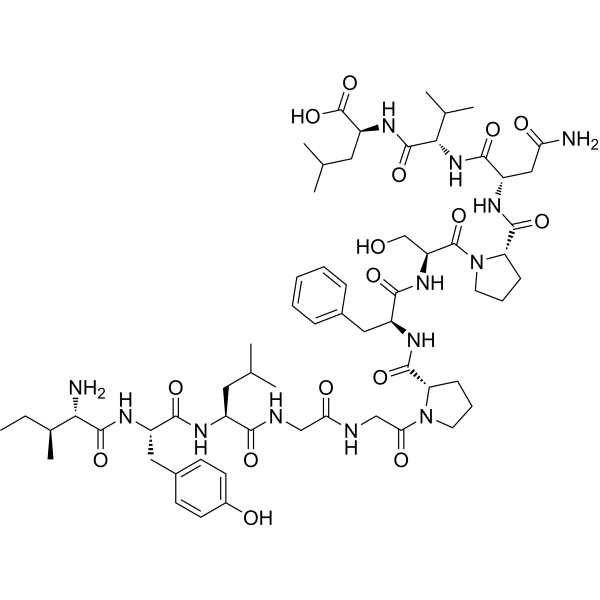
C-Reactive Protein (CRP) (174-185)

Based on 1 Customer Validation
C-Reactive Protein (CRP) is an anti-pneumococcal plasma protein that can serve as an inflammatory marker. C-Reactive protein can protect mice from pneumococcal infection by activating complement. C-Reactive protein can inhibit the activation of caspase-3/9 through the CD64/AKT/mTOR pathway, thereby promoting chemotherapy resistance in mice with tongue squamous cell carcinoma.
For research use only. We do not sell to patients.
- Purity : 99.88%
- CAS No.: 147516-85-6
- Formula: C62H93N13O16
- Molecular Weight:1276.48
-
Storage:
Sealed storage, away from moisture and light, under nitrogen.
Powder -80°C, 2 years , -20°C, 1 year* In solvent : -80°C, 6 months; -20°C, 1 month (sealed storage, away from moisture and light, under nitrogen)

To place orders, for customer services and technical support, please contact: MedChemExpress USA
Tel: 609-228-6898 E-mail: [email protected] [email protected]


-
 Biological Activity
-
Chemical Information
-
Solvent & Solubility
- Protocols
- Purity & Documentation
- References
-
 Help & FAQs


All Caspase Isoforms
More

Biological Activity
Description
In Vitro
C-Reactive Protein (CRP) (0-25 μg/mL; 24 h) promotes monocyte migration by stimulating 3T3-L1 adipocytes to produce CXCL7[3]. C-Reactive Protein (CRP) can impair G1/S-dependent regeneration of renal tubular epithelial cells[4]. C-Reactive Protein (CRP) (10 μg/mL, 4 days) can enhance TSCC cell viability and increase cell resistance to DDP[5]. C-Reactive Protein (CRP) is a highly structurally conserved major acute phase plasma protein in humans[6].
MedChemExpress (MCE) has not independently confirmed the accuracy of these methods. They are for reference only. Further protocols information, click here.
In Vivo
MedChemExpress (MCE) has not independently confirmed the accuracy of these methods. They are for reference only.
-
Animal Model:A murine model of pneumococcal infection[1].
-
Dosage:25 μg
-
Administration:Intravenous injection (i.v.); once daily; 7 days
-
Result:Activated complement in mouse serum.
-
Animal Model:Male hooded Wistar rats (weighing 125-150 g)[2].
-
Dosage:20 mg/kg
-
Administration:Intraperitoneal injection (i.p.); once daily; 3 days
-
Result:Upregulated PKC, NADPH oxidase, ERK, and JNK phosphorylation.


Chemical Information
-
CAS No. 147516-85-6
-
Appearance Solid
-
Molecular Weight 1276.48
-
Formula C62H93N13O16
-
Color White to off-white
-
Sequence
Ile-Tyr-Leu-Gly-Gly-Pro-Phe-Ser-Pro-Asn-Val-Leu
-
Sequence Shortening
IYLGGPFSPNVL
-
Shipping
Room temperature in continental US; may vary elsewhere.
-
Storage
Sealed storage, away from moisture and light, under nitrogen
Powder -80°C 2 years -20°C 1 year * In solvent : -80°C, 6 months; -20°C, 1 month (sealed storage, away from moisture and light, under nitrogen)


Solvent & Solubility
In Vitro:
H2O : 10 mg/mL (7.83 mM; Need ultrasonic)
Please refer to the solubility information to select the appropriate solvent. Once prepared, please aliquot and store the solution to prevent product inactivation from repeated freeze-thaw cycles.
Storage method and period of stock solution: -80°C, 6 months; -20°C, 1 month (sealed storage, away from moisture and light, under nitrogen). When stored at -80°C, please use it within 6 months. When stored at -20°C, please use it within 1 month.
* Note: If you choose water as the stock solution, please dilute it to the working solution, then filter and sterilize it with a 0.22 μm filter before use.
Please refer to the solubility information to select the appropriate solvent. Once prepared, please aliquot and store the solution to prevent product inactivation from repeated freeze-thaw cycles.
Storage method and period of stock solution: -80°C, 6 months; -20°C, 1 month (sealed storage, away from moisture and light, under nitrogen). When stored at -80°C, please use it within 6 months. When stored at -20°C, please use it within 1 month.
* Note: If you choose water as the stock solution, please dilute it to the working solution, then filter and sterilize it with a 0.22 μm filter before use.
Concentration (start) × Volume (start) = Concentration (final) × Volume (final)

Protocols
-
Research Protocol for Infectious Diseases
Infectious-disease experiments test how pathogens interact with host barriers, innate immune receptors, inflammatory signaling, pathogen replication, and tissue injury; pattern-recognition receptors such as TLRs, RIG-I-like receptors, NOD-like receptors, and inflammasomes detect microbial molecules and activate NF-κB, interferon, and cytokine responses. The central hypothesis is that infection severity reflects the balance between pathogen burden and host response: protective inflammation restricts pathogen growth, whereas excessive or mislocalized inflammation contributes to tissue damage and disease phenotype. Unresolved questions include which host pathways are protective versus pathogenic, why some infection models fail to translate to human disease, and which combined readouts best predict clinically relevant infection outcomes.
-
Apoptosis Solutions
Apoptosis is a regulated, generally non-lytic cell-death pathway that removes unwanted, damaged, infected, or abnormal cells through coordinated morphological changes, caspase activation, DNA fragmentation, and membrane remodeling. The intrinsic apoptosis pathway is controlled mainly by mitochondrial outer membrane permeabilization, BCL-2 family proteins, cytochrome c release, apoptosome formation, caspase-9 activation, and downstream executioner caspase-3/7 activation. The extrinsic apoptosis pathway is initiated by death receptors such as Fas, TNFR, and TRAIL receptors, which recruit adaptor proteins and activate caspase-8 before engaging executioner caspases or mitochondrial amplification through BID cleavage. Apoptosis is linked to many phenotypes, including cancer cell killing, tissue homeostasis, immune regulation, neurodegeneration, infection response, and treatment-induced cytotoxicity; unresolved questions include how apoptosis interacts with necroptosis, pyroptosis, ferroptos


Purity & Documentation
-
Data Sheet (285 KB)
-
SDS (252 KB)
- English - EN (252 KB)
- Français - FR (252 KB)
- Deutsch - DE (252 KB)
- Norwegian - NO (252 KB)
- Español - ES (252 KB)
- Swedish - SV (252 KB)
- Italian - IT (252 KB)
- Korean - KR (252 KB)
- Portuguese - PT (252 KB)
-
Handling Instructions (2659 KB)
References
[1]. Singh SK, et al. Complement Activation by C-Reactive Protein Is Critical for Protection of Mice Against Pneumococcal Infection. Front Immunol. 2020 Aug 13;11:1812. [Content Brief]
[2]. Devaraj S, et al. C-reactive protein stimulates superoxide anion release and tissue factor activity in vivo. Atherosclerosis. 2009 Mar;203(1):67-74. [Content Brief]
[3]. Chen JY, et al. C-reactive protein derived from perivascular adipose tissue accelerates injury-induced neointimal hyperplasia. J Transl Med. 2020 Feb 11;18(1):68. [Content Brief]
[4]. Tang Y, et al. C-reactive protein promotes acute kidney injury by impairing G1/S-dependent tubular epithelium cell regeneration. Clin Sci (Lond). 2014 May;126(9):645-59. [Content Brief]
[5]. Yan X, et al. C-reactive protein promotes tongue squamous cell carcinoma chemoresistance by inhibiting the activation of caspase-3/9 via the CD64/AKT/mTOR pathway. Hum Cell. 2021 Sep;34(5):1424-1433. [Content Brief]
[6]. Ansar W, et al. C-reactive protein and the biology of disease. Immunol Res. 2013 May;56(1):131-42. [Content Brief]


Complete Stock Solution Preparation Table
Please refer to the solubility information to select the appropriate solvent. Once prepared, please aliquot and store the solution to prevent product inactivation from repeated freeze-thaw cycles.
Storage method and period of stock solution: -80°C, 6 months; -20°C, 1 month (sealed storage, away from moisture and light, under nitrogen). When stored at -80°C, please use it within 6 months. When stored at -20°C, please use it within 1 month.
| Optional Solvent | Concentration Solvent Mass | 1 mg | 5 mg | 10 mg | 25 mg |
|---|---|---|---|---|---|
| H2O | 1 mM | 0.7834 mL | 3.9170 mL | 7.8340 mL | 19.5851 mL |
| 5 mM | 0.1567 mL | 0.7834 mL | 1.5668 mL | 3.9170 mL |
* Note: If you choose water as the stock solution, please dilute it to the working solution, then filter and sterilize it with a 0.22 μm filter before use.


C-Reactive Protein (CRP) (174-185) Related Classifications
HY-P1823 Related Classifications
 Powered by Bioz