



BChE-IN-11

Based on 1 Customer Validation
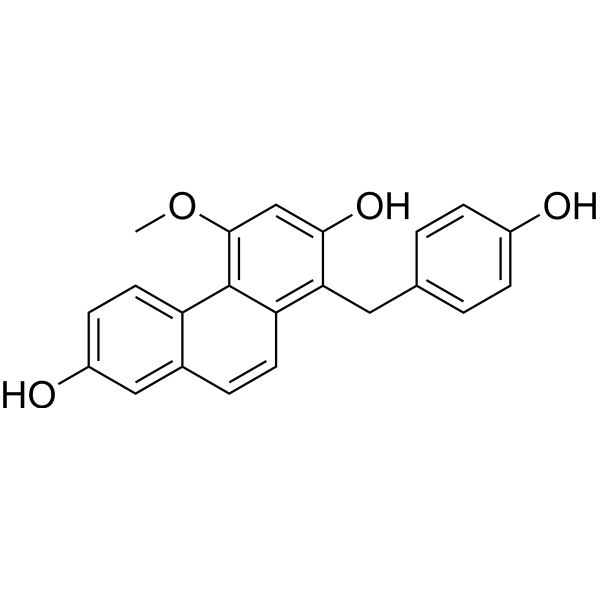
BChE-IN-11 (compound 10) is a potent, selective and non-competitive BChE (butyrylcholinesterase) inhibitor, with an IC50 of 2.1 μM. BChE-IN-11 can be used for Alzheimer's disease (AD) research.
Nos produits utilisent uniquement pour la recherche. Nous ne vendons pas aux patients.
- Pureté : 98.78%
- CAS No.: 133740-30-4
- Formule: C22H18O4
- Masse moléculaire:346.38
-
Stockage:
4°C, protect from light
* In solvent : -80°C, 6 months; -20°C, 1 month (protect from light)

To place orders, for customer services and technical support, please contact: MedChemExpress USA
Tel: 609-228-6898 E-mail: [email protected] [email protected]


-
 Activité biologique
-
Chemical Information
- Protocole
- Pureté et documentation
- Références
-
 Help & FAQs




Activité biologique
Description
IC50 & Target
|
BChE 2.1 ± 0.3 μM (IC50) |
AChE |
Cellular Effect
|
Cell Line

|
Type | Value | Description | References |
|---|---|---|---|---|
| BV-2 | IC50 |
30.2 μM
Compound: 30
|
Antineuroinflammatory activity against mouse BV2 cells assessed as inhibition of LPS-induced NO production incubated for 24 hrs by Griess assay
Antineuroinflammatory activity against mouse BV2 cells assessed as inhibition of LPS-induced NO production incubated for 24 hrs by Griess assay
|
[PMID: 31415170] |
| Neutrophil | IC50 |
0.5 μM
Compound: 14
|
Antiinflammatory activity in human neutrophils assessed as inhibition of FMLP/cytochalasin B-induced superoxide anion generation by measuring superoxide dismutase-inhibitable reduction of ferricytochrome c preincubated for 5 mins followed by FMLP/cytochal
Antiinflammatory activity in human neutrophils assessed as inhibition of FMLP/cytochalasin B-induced superoxide anion generation by measuring superoxide dismutase-inhibitable reduction of ferricytochrome c preincubated for 5 mins followed by FMLP/cytochal
|
[PMID: 27525452] |
| Neutrophil | IC50 |
0.9 μM
Compound: 14
|
Antiinflammatory activity in human neutrophils assessed as inhibition of fMLP/CB-induced elastase release using MeO-Suc-Ala-Ala-Pro-Val-p-nitroanilide as elastase substrate preincubated for 5 mins followed by fMLP/CB-induction
Antiinflammatory activity in human neutrophils assessed as inhibition of fMLP/CB-induced elastase release using MeO-Suc-Ala-Ala-Pro-Val-p-nitroanilide as elastase substrate preincubated for 5 mins followed by fMLP/CB-induction
|
[PMID: 27525452] |
In Vitro
BChE-IN-11 (compound 10) shows inhibition activity for BChE and AChE, with inhibition of 96.6 ± 1.2% and 19.1 ± 3.8% at 25 μg/mL, respectively[1]. BChE-IN-11 binds to the active pocket of BChE via multiple hydrogen bonds with His438, Pro285, Gly115 and π–π stacking with Tyr332 and Trp82[1].
MedChemExpress (MCE) has not independently confirmed the accuracy of these methods. They are for reference only. Further protocols information, click here.


Chemical Information
-
CAS No. 133740-30-4
-
Appearance Solid
-
Masse moléculaire 346.38
-
Formule C22H18O4
-
Color Light brown to brown
-
SMILES
OC1=CC(OC)=C2C3=CC=C(O)C=C3C=CC2=C1CC4=CC=C(O)C=C4
-
Structure Classification
-
Initial Source
-
Livraison
Room temperature in continental US; may vary elsewhere.
-
Stockage
4°C, protect from light
* In solvent : -80°C, 6 months; -20°C, 1 month (protect from light)

Protocole
-
Cell Cytotoxicity Assay
Cytotoxicity assays are usually based on the assessment of cell membrane damage, which can also be indirectly detected by measuring cell viability. Detection methods include MTT assay, CKK-8 assay, LDH assay and ATP assay, etc.
-
Alzheimer’s Disease Modeling
Alzheimer’s Disease (AD) is a neurodegenerative disorder characterized by a progressive decline in cognitive functions and loss of specific types of neurons and synapses. Alzheimer's symptoms can be simulated in mice by injecting drugs (such as Aβ) or genetically modified.


Pureté et documentation
-
Fiche technique (267 KB)
-
SDS (251 KB)
- English - EN (251 KB)
- Français - FR (251 KB)
- Deutsch - DE (251 KB)
- Norwegian - NO (251 KB)
- Español - ES (251 KB)
- Swedish - SV (251 KB)
- Italian - IT (251 KB)
- Korean - KR (251 KB)
- Portuguese - PT (251 KB)
-
Instruction de manipulation (2659 KB)
Références

Calculators
Concentration (start) × Volume (start) = Concentration (final) × Volume (final)


BChE-IN-11 Related Classifications
HY-N10488 Related Classifications
 Powered by Bioz