



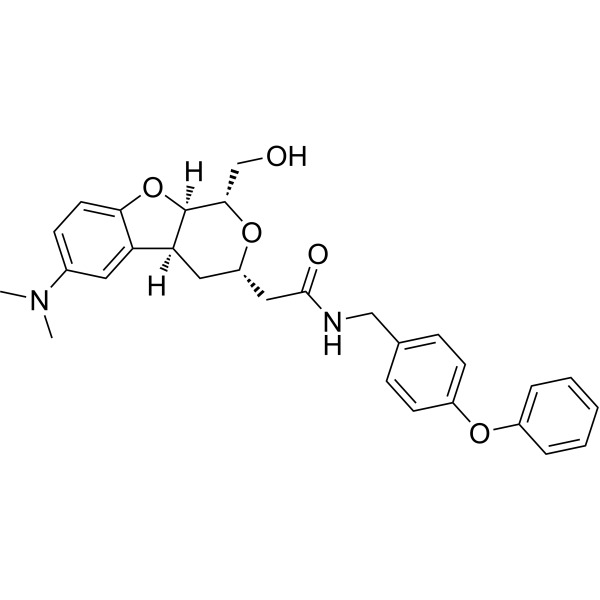
BRD0418

Based on 1 Customer Validation
BRD0418 is a diversity-oriented synthesis (DOS) molecule that regulates the expression of tribbles pseudokinase 1. BRD0418 has the effect of causing hot lipoprotein metabolism from fat production to clearance. BRD0418 can be used in the study of coronary artery disease (CAD) .
Nur für Forschungszwecke. Wir verkaufen nicht an Patienten.
- Reinheit : 99.22%
- CAS. Nr.: 1565827-99-7
- Formel: C29H32N2O5
- Molecular Weight:488.57
-
Speicherung:Powder -20°C, 3 years ; In solvent -80°C, 6 months , -20°C, 1 month

To place orders, for customer services and technical support, please contact: MedChemExpress USA
Tel: 609-228-6898 E-mail: [email protected] [email protected]


-
 Biologische Aktivität
-
Chemical Information
-
Lösungsmittel & Löslichkeit
- Protokoll
- Reinheit & Dokumentation
- Verweise
-
 Help & FAQs




Biologische Aktivität
Beschreibung


Chemical Information
-
CAS. Nr. 1565827-99-7
-
Appearance Solid
-
Molecular Weight 488.57
-
Formel C29H32N2O5
-
Color Light yellow to yellow
-
SMILES
O=C(C[C@@H]1C[C@@]2([C@@]([H])(OC3=CC=C(C=C23)N(C)C)[C@@H](O1)CO)[H])NCC4=CC=C(C=C4)OC5=CC=CC=C5
-
Versand
Room temperature in continental US; may vary elsewhere.
-
Speicherung
Powder -20°C 3 years In solvent -80°C 6 months -20°C 1 month


Lösungsmittel & Löslichkeit
In Vitro:
DMSO : 50 mg/mL (102.34 mM; Need ultrasonic; Hygroscopic DMSO has a significant impact on the solubility of product, please use newly opened DMSO)
Please refer to the solubility information to select the appropriate solvent. Once prepared, please aliquot and store the solution to prevent product inactivation from repeated freeze-thaw cycles.
Storage method and period of stock solution: -80°C, 6 months; -20°C, 1 month. When stored at -80°C, please use it within 6 months. When stored at -20°C, please use it within 1 month.
Please refer to the solubility information to select the appropriate solvent. Once prepared, please aliquot and store the solution to prevent product inactivation from repeated freeze-thaw cycles.
Storage method and period of stock solution: -80°C, 6 months; -20°C, 1 month. When stored at -80°C, please use it within 6 months. When stored at -20°C, please use it within 1 month.
Konzentration (Stammlösung) × Volumen (Stammlösung) = Konzentration (Ziellösung) × Volumen (Ziellösung)


Reinheit & Dokumentation
-
Data Sheet (269 KB)
-
SDS (251 KB)
- English - EN (251 KB)
- Français - FR (251 KB)
- Deutsch - DE (251 KB)
- Norwegian - NO (251 KB)
- Español - ES (251 KB)
- Swedish - SV (251 KB)
- Italian - IT (251 KB)
- Korean - KR (251 KB)
- Portuguese - PT (251 KB)
-
Handling Instructions (2659 KB)
Verweise


Complete Stock Solution Preparation Table
Please refer to the solubility information to select the appropriate solvent. Once prepared, please aliquot and store the solution to prevent product inactivation from repeated freeze-thaw cycles.
Storage method and period of stock solution: -80°C, 6 months; -20°C, 1 month. When stored at -80°C, please use it within 6 months. When stored at -20°C, please use it within 1 month.
| Optional Solvent | Concentration Solvent Mass | 1 mg | 5 mg | 10 mg | 25 mg |
|---|---|---|---|---|---|
| DMSO | 1 mM | 2.0468 mL | 10.2339 mL | 20.4679 mL | 51.1697 mL |
| 5 mM | 0.4094 mL | 2.0468 mL | 4.0936 mL | 10.2339 mL | |
| 10 mM | 0.2047 mL | 1.0234 mL | 2.0468 mL | 5.1170 mL | |
| 15 mM | 0.1365 mL | 0.6823 mL | 1.3645 mL | 3.4113 mL | |
| 20 mM | 0.1023 mL | 0.5117 mL | 1.0234 mL | 2.5585 mL | |
| 25 mM | 0.0819 mL | 0.4094 mL | 0.8187 mL | 2.0468 mL | |
| 30 mM | 0.0682 mL | 0.3411 mL | 0.6823 mL | 1.7057 mL | |
| 40 mM | 0.0512 mL | 0.2558 mL | 0.5117 mL | 1.2792 mL | |
| 50 mM | 0.0409 mL | 0.2047 mL | 0.4094 mL | 1.0234 mL | |
| 60 mM | 0.0341 mL | 0.1706 mL | 0.3411 mL | 0.8528 mL | |
| 80 mM | 0.0256 mL | 0.1279 mL | 0.2558 mL | 0.6396 mL | |
| 100 mM | 0.0205 mL | 0.1023 mL | 0.2047 mL | 0.5117 mL |


BRD0418 Related Classifications
HY-123494 Related Classifications
 Powered by Bioz