



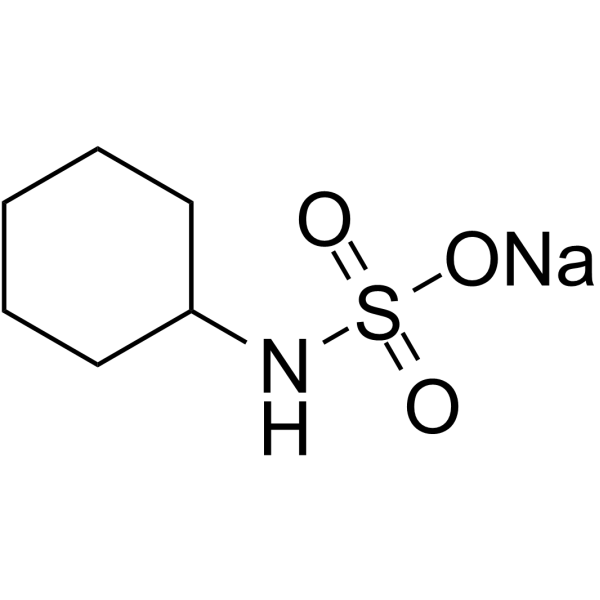
Cyclamic acid sodium

Based on 1 Customer Validation
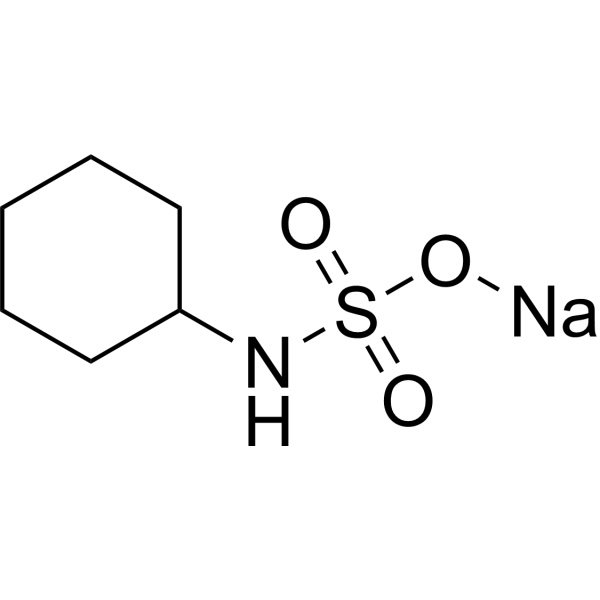
Cyclamic acid sodium (Sodium cyclamate) is a commonly used sweetener. Cyclamic acid sodium is toxic to osteoblasts and can inhibit cell proliferation, induce apoptosis and reduce cell mineralization. Cyclamic acid sodium causes focal necrosis of bladder organs in rats in vitro, which can promote bladder cancer, but some studies have shown that low doses of Cyclamic acid sodium have no carcinogenic effect. In addition, Cyclamic acid sodium has no effect on insulin and glucagon secretion induced by arginine.
Nur für Forschungszwecke. Wir verkaufen nicht an Patienten.
- Reinheit: 98.0%
- CAS. Nr.: 139-05-9
- Formel: C6H12NNaO3S
- Molecular Weight:201.22
-
Speicherung:
4°C, sealed storage, away from moisture
* In solvent : -80°C, 6 months; -20°C, 1 month (sealed storage, away from moisture)

To place orders, for customer services and technical support, please contact: MedChemExpress USA
Tel: 609-228-6898 E-mail: [email protected] [email protected]


-
 Biologische Aktivität
-
Chemical Information
-
Lösungsmittel & Löslichkeit
- Reinheit & Dokumentation
- Verweise
-
 Help & FAQs




Biologische Aktivität
BMP2[3]
Cyclamic acid sodium (12-24 mM; 89 days) can lead to progressive abnormalities and focal necrosis of urinary tract epithelium of bladder organ in rats in vitro[2].
Cyclamic acid sodium (0-0.10 μM; 24-72 h) inhibits cell proliferation, induces apoptosis, decreases cell mineralization and the expression of BMP2 in osteoblasts[3].
MedChemExpress (MCE) has not independently confirmed the accuracy of these methods. They are for reference only.
-
Cell Line:Pre-osteoblasts (MC3T3E1) cells
-
Concentration:0, 0.02, 0.04, 0.06, 0.08 and 0.10 μM
-
Incubation Time:24, 48 and 72 h
-
Result:Inhibited cell proliferation in a time- and concentration-dependent manner.
Cyclamic acid sodium (440 μM; Pancreatic perfusion; Single dose) has no effect on arginine-induced insulin and glucagon secretion in pancreas of perfusion rats[5].
MedChemExpress (MCE) has not independently confirmed the accuracy of these methods. They are for reference only.
-
Animal Model:Mice of the ASH-CS1 strain[4]
-
Dosage:Diet containing 0.7, 1.75, 3.5 and 7.0%
-
Administration:Feed administration; 80 weeks
-
Result:Slightly reduced rate of weight gain during the last 6 months of the study, but this was not thought to represent a toxic effect.
Caused mild anemia in mice at a dose of 7.0%.
Did not exert a carcinogenic effect in mice at dietary levels up to 7.0% and that the no-untoward-effect level was 3.5%.
-
Animal Model:Arginine treated wistar strain male rats (250-300 g)[5]
-
Dosage:440 μM
-
Administration:Pancreatic perfusion; Single dose
-
Result:Did not influence arginine-induced insulin and glucagon secretion in the perfused rat pancreas.


Chemical Information
-
CAS. Nr. 139-05-9
-
Appearance Solid
-
Molecular Weight 201.22
-
Formel C6H12NNaO3S
-
Color White to off-white
-
SMILES
O=S(NC1CCCCC1)(O[Na])=O
-
Synonyms
Sodium cyclamate; Cyclohexylsulfamic acid sodium
-
Versand
Room temperature in continental US; may vary elsewhere.
-
Speicherung
4°C, sealed storage, away from moisture
* In solvent : -80°C, 6 months; -20°C, 1 month (sealed storage, away from moisture)


Lösungsmittel & Löslichkeit
H2O : 50 mg/mL (248.48 mM; Need ultrasonic)
DMSO : 20 mg/mL (99.39 mM; ultrasonic and warming and heat to 60°C; Hygroscopic DMSO has a significant impact on the solubility of product, please use newly opened DMSO)
Please refer to the solubility information to select the appropriate solvent. Once prepared, please aliquot and store the solution to prevent product inactivation from repeated freeze-thaw cycles.
Storage method and period of stock solution: -80°C, 6 months; -20°C, 1 month (sealed storage, away from moisture). When stored at -80°C, please use it within 6 months. When stored at -20°C, please use it within 1 month.
* Note: If you choose water as the stock solution, please dilute it to the working solution, then filter and sterilize it with a 0.22 μm filter before use.
Please refer to the solubility information to select the appropriate solvent. Once prepared, please aliquot and store the solution to prevent product inactivation from repeated freeze-thaw cycles.
Storage method and period of stock solution: -80°C, 6 months; -20°C, 1 month (sealed storage, away from moisture). When stored at -80°C, please use it within 6 months. When stored at -20°C, please use it within 1 month.
* Note: If you choose water as the stock solution, please dilute it to the working solution, then filter and sterilize it with a 0.22 μm filter before use.
Konzentration (Stammlösung) × Volumen (Stammlösung) = Konzentration (Ziellösung) × Volumen (Ziellösung)
Select the appropriate dissolution method based on your experimental animal and administration route.
- For the following dissolution methods, please ensure to first prepare a clear stock solution using an In Vitro approach and then sequentially add co-solvents:
- To ensure reliable experimental results, the clarified stock solution can be appropriately stored based on storage conditions. As for the working solution for In Vivo experiments, it is recommended to prepare freshly and use it on the same day.
- The percentages shown for the solvents indicate their volumetric ratio in the final prepared solution. If precipitation or phase separation occurs during preparation, heat and/or sonication can be used to aid dissolution.
Add each solvent one by one: 10% DMSO 40% PEG300 5% Tween-80 45% Saline
Solubility: ≥ 2 mg/mL (9.94 mM); Clear solution
This protocol yields a clear solution of ≥ 2 mg/mL (saturation unknown).
Taking 1 mL working solution as an example, add 100 μL DMSO stock solution (20.0 mg/mL) to 400 μL PEG300, and mix evenly; then add 50 μL Tween-80 and mix evenly; then add 450 μL Saline to adjust the volume to 1 mL.
Preparation of Saline: Dissolve 0.9 g sodium chloride in ddH₂O and dilute to 100 mL to obtain a clear Saline solution.
Add each solvent one by one: 10% DMSO 90% (20% SBE-β-CD in Saline)
Solubility: ≥ 2 mg/mL (9.94 mM); Clear solution
This protocol yields a clear solution of ≥ 2 mg/mL (saturation unknown).
Taking 1 mL working solution as an example, add 100 μL DMSO stock solution (20.0 mg/mL) to 900 μL 20% SBE-β-CD in Saline, and mix evenly.
Preparation of 20% SBE-β-CD in Saline (4°C, storage for one week): 2 g SBE-β-CD powder is dissolved in 10 mL Saline, completely dissolve until clear.
Please enter the basic information of animal experiments:
-
-
-
-
Recommended: Prepare an additional quantity of animals to account for potential losses during experiments.
Working solution concentration: 0.22 mg/mL
This product has good water solubility, please refer to the measured solubility data in water/PBS/Saline for details.


Reinheit & Dokumentation
-
Data Sheet (279 KB)
-
SDS (393 KB)
- English - EN (393 KB)
- Français - FR (393 KB)
- Deutsch - DE (393 KB)
- Norwegian - NO (393 KB)
- Español - ES (393 KB)
- Swedish - SV (393 KB)
- Italian - IT (393 KB)
- Korean - KR (393 KB)
- Portuguese - PT (393 KB)
-
Handling Instructions (2659 KB)
Verweise
[1]. Leban I, et, al. Structures of artificial sweeteners--cyclamic acid and sodium cyclamate with other cyclamates. Acta Crystallogr B. 2007 Jun;63(Pt 3):418-25. [Content Brief]
[2]. Knowles MA, Jani H, Hicks RM. Induction of morphological changes in the urothelium of cultured adult rat bladder by sodium saccharin and sodium cyclamate. Carcinogenesis. 1986 May;7(5):767-74. [Content Brief]
[3]. Chen Z, et al. Toxicity of food sweetener-sodium cyclamate on osteoblasts cells. Biochem Biophys Res Commun. 2019 Jan 8;508(2):507-511. [Content Brief]
[4]. Brantom PG, et al. Long-term toxicity of sodium cyclamate in mice. Food Cosmet Toxicol. 1973 Oct;11(5):735-46. [Content Brief]
[5]. Usami M, et al. Effect of cyclamate sodium, saccharin sodium and stevioside on arginine-induced insulin and glucagon secretion in the isolated perfused rat pancreas. Horm Metab Res. 1980 Dec;12(12):705-6. [Content Brief]


Complete Stock Solution Preparation Table
Please refer to the solubility information to select the appropriate solvent. Once prepared, please aliquot and store the solution to prevent product inactivation from repeated freeze-thaw cycles.
Storage method and period of stock solution: -80°C, 6 months; -20°C, 1 month (sealed storage, away from moisture). When stored at -80°C, please use it within 6 months. When stored at -20°C, please use it within 1 month.
| Optional Solvent | Concentration Solvent Mass | 1 mg | 5 mg | 10 mg | 25 mg |
|---|---|---|---|---|---|
| DMSO / H2O | 1 mM | 4.9697 mL | 24.8484 mL | 49.6968 mL | 124.2421 mL |
| 5 mM | 0.9939 mL | 4.9697 mL | 9.9394 mL | 24.8484 mL | |
| 10 mM | 0.4970 mL | 2.4848 mL | 4.9697 mL | 12.4242 mL | |
| 15 mM | 0.3313 mL | 1.6566 mL | 3.3131 mL | 8.2828 mL | |
| 20 mM | 0.2485 mL | 1.2424 mL | 2.4848 mL | 6.2121 mL | |
| 25 mM | 0.1988 mL | 0.9939 mL | 1.9879 mL | 4.9697 mL | |
| 30 mM | 0.1657 mL | 0.8283 mL | 1.6566 mL | 4.1414 mL | |
| 40 mM | 0.1242 mL | 0.6212 mL | 1.2424 mL | 3.1061 mL | |
| 50 mM | 0.0994 mL | 0.4970 mL | 0.9939 mL | 2.4848 mL | |
| 60 mM | 0.0828 mL | 0.4141 mL | 0.8283 mL | 2.0707 mL | |
| 80 mM | 0.0621 mL | 0.3106 mL | 0.6212 mL | 1.5530 mL | |
| H2O | 100 mM | 0.0497 mL | 0.2485 mL | 0.4970 mL | 1.2424 mL |
* Note: If you choose water as the stock solution, please dilute it to the working solution, then filter and sterilize it with a 0.22 μm filter before use.


Cyclamic acid sodium Related Classifications
HY-W014839 Related Classifications
 Powered by Bioz