



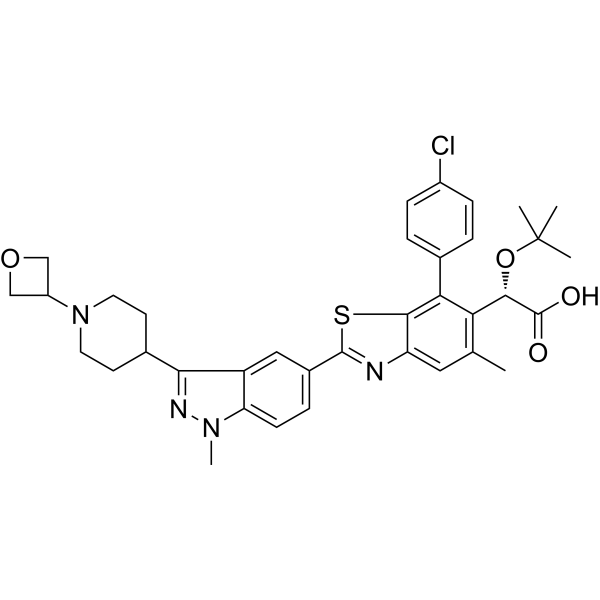
GS-9822
GS-9822 is a potent antivira agent with nanomolar activity against wild-type HIV-1 viruses. GS-9822 potently inhibits the LEDGF/p75-integrase interaction with an IC50 of 0.07 μM. GS-9822 has high in vitro metabolic stability and favorable oral pharmacokinetic profiles with low systemic clearance in rats, dogs, and monkeys.
Nur für Forschungszwecke. Wir verkaufen nicht an Patienten.
- CAS. Nr.: 2219362-41-9
- Formel: C36H39ClN4O4S
- Molecular Weight:659.24
-
Speicherung:
Please store the product under the recommended conditions in the Certificate of Analysis.

To place orders, for customer services and technical support, please contact: MedChemExpress USA
Tel: 609-228-6898 E-mail: [email protected] [email protected]


-
 Biologische Aktivität
-
Chemical Information
- Protokoll
- Reinheit & Dokumentation
- Verweise
-
 Help & FAQs




Biologische Aktivität
Beschreibung
IC50 & Target
EC50: 0.0022 μM (Strain IIIb), 0.0025 μM (Strain NL4.3)[1]
IC50: 0.07 μM (LEDGF/p75-integrase)[1]


Chemical Information
-
CAS. Nr. 2219362-41-9
-
Molecular Weight 659.24
-
Formel C36H39ClN4O4S
-
SMILES
CC(C)(C)O[C@@H](C1=C(C)C=C(N=C(C2=CC=C3C(C(C4CCN(C5COC5)CC4)=NN3C)=C2)S6)C6=C1C7=CC=C(Cl)C=C7)C(O)=O
-
Versand
Room temperature in continental US; may vary elsewhere.
-
Speicherung
Please store the product under the recommended conditions in the Certificate of Analysis.


Reinheit & Dokumentation
Verweise

Calculators
Konzentration (Stammlösung) × Volumen (Stammlösung) = Konzentration (Ziellösung) × Volumen (Ziellösung)


GS-9822 Related Classifications
HY-122229 Related Classifications
 Powered by Bioz