



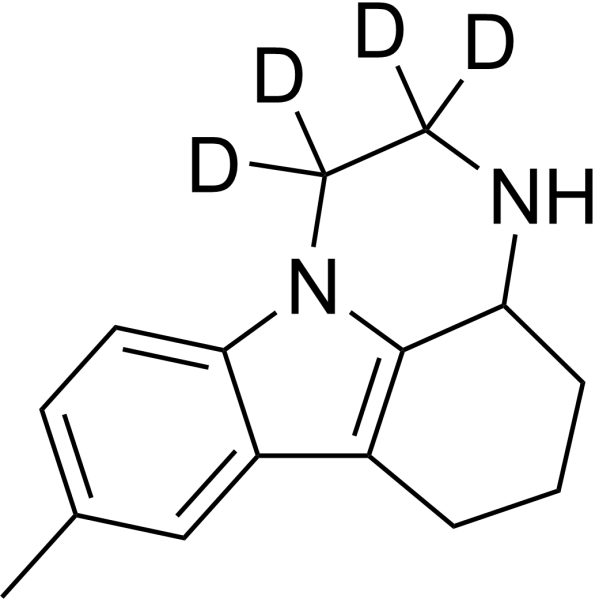
Pirlindole-d4
Pirlindole-d4 is the d4-labeled Pirlindole (HY-100679). Pirlindole is an orally active, selective and reversible MAO-A inhibitor with an IC50 value of 250 nM. Pirlindole inhibits genomic replication of Enterovirus species B and D, and exhibits moderate activity against enterovirus species A. Pirlindole inhibits MAO-A-mediated monoamine metabolism, promotes adult hippocampal neurogenesis, rescues stress-induced dendritic atrophy of hippocampal granule neurons, reverses behavioral effects associated with chronic mild stress, and also possesses anticonvulsant, analgesic, local anesthetic, hypotensive, antiplatelet aggregation and antispasmodic activities. Pirlindole shows no detectable mutagenic, clastogenic or carcinogenic properties. Pirlindole can be used in research related to depression and enterovirus infections.
Nos produits utilisent uniquement pour la recherche. Nous ne vendons pas aux patients.
- CAS No.: 1801646-26-3
- Formule: C15H14D4N2
- Masse moléculaire:230.34
-
Stockage:
Please store the product under the recommended conditions in the Certificate of Analysis.

To place orders, for customer services and technical support, please contact: MedChemExpress USA
Tel: 609-228-6898 E-mail: [email protected] [email protected]


-
 Activité biologique
-
Chemical Information
- Protocole
- Pureté et documentation
- Références
-
 Help & FAQs




Activité biologique
Description
IC50 & Target
|
MAO-A 250 nM (IC50) |
Application
1. This compound can be used as a tracer
2. This compound can be used as an internal standard for quantitative analysis by NMR, GC-MS, or LC-MS.


Chemical Information
-
CAS No. 1801646-26-3
-
Unlabeled CAS 60762-57-4
-
Masse moléculaire 230.34
-
Formule C15H14D4N2
-
SMILES
CC=1C=C2C3=C4N(C2=CC1)C(C(NC4CCC3)([2H])[2H])([2H])[2H]
-
Livraison
Room temperature in continental US; may vary elsewhere.
-
Stockage
Please store the product under the recommended conditions in the Certificate of Analysis.

Protocole
-
Cell Cytotoxicity Assay
Cytotoxicity assays are usually based on the assessment of cell membrane damage, which can also be indirectly detected by measuring cell viability. Detection methods include MTT assay, CKK-8 assay, LDH assay and ATP assay, etc.
-
SH-SY5Y neuronal-like differentiation
SH-SY5Y neuronal-like differentiation uses defined culture conditions to shift proliferative human neuroblastoma cells toward a neuron-like state, mainly assessed by reduced proliferation, neurite extension, neuronal-marker expression, and, in some protocols, increased dependence on neurotrophic support. Retinoic acid (RA) is commonly used for the first differentiation phase, and sequential RA followed by brain-derived neurotrophic factor (BDNF) in serum-free medium is a well-characterized approach for generating neuron-like SH-SY5Y cultures with extensive neurite outgrowth. The primary readouts are morphology-based neurite outgrowth and marker-based confirmation using proteins such as βIII-tubulin, MAP2, GAP43, synaptophysin, NeuN, NSE, TH, or related neuronal/synaptic markers, depending on the study endpoint.
-
Cell differentiation
Cell differentiation refers to the process in which cells of the same origin gradually produce cell groups with different morphological structure and functional characteristics.
-
Cerebellar Granule Neuron Culture
Cerebellar granule neuron culture is a primary neuronal culture method in which postnatal rodent cerebella are dissected, meninges are removed, tissue is enzymatically and mechanically dissociated, and neurons are plated on poly-cation-coated surfaces in medium that supports neuronal attachment, maturation, neurite-network formation, and biochemical or imaging analysis. Cultured CGNs are used to study neuronal development, survival, apoptosis, differentiation, neurotransmitter release, and toxin-sensitive synaptic proteins; mature cultures develop dense neuritic networks, neuronal activity, glutamate release, and neuronal marker expression. A common survival paradigm uses depolarizing extracellular potassium: CGNs maintained in high potassium medium survive and differentiate, whereas switching mature cultures from 25 mM KCl to 5 mM KCl induces apoptotic death that can be used as a readout of activity-dependent neuronal survival.
-
Genotoxicity/Mutagenicity Study
The bacterial reverse mutation assay detects point mutations that restore amino-acid prototrophy in auxotrophic Salmonella typhimurium or Escherichia coli tester strains; after exposure to a test article, mutagenic activity is read out as an increased number of revertant colonies on minimal agar compared with the vehicle control. The assay uses tester strains with different mutation targets so that base-substitution and frameshift mutagens can be detected, and testing is performed with and without exogenous mammalian metabolic activation because some chemicals require biotransformation to become mutagenic.


Pureté et documentation
Références
[1]. Morais M, et al. The effects of chronic stress on hippocampal adult neurogenesis and dendritic plasticity are reversed by selective MAO-A inhibition. Journal of psychopharmacology (Oxford, England). 2014 Dec;28(12):1178-83. [Content Brief]
[2]. Macedo A, et al. Pirlindole in the treatment of depression: a meta-analysis. Clinical drug investigation. 2011;31(1):61-71. [Content Brief]
[3]. Bruhwyler J, et al. Pirlindole: a selective reversible inhibitor of monoamine oxidase A. A review of its preclinical properties. Pharmacological research. 1997 Jul;36(1):23-33. [Content Brief]
[4]. Ulferts R, et al. Screening of a Library of FDA-Approved Drugs Identifies Several Enterovirus Replication Inhibitors That Target Viral Protein 2C. Antimicrobial agents and chemotherapy. 2016 May;60(5):2627-38. [Content Brief]

Calculators
Concentration (start) × Volume (start) = Concentration (final) × Volume (final)


Pirlindole-d4 Related Classifications
HY-100679S Related Classifications
 Powered by Bioz
Keywords
- Pirlindole-d4
- 1801646-26-3
- Isotope-Labeled Compounds
- Monoamine Oxidase
- Enterovirus
- monoamine oxidase subtype A
- Coxsackievirus B3 viral protein 2C
- BGM cells
- hippocampal adult neurogenesis
- noradrenaline reuptake transporters
- HeLa R19 cells
- enterovirus species B
- Salmonella typhimurium
- serotonin reuptake transporters
- enterovirus species D
- Inhibitor
- inhibitor
- inhibit