



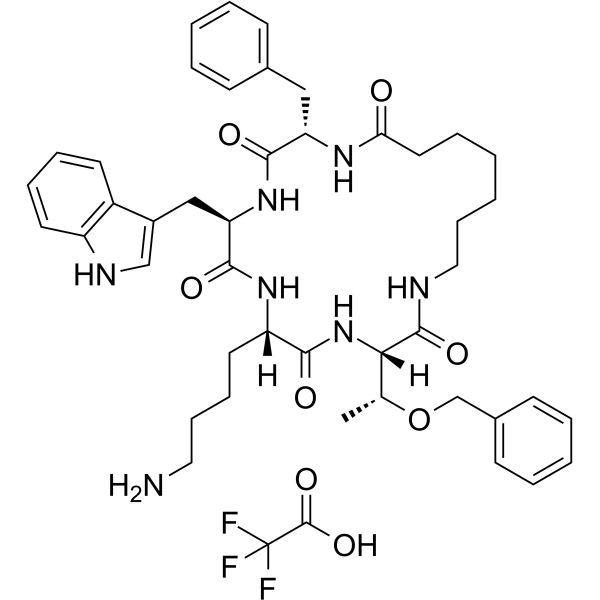
Cyclosomatostatin TFA
Based on 1 publication(s) in Google Scholar
Cyclosomatostatin TFA is a non-selective somatostatin receptor antagonist that blocks SSTR1-5-mediated signaling. Cyclosomatostatin TFA decreases the ALDH+ stem cell population and sphere formation without affecting cell viability, and reduces cell proliferation. Cyclosomatostatin TFA activates opioid receptors. Cyclosomatostatin TFA can be used for research on arthritis and colorectal cancer.
For research use only. We do not sell to patients.
- Formula: C46H58F3N7O8
- Molecular Weight:893.99
-
Storage:
Please store the product under the recommended conditions in the Certificate of Analysis.

To place orders, for customer services and technical support, please contact: MedChemExpress USA
Tel: 609-228-6898 E-mail: [email protected] [email protected]


-
 Biological Activity
-
Chemical Information
-
Solvent & Solubility
- Purity & Documentation
- References
-
 Help & FAQs


Publications Citing Use of MedChemExpress (MCE) Cyclosomatostatin TFA
MoreAll Opioid Receptor Isoforms
More

Biological Activity
Description
|
SSTR1 |
In Vitro
Cyclosomatostatin (10 μM; 48 h) TFA significantly decreases the ALDH+ cell population, cell count, and sphere formation in HT29 and SW480 colorectal cancer cell lines without affecting cell viability[2].
Cyclosomatostatin (0.3-3 μM; 5 min) TFA inhibits cholinergic twitch contractions in the guinea-pig ileum with more than 50% reduction at 1 μM[4].
Cyclosomatostatin (3-10 μM; 5 min) TFA inhibits nerve-mediated cholinergic contractions of the rat stomach fundus strip[4].
Cyclosomatostatin (1 μM; 10 min) TFA prevents SST-mediated hyperpolarization and reduced excitability of mouse prelimbic cortex pyramidal neurons, demonstrating that these effects are dependent on SSTRs[5].
Cyclosomatostatin (1 μM) TFA largely does not reverse SST-mediated hyperpolarization and reduced excitability of mouse prelimbic cortex pyramidal neurons[5].
MedChemExpress (MCE) has not independently confirmed the accuracy of these methods. They are for reference only.
-
Cell Line:HT29 and SW480
-
Concentration:10 μM
-
Incubation Time:48 h
-
Result:Decreased ALDH+ cells, cell count by 50%, and sphere formation in HT29 cells without affecting cell viability.
Decreased ALDH+ cells, sphere formation, and cell count by 30% in SW480 cells without affecting cell viability.
In Vivo
MedChemExpress (MCE) has not independently confirmed the accuracy of these methods. They are for reference only.
-
Animal Model:Wistar rats (adult male, 240-420 g)[1]
-
Dosage:0.1 mM, 0.2 mL
-
Administration:i.a.; single injection
-
Result:Increased responses to noxious movements in half of the units, with a mean response of approximately 150% of control values.
The effect was transient, returning to control levels after about 30 minutes.


Chemical Information
-
Molecular Weight 893.99
-
Formula C46H58F3N7O8
-
Sequence
cyclo(7-Aminoheptanoyl-Phe-dTrp-Lys-Thr(Bzl))
-
Sequence Shortening
Cyclo(7-Aminoheptanoyl-FwK-Thr(Bzl))
-
Shipping
Room temperature in continental US; may vary elsewhere.
-
Storage
Please store the product under the recommended conditions in the Certificate of Analysis.


Publications (1)
-
Journal Impact Factor
-
Most Recent
-
J Clin Invest
Genomic and transcriptomic features of androgen receptor signaling inhibitor resistance in metastatic castration-resistant prostate cancer. [Abstract]2024 Aug 13;134(19):e178604. PMID: 39352383


Solvent & Solubility
In Vitro
H2O
Peptide Solubility and Storage Guidelines:
1. Calculate the length of the peptide.
2. Calculate the overall charge of the entire peptide according to the following table:
| Contents | Assign value | |
|---|---|---|
| Acidic amino acid | Asp (D), Glu (E), and the C-terminal -COOH. | -1 |
| Basic amino acid | Arg (R), Lys (K), His (H), and the N-terminal -NH2 | +1 |
| Neutral amino acid | Gly (G), Ala (A), Leu (L), Ile (I), Val (V), Cys (C), Met (M), Thr (T), Ser (S), Phe (F), Tyr (Y), Trp (W), Pro (P), Asn (N), Gln (Q) | 0 |
3. Recommended solution:
| Overall charge of peptide | Details |
|---|---|
| Negative (<0) |
1. Try to dissolve the peptide in water first. 2. If water fails, add NH4OH (<50 μL). 3. If the peptide still does not dissolve, add DMSO (50-100 μL) to solubilize the peptide. |
| Positive (>0) |
1. Try to dissolve the peptide in water first. 2. If water fails, try dissolving the peptide in a 10%-30% acetic acid solution. 3. If the peptide still does not dissolve, try dissolving the peptide in a small amount of DMSO. |
| Zero (=0) |
1. Try to dissolve the peptide in organic solvent (acetonitrile, methanol, etc.) first. 2. For very hydrophobic peptides, try dissolving the peptide in a small amount of DMSO, and then dilute the solution with water to the desired concentration. |


Purity & Documentation
References

Calculators
Concentration (start) × Volume (start) = Concentration (final) × Volume (final)


Cyclosomatostatin TFA Related Classifications
HY-P1201A Related Classifications
 Powered by Bioz
Keywords
- Cyclosomatostatin
- Somatostatin Receptor
- Opioid Receptor
- articular afferents
- non-selective somatostatin receptor antagonist
- rat hepatocytes
- SSTR1-5-mediated signaling
- rat liver basolateral plasma membranes
- HT29 and SW480 colorectal cancer cell lines
- ALDH+ stem cell population
- pI 6.1 carboxylesterase inhibitor
- rat stomach fundus strip
- guinea-pig ileum
- Inhibitor
- inhibitor
- inhibit