



CD44 Protein, Human (HEK293, His)
Based on 1 publication(s) in Google Scholar
CD44 Protein is a type of cell surface receptor protein. CD44 Protein mediates various signaling pathways, including protein kinases, changes in the cytoskeleton, intracellular pathways, proteases, and transcription factors, which promote cancer cell division, proliferation, invasion, angiogenesis, and metabolic changes. The expression level of CD44 Protein is positively correlated with the malignancy and invasiveness of glioblastoma. CD44 Protein, Human (HEK293, His) is a recombinant CD44 protein tagged with a C-6*His label, expressed by HEK293. CD44 Protein, Human (HEK293, His) consists of 200 amino acids and has a molecular weight of 38-50 kDa.
- Species: Human
- Source: HEK293
-
Storage:Stored at -20°C for 2 years from date of receipt. After reconstitution, it is stable at 4°C for 1 week or -20°C for longer (with carrier protein). It is recommended to freeze aliquots at -20°C or -80°C for extended storage.


To place orders, for customer services and technical support, please contact: MedChemExpress USA
Tel: 609-228-6898 E-mail: [email protected] [email protected]


-
 Biological Activity
-
Technical Parameters
-
Product Properties
- Documentation
- References
- Help & FAQs




Biological Activity
Description
CD44 Protein is a type of cell surface receptor protein. CD44 Protein mediates various signaling pathways, including protein kinases, changes in the cytoskeleton, intracellular pathways, proteases, and transcription factors, which promote cancer cell division, proliferation, invasion, angiogenesis, and metabolic changes. The expression level of CD44 Protein is positively correlated with the malignancy and invasiveness of glioblastoma. CD44 Protein, Human (HEK293, His) is a recombinant CD44 protein tagged with a C-6*His label, expressed by HEK293. CD44 Protein, Human (HEK293, His) consists of 200 amino acids and has a molecular weight of 38-50 kDa[1][2].
Background
CD44 Protein is a non-kinase transmembrane proteoglycan encoded by a gene located on human chromosome 11. The CD44 Protein has an extracellular domain, a membrane proximal region, a transmembrane domain, and a cytoplasmic tail[2]. CD44 Protein can bind with various ligands, including hyaluronic acid (HA), osteopontin (OPN), chondroitin, collagen, fibronectin, and serum glycosaminoglycan/sulfated proteoglycans[2]. CD44 Protein has various subtypes that undergo subtype switching in tumor cells, playing biological roles in the growth, metastasis, and prognosis of multiple tumors[2]. CD44 Protein plays a role in cell-to-cell interactions, cell adhesion, and migration, helping them sense and respond to changes in the tissue microenvironment[3]. The interaction of CD44 Protein-HA (hyaluronic acid) with Rac1-dependent PKNγ kinase activation can promote the phosphorylation of PLCγ1 and cortactin, leading to PLCγ1-mediated IP3 production/Ca2+ signaling and cortactin-mediated cytoskeletal functions, which are essential for keratinocyte functions such as cell adhesion and differentiation[3]. CD44 Protein is closely related to pathological processes such as tumors, viral infections, pathological angiogenesis, and rheumatoid arthritis[2].
In Vitro
CD44 Protein is highly expressed in human glioma cell lines A172 and KG-1-C, and localized around tumor blood vessels and necrotic lesions[1]. CD44 Protein can mediate oxidative stress-induced upregulation of MUC5B in airway epithelial cells, thereby promoting the development of airway diseases[4]. CD44 Protein is overexpressed in CD44 transfected fibroblasts, thereby inhibiting the tumorigenicity of the cells[5].
In Vivo
The low expression of CD44 Protein in CD44 deficient nude mice resulted in excessive granulomatous response to viral infection and promoted tumor growth[5]. CD44 Protein is overexpressed in intestinal tumors of APC mutant mice due to the activation signals from β-catenin/Tcf-4. However, in TCF-4 mutant mice, where β-catenin/Tcf-4 signaling is blocked, there's a complete absence of CD44-positive cells in the small intestine epithelium, resulting in a total loss of CD44 function[6].
Verified Bioactivity
1.Measured in a cell proliferation assay using A549 cells. The ED50 this effect is 1.543 ng/ml, corresponding to a specific activity is 6.481×10⁵ units/mg.
2.Easured by its binding ability in a functional ELISA. Immobilized Human CD44 at 5 μg/mL (100 μL/well) can bind Hyaluronan biotin sodium salt. The ED50 for this effect is 145.5 ng/mL.
3.Human Siglec-15 (HY-P70742) immobilized on Protein A Chip can bind Human CD44 with an affinity constant of 500-1000 nM as determined in a SPR assay.
MCE Validation Data
-
Purity - SDS-PAGE
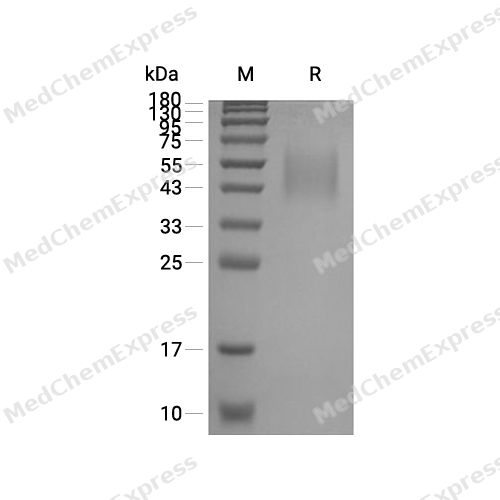
Purity - SDS-PAGE
-
Bioactivity - Cell-Based Assay
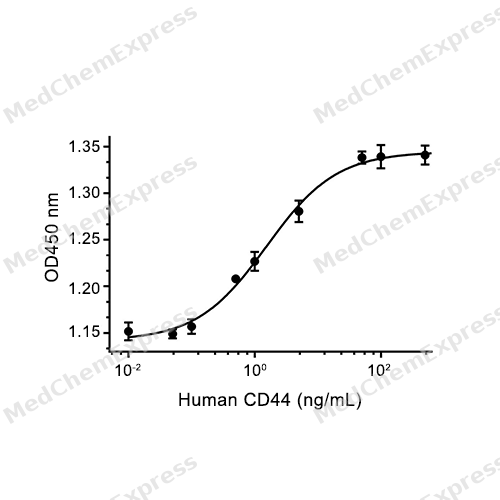
Bioactivity - Cell-Based Assay


Publications (1)
-
Journal Impact Factor
-
Most Recent


Technical Parameters
-
Species Human
-
Source HEK293
-
Tag C-6*His
-
Accession
P16070-1 (Q21-P220)
-
Molecular Construction
-
N-term
-
CD44 (Q21-P220)
Accession # P16070-1 -
6*His
-
C-term
-
-
Protein Length
Partial Extracellular Domain
-
Synonyms
CD44; Chondroitin Sulfate Proteoglycan 8; Prev. MDU2; Heparan Sulfate Proteoglycan; Prev. MDU3; Phagocytic Glycoprotein I; Prev. MIC4; Phagocyte Glycoprotein 1; HUTCH-I; In(Lu) Related-P80; CDw44; Soluble CD44; GP90 Lymphocyte Homing/Adhesion Receptor; EC
-
AA Sequence
QIDLNITCRFAGVFHVEKNGRYSISRTEAADLCKAFNSTLPTMAQMEKALSIGFETCRYGFIEGHVVIPRIHPNSICAANNTGVYILTSNTSQYDTYCFNASAPPEEDCTSVTDLPNAFDGPITITIVNRDGTRYVQKGEYRTNPEDIYPSNPTDDDVSSGSSSERSSTSGGYIFYTFSTVHPIPDEDSPWITDSTDRIP
-
Molecular Weight
Approximately 32-60 kDa, based on SDS-PAGE under reducing conditions, due to the glycosylation.
-
Glycosylation
Yes
-
Purity
≥ 95%, as determined by reducing SDS-PAGE.


Product Properties
Lyophilized powder
Lyophilized from a 0.2 μm filtered solution of 20 mM PB, 150 mM NaCl, pH 7.4.
<1 EU/μg, determined by LAL method.
It is not recommended to reconstitute to a concentration less than 100 μg/mL in ddH2O. For long term storage it is recommended to add a carrier protein (0.1% BSA, 5% HSA, 10% FBS or 5% Trehalose).
Stored at -20°C for 2 years from date of receipt. After reconstitution, it is stable at 4°C for 1 week or -20°C for longer (with carrier protein). It is recommended to freeze aliquots at -20°C or -80°C for extended storage.
Room temperature in continental US; may vary elsewhere.


Documentation
-
Data Sheet (265 KB)
-
SDS (254 KB)
- English - EN (254 KB)
- Français - FR (254 KB)
- Deutsch - DE (254 KB)
- Norwegian - NO (254 KB)
- Español - ES (254 KB)
- Swedish - SV (254 KB)
- Italian - IT (254 KB)
- Korean - KR (254 KB)
- Portuguese - PT (254 KB)
-
Handling Instructions (2659 KB)


References
[1]. Yoshida T, et al. CD44 in human glioma correlates with histopathological grade and cell migration. Pathol Int. 2012 Jul;62(7):463-70. [Content Brief]
[2]. Chen C, et al. The biology and role of CD44 in cancer progression: therapeutic implications. J Hematol Oncol. 2018 May 10;11(1):64. [Content Brief]
[3]. Bourguignon LY, et al. Hyaluronan-CD44 interaction with Rac1-dependent protein kinase N-gamma promotes phospholipase Cgamma1 activation, Ca(2+) signaling, and cortactin-cytoskeleton function leading to keratinocyte adhesion and differentiation. J Biol Chem. 2004 Jul 9;279(28):29654-69. [Content Brief]
[4]. Casalino-Matsuda SM, et al. Hyaluronan fragments/CD44 mediate oxidative stress-induced MUC5B up-regulation in airway epithelium. Am J Respir Cell Mol Biol. 2009 Mar;40(3):277-85. [Content Brief]
[5]. Schmits R, et al. CD44 regulates hematopoietic progenitor distribution, granuloma formation, and tumorigenicity. Blood. 1997 Sep 15;90(6):2217-33. PMID: 9310473. [Content Brief]
[6]. Wielenga VJ, et al. Expression of CD44 in Apc and Tcf mutant mice implies regulation by the WNT pathway. Am J Pathol. 1999 Feb;154(2):515-23. [Content Brief]

Calculators
Concentration (start) × Volume (start) = Concentration (final) × Volume (final)


 Powered by Bioz

