



Exodus-2/CCL21 Protein, Human
Based on 1 publication(s) in Google Scholar
Exodus-2/CCL21 Protein, Human is a homeostatic lymphoid chemokine that contributes to the entry of T cells and dendritic cells into the lymphoid T-zone. It acts through chemokine receptors CCR7 and CXCR3 to promote fibrogenic and inflammatory cytokine production. Exodus-2/CCL21 Protein, Human is a recombinant human Exodus-2/CCL21 (S24-P134) expressed by E. coli.
- Species: Human
- Source: E. coli
-
Storage:Stored at -20°C for 2 years from date of receipt. After reconstitution, it is stable at 4°C for 1 week or -20°C for longer (with carrier protein). It is recommended to freeze aliquots at -20°C or -80°C for extended storage.


To place orders, for customer services and technical support, please contact: MedChemExpress USA
Tel: 609-228-6898 E-mail: [email protected] [email protected]


-
 Biological Activity
-
Technical Parameters
-
Product Properties
- Documentation
- References
- Help & FAQs




Biological Activity
Description
Exodus-2/CCL21 Protein, Human is a homeostatic lymphoid chemokine that contributes to the entry of T cells and dendritic cells into the lymphoid T-zone. It acts through chemokine receptors CCR7 and CXCR3 to promote fibrogenic and inflammatory cytokine production. Exodus-2/CCL21 Protein, Human is a recombinant human Exodus-2/CCL21 (S24-P134) expressed by E. coli[1].
Background
CCL21, also known as exodus-2 and secondary lymphoid chemokine (SLC), is a small cytokine belonging to the CC chemokine family and is located on chromosome 9 in the human genome. It binds to glycosaminoglycan (GAG) and is anchored to the surface of endothelial cells. As a chemokine, CCL21 inhibits hematopoiesis and stimulates chemotaxis, and is chemotactic in vitro for thymocytes and activated T cells, but not for B cells, macrophages or neutrophils. At the same time, CCL21 is a potent stimulator of T cell migration and adhesion, binding to the glycoprotein PSGL-1 on T cells to promote the migration of T cells to secondary lymphoid organs. CCL21 can act through chemokine receptors CCR7 and CXCR3. Among them, CCR7 is a GPCR that is normally expressed by T cell subsets central memory cells, thymic T cells, B cells, mature DCs and other rare cell subsets. ccl21 can function as a microglia activator in the CNS and is expressed exclusively in endangered or mechanically damaged neurons[1][2].
In Vitro
Namru mammary gland (NMuMG) epithelial cells undergo TGF-β1 (10 ng/mL, 48 h)-induced epithelial-mesenchymal transition (EMT), and gain the capacity to migrate toward CCL21 (350 ng/mL; 48 h). TGF-β1 promotes chemotactic migration of CCR7-positive immune cells[5].
CCL21 (50 ng/mL, 100 ng/mL, 200 ng/mL; 48 h) promotes T24 cell proliferation in concentration-dependent manner, exhibits significant effect at 200 ng/mL[6].
In Vivo
CCL21(0.1 µg/mL, 2 h) can interact with polysialic acid to regulate the migratory capacity of human dendritic cells[3].
Verified Bioactivity
1.Full biological activity determined by a chemotaxis bioassay using human lymphocytes is in a concentration range of 10-100 ng/ml.
2.The biological activity determined by a chemotaxis bioassay using Jurkat cells. The ED50 for this effect is 11.61 ng/mL, corresponding to a specific activity is 8.613×10⁴ U/mg.
MCE Validation Data
-
Purity - SDS-PAGE
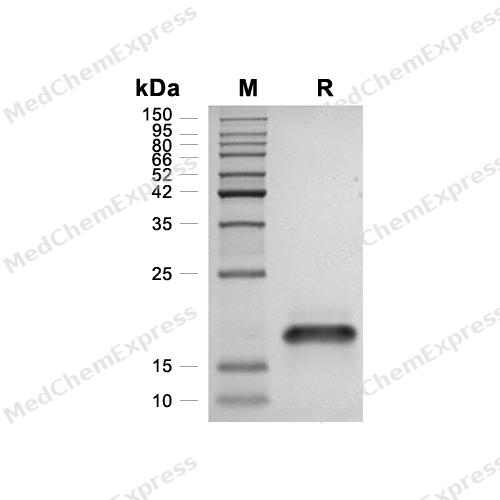
Purity - SDS-PAGE
-
Bioactivity - Cell-Based Assay
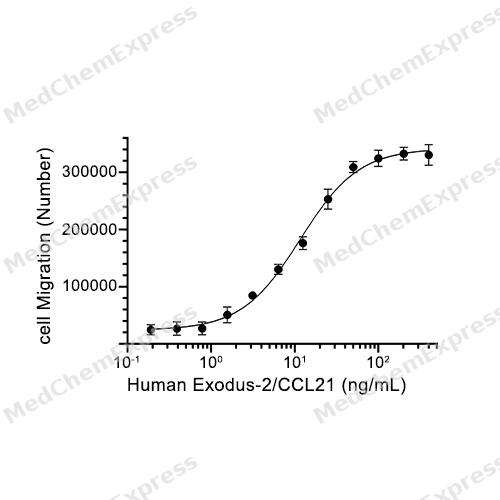
Bioactivity - Cell-Based Assay


Publications (1)
-
Journal Impact Factor
-
Most Recent


Technical Parameters
-
Species Human
-
Source E. coli
-
Tag Tag Free
-
Accession
O00585 (S24-P134)
-
Molecular Construction
-
N-term
-
CCL21 (S24-P134)
Accession # O00585 -
C-term
-
-
Protein Length
Full Length of Mature Protein
-
Synonyms
CCL21; Small Inducible Cytokine Subfamily A (Cys-Cys), Member 21; Prev. SCYA21; Secondary Lymphoid Tissue Chemokine; 6Ckine; Chemokine (C-C Motif) Ligand 21; SLC; Small-Inducible Cytokine A21; C-C Motif Chemokine 21; Beta Chemokine Exodus-2; TCA4; Exodus-
-
AA Sequence
SDGGAQDCCLKYSQRKIPAKVVRSYRKQEPSLGCSIPAILFLPRKRSQAELCADPKELWVQQLMQHLDKTPSPQKPAQGCRKDRGASKTGKKGKGSKGCKRTERSQTPKGP
-
Predicted Molecular Mass
12.3 kDa
-
Molecular Weight
Approximately 19 kDa, based on SDS-PAGE under reducing conditions.
-
Purity
≥ 95%, as determined by reducing SDS-PAGE.


Product Properties
Lyophilized powder.
Lyophilized from a 0.22 μm filtered solution of 20 mM PB, 150 mM NaCl, pH 7.4.
<1 EU/μg, determined by LAL method.
It is not recommended to reconstitute to a concentration less than 100 μg/mL in ddH2O. For long term storage it is recommended to add a carrier protein (0.1% BSA, 5% HSA, 10% FBS or 5% Trehalose).
Stored at -20°C for 2 years from date of receipt. After reconstitution, it is stable at 4°C for 1 week or -20°C for longer (with carrier protein). It is recommended to freeze aliquots at -20°C or -80°C for extended storage.
Room temperature in continental US; may vary elsewhere.


Documentation
-
Data Sheet (263 KB)
-
SDS (251 KB)
- English - EN (251 KB)
- Français - FR (251 KB)
- Deutsch - DE (251 KB)
- Norwegian - NO (251 KB)
- Español - ES (251 KB)
- Swedish - SV (251 KB)
- Italian - IT (251 KB)
- Korean - KR (251 KB)
- Portuguese - PT (251 KB)
-
Handling Instructions (2659 KB)


References
[1]. Balsam Rizeq, et al. The Role of CCL21/CCR7 Chemokine Axis in Breast Cancer Progression. Cancers (Basel). 2020 Apr 23;12(4):1036. [Content Brief]
[2]. Manzo A, et al. CCL21 expression pattern of human secondary lymphoid organ stroma is conserved in inflammatory lesions with lymphoid neogenesis. Am J Pathol. 2007 Nov;171(5):1549-62. [Content Brief]
[3]. Knut Biber, et al. Neuronal CCL21 up-regulates microglia P2X4 expression and initiates neuropathic pain development. EMBO J. 2011 May 4;30(9):1864-73. [Content Brief]
[4]. Marieke Bax, et al. Interaction of polysialic acid with CCL21 regulates the migratory capacity of human dendritic cells. PLoS One. 2009 Sep 14;4(9):e6987. [Content Brief]
[5]. Pang MF, et al. TGF-β1-induced EMT promotes targeted migration of breast cancer cells through the lymphatic system by the activation of CCR7/CCL21-mediated chemotaxis. Oncogene. 2016 Feb 11;35(6):748-60. [Content Brief]
[6]. Mo M, et al. CCL21/CCR7 enhances the proliferation, migration, and invasion of human bladder cancer T24 cells. PLoS One. 2015 Mar 23;10(3):e0119506. [Content Brief]

Calculators
Concentration (start) × Volume (start) = Concentration (final) × Volume (final)


 Powered by Bioz

