



MIP-3 beta/CCL19 Protein, Human
Based on 1 publication(s) in Google Scholar
The MIP-3 beta/CCL19 protein exhibits multifaceted effects affecting lymphocyte recycling, homing, and immune responses. It is involved in T cell trafficking in the thymus and guides T cells and B cells to secondary lymphoid organs by binding to CCR7. MIP-3 beta/CCL19 Protein, Human is the recombinant human-derived MIP-3 beta/CCL19 protein, expressed by E. coli , with tag free.
- Species: Human
- Source: E. coli
-
Storage:Stored at -20°C for 2 years from date of receipt. After reconstitution, it is stable at 4°C for 1 week or -20°C for longer (with carrier protein). It is recommended to freeze aliquots at -20°C or -80°C for extended storage.


To place orders, for customer services and technical support, please contact: MedChemExpress USA
Tel: 609-228-6898 E-mail: [email protected] [email protected]


-
 Biological Activity
-
Technical Parameters
-
Product Properties
- Documentation
- Help & FAQs




Biological Activity
Description
The MIP-3 beta/CCL19 protein exhibits multifaceted effects affecting lymphocyte recycling, homing, and immune responses. It is involved in T cell trafficking in the thymus and guides T cells and B cells to secondary lymphoid organs by binding to CCR7. MIP-3 beta/CCL19 Protein, Human is the recombinant human-derived MIP-3 beta/CCL19 protein, expressed by E. coli , with tag free.
Background
MIP-3 beta/CCL19 Protein is suggested to have a multifaceted role, extending beyond inflammatory and immunological responses to encompass normal lymphocyte recirculation and homing. Its potential involvement in the trafficking of T-cells in the thymus, as well as the migration of both T-cells and B-cells to secondary lymphoid organs, underscores its importance in orchestrating cellular movements crucial for immune surveillance and responses. Acting through its binding to the chemokine receptor CCR7, MIP-3 beta/CCL19 demonstrates potent chemotactic activity specifically for T-cells and B-cells, excluding granulocytes and monocytes from its recruitment. Furthermore, it binds to the atypical chemokine receptor ACKR4, facilitating the recruitment of beta-arrestin (ARRB1/2) to ACKR4. Notably, MIP-3 beta/CCL19 interacts with TNFAIP6 via its Link domain, adding another layer to its complex network of molecular associations. The diverse functions of MIP-3 beta/CCL19 highlight its pivotal role in immune cell dynamics and underscore the need for comprehensive exploration into its regulatory mechanisms.
Verified Bioactivity
Measured by its ability to chemoattract Jurkat cells. The ED50 for this effect is 10-40 ng/mL.
MCE Validation Data
-
Purity - SDS-PAGE
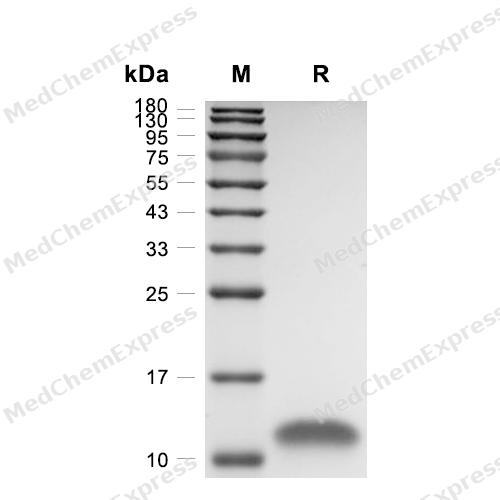
Purity - SDS-PAGE
-
Bioactivity - Cell-Based Assay
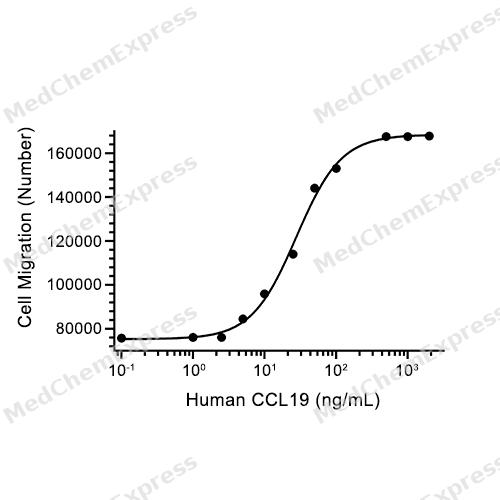
Bioactivity - Cell-Based Assay


Publications (1)
-
Journal Impact Factor
-
Most Recent
-
Immunity
2026 Feb 18:S1074-7613(26)00050-6. PMID: 41713421


Technical Parameters
-
Species Human
-
Source E. coli
-
Tag Tag Free
-
Accession
Q99731 (G22-S98)
-
Gene ID6363
-
Molecular Construction
-
N-term
-
CCL19 (G22-S98)
Accession # Q99731 -
C-term
-
-
Protein Length
Full Length of Mature Protein
-
Synonyms
CCL19; Small-Inducible Cytokine A19; Prev. SCYA19; CC Chemokine Ligand 19; ELC; C-C Motif Chemokine 19; CK Beta-11; EBI1-Ligand Chemokine; Exodus-3; MIP-3-Beta; MIP-3b; MIP3B; CKb11; Macrophage Inflammatory Protein 3 Beta; Small Inducible Cytokine Subfami
-
AA Sequence
GTNDAEDCCLSVTQKPIPGYIVRNFHYLLIKDGCRVPAVVFTTLRGRQLCAPPDQPWVERIIQRLQRTSAKMKRRSS
-
Predicted Molecular Mass
8.8 kDa
-
Molecular Weight
Approximately 11 kDa, based on SDS-PAGE under reducing conditions.
-
Purity
≥ 95%, as determined by reducing SDS-PAGE.


Product Properties
Lyophilized powder
Lyophilized from a 0.22 μm filtered solution of PBS, pH 7.4, 8% trehalose.
<1 EU/μg, determined by LAL method.
It is not recommended to reconstitute to a concentration less than 100 μg/mL in ddH2O.
Stored at -20°C for 2 years from date of receipt. After reconstitution, it is stable at 4°C for 1 week or -20°C for longer (with carrier protein). It is recommended to freeze aliquots at -20°C or -80°C for extended storage.
Room temperature in continental US; may vary elsewhere.


Documentation
-
Data Sheet (236 KB)
-
SDS (252 KB)
- English - EN (252 KB)
- Français - FR (252 KB)
- Deutsch - DE (252 KB)
- Norwegian - NO (252 KB)
- Español - ES (252 KB)
- Swedish - SV (252 KB)
- Italian - IT (252 KB)
- Korean - KR (252 KB)
- Portuguese - PT (252 KB)
-
Handling Instructions (2659 KB)

Calculators
Concentration (start) × Volume (start) = Concentration (final) × Volume (final)


 Powered by Bioz

