



Amebic Infection
-
Amebic Infection (12)

- 1

- Formula: C4H4ClNO2
- Molecular Weight: 133.53
N-Chlorosuccinimide (Succinchlorimide) is an oxidizing, hydrolyzable biochemical reagent with bactericidal and amoebicidal activities. N-Chlorosuccinimide can either form N-chloramines via concerted transfer of Cl+ or hydrolyze in aqueous solution to produce hypochlorous acid/hypochlorite. N-Chlorosuccinimide is effective in killing Shigella dysenteriae, Escherichia typhi and cysts of Entamoeba histolytica. N-Chlorosuccinimide can be formulated into fast-dispersing, fully soluble water purification tablets. N-Chlorosuccinimide is used in studies related to bacterial infections and parasitic infections.

- Formula: C20H28Br2N4S2
- Molecular Weight: 548.40
MS-L6 is a OXPHOS inhibitor and antimalarial agent. MS-L6 inhibits NADH oxidation and electron transport. MS-L6 induces OXPHOS uncoupling, dissipates mitochondrial membrane potential, increases non-ATP-coupled oxygen consumption, and reduces ATP synthesis. MS-L6 triggers the production of ROS. MS-L6 exhibits anti-amoebic activity. MS-L6 exerts antitumor activity in mouse lymphoma xenograft models. MS-L6 can be used in research related to B-cell lymphoma, T-cell lymphoma, and non-Hodgkin B-cell lymphoma.

- Formula: C66H103N17O16S
- Molecular Weight: 1422.69
Bacitracin A is an antibiotic with antibacterial activity against Gram-positive bacteria. Bacitracin A forms a ternary complex with divalent metal ions and C55-isopentenyl pyrophosphate, thereby inhibiting peptidoglycan biosynthesis and cell wall synthesis. Bacitracin A induces the formation of protoplasts and L-form bacteria, alters membrane permeability, regulates metal ion transport, inhibits in vitro enzyme biosynthesis, disrupts the cytoplasmic membrane and exerts bactericidal activity. Bacitracin A can be used in studies related to bacterial infections, fungal infections and amoebic infections.
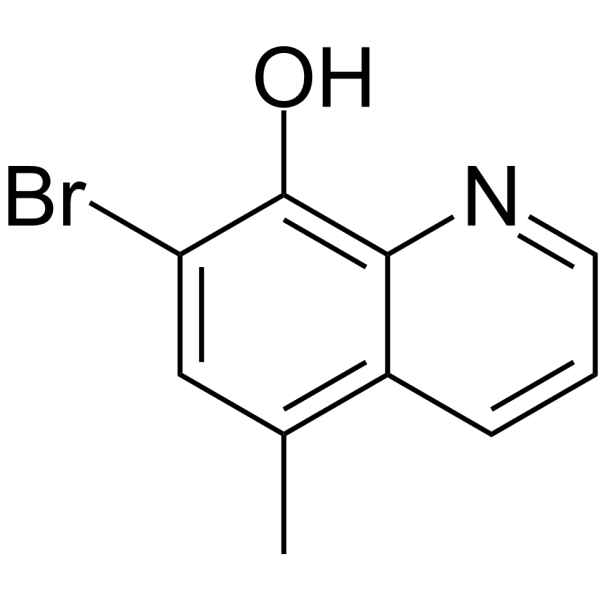
- Formula: C10H8BrNO
- Molecular Weight: 238.08
Tilbroquinol is an orally active halogenated hydroxyquinoline antiprotozoal agent, mainly used for anti-amoebic infections. Tilbroquinol targets intestinal protozoa and Entamoeba histolytica to eliminate parasites in the intestinal lumen. Tilbroquinol can be used in research related to intestinal infections, intestinal amoebiasis and hepatic amoebiasis.

- Formula: C17H24O6
- Molecular Weight: 324.37

- Formula: C24H28O7
- Molecular Weight: 428.47
NS-181 is an orally active MetAP2 inhibitor and antiamebic agent with oral effectiveness.NS-181 functionally inhibits methionine aminopeptidase 2, a protein critical for Entamoeba histolytica proliferation. NS-181 exerts antiamebic activity against Entamoeba histolytica, leading to resolution of amebic liver abscess. NS-181 can be used for the research of amebiasis.

- Formula: C11H14AsNO3S2
- Molecular Weight: 347.29
Arsthinenol (Arsthinol; Balarsen) is an orally active small organic arsenic molecule. Arsthinenol exhibits anti-amoebic activity by eliminating cysts and trophozoites of Entamoeba histolytica in feces and promoting the healing of amoebic rectal ulcers. Arsthinenol forms the hydroxypropyl-β-cyclodextrin inclusion complex STB-HPβCD, which has an IC50 of 31.6 μM against U87 MG cells and possesses anti-tumor activity. Arsthinenol can be used in the research of intestinal amoebiasis and glioblastoma.

- Formula: C11H8O4
- Molecular Weight: 204.18
7-Acetoxycoumarin (Acetylumbelliferone) is an anti-inflammatory inhibitor with antibacterial and amoebicidal activities. 7-Acetoxycoumarin reduces the phosphorylation levels of ERK, JNK, NF-κB and p38 MAPK. 7-Acetoxycoumarin downregulates the protein and mRNA expression levels of iNOS and COX-2. 7-Acetoxycoumarin inhibits the production of IL-1β, IL-6, TNF-α, NO and PG2. 7-Acetoxycoumarin reduces the degradation of IκBα. 7-Acetoxycoumarin can be used in studies related to amoebiasis and Bacillus lentus infection.


- Formula: C18H14F3N3O2
- Molecular Weight: 361.32
FFK29 is a synthetic class II histone deacetylase inhibitor (HDACi). FFK29 can potently inhibit the growth and encystation of Acanthamoeba. FFK29 can be studied in research on protozoan and parasitic diseases.

- Formula: C4H4ClNO2
- Molecular Weight: 133.53
N-Chlorosuccinimide (Standard) (Succinchlorimide (Standard)) is the analytical standard of N-Chlorosuccinimide (HY-Y0532). This product is intended for research and analytical applications. N-Chlorosuccinimide (Succinchlorimide) is an oxidizing, hydrolyzable biochemical reagent with bactericidal and amoebicidal activities. N-Chlorosuccinimide can either form N-chloramines via concerted transfer of Cl+ or hydrolyze in aqueous solution to produce hypochlorous acid/hypochlorite. N-Chlorosuccinimide is effective in killing Shigella dysenteriae, Escherichia typhi and cysts of Entamoeba histolytica. N-Chlorosuccinimide can be formulated into fast-dispersing, fully soluble water purification tablets. N-Chlorosuccinimide is used in studies related to bacterial infections and parasitic infections.

- Formula: C23H45N5O14
- Molecular Weight: 615.63
Paromomycin (Aminosidine) is an orally active broad-spectrum aminoglycoside aminocyclitol. Paromomycin is produced by Streptomyces riomosus var. Paromomycinus. Paromomycin binding induces local conformational changes in the 16S rRNA A-site. Paromomycin exhibits inhibitory activity against C. parvum. Paromomycin can be used in research related to leishmaniasis, amoebiasis and cryptosporidiosis.
- 1



