



COG 133 TFA
Based on 2 publication(s) in Google Scholar
COG 133 TFA is a fragment of Apolipoprotein E (APOE) peptide. COG 133 TFA competes with the ApoE holoprotein for binding the LDL receptor, with potent anti-inflammatory and neuroprotective effects. COG 133 TFA is also a nAChR antagonist with an IC50 of 445 nM.
For research use only. We do not sell to patients.
- Purity : 99.89%
- CAS No.: 2828432-37-5
- Formula: C99H182F3N37O21.xC2HF3O2
- Molecular Weight:2283.78 (free base)
-
Storage:
Sealed storage, away from moisture.
Powder -80°C, 2 years , -20°C, 1 year* In solvent : -80°C, 6 months; -20°C, 1 month (sealed storage, away from moisture)

To place orders, for customer services and technical support, please contact: MedChemExpress USA
Tel: 609-228-6898 E-mail: [email protected] [email protected]


-
 Biological Activity
-
Chemical Information
-
Solvent & Solubility
- Protocols
- Purity & Documentation
- References
-
 Help & FAQs



Publications Citing Use of MedChemExpress (MCE) COG 133 TFA
More

Biological Activity
Description
IC50 & Target
IC50: 445 nM (nAChR)[2]
In Vivo
MedChemExpress (MCE) has not independently confirmed the accuracy of these methods. They are for reference only.
-
Animal Model:Male C57BL/6 mice (6-week-old) instilled with Bleomycin[3]
-
Dosage:1 mg/kg
-
Administration:Intratracheal administration; every other day; for 4 weeks
-
Result:Did blunt the resolution of lung fibrosis.


Chemical Information
-
CAS No. 2828432-37-5
-
Appearance Solid
-
Molecular Weight 2283.78 (free base)
-
Formula C99H182F3N37O21.xC2HF3O2
-
Color White to off-white
-
Sequence
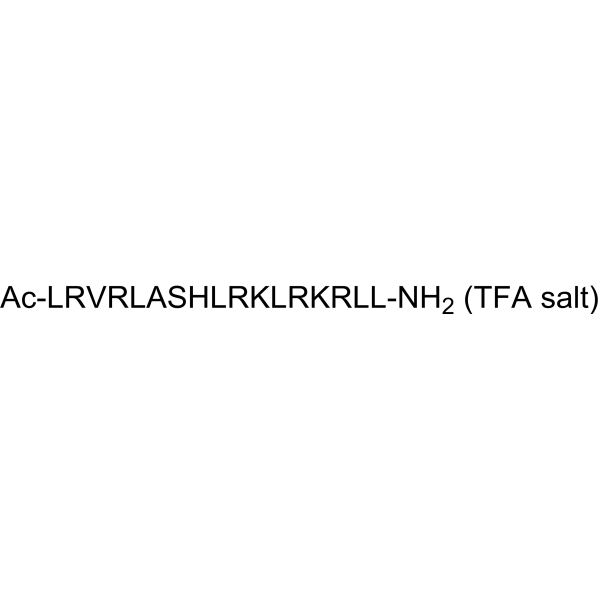
Ac-Leu-Arg-Val-Arg-Leu-Ala-Ser-His-Leu-Arg-Lys-Leu-Arg-Lys-Arg-Leu-Leu-NH2
-
Sequence Shortening
Ac-LRVRLASHLRKLRKRLL-NH2
-
Shipping
Room temperature in continental US; may vary elsewhere.
-
Storage
Sealed storage, away from moisture
Powder -80°C 2 years -20°C 1 year * In solvent : -80°C, 6 months; -20°C, 1 month (sealed storage, away from moisture)


Publications (2)
-
Journal Impact Factor
-
Most Recent
-
Protein Cell
2024 Jul 20;15(8):594-611. PMID: 38366188 -
Adv Sci (Weinh)
Insufficient Mechanical Loading Downregulates Piezo1 in Chondrocytes and Impairs Fracture Healing Through ApoE-Induced Senescence. [Abstract]2024 Dec;11(46):e2400502. PMID: 39418070


Solvent & Solubility
In Vitro:
H2O : 25 mg/mL (Need ultrasonic)
In Vivo:
For the following dissolution methods, please prepare the working solution directly:
It is recommended to prepare fresh solutions and use them promptly within a short period of time.
The percentages shown for the solvents indicate their volumetric ratio in the final prepared solution. If precipitation or phase separation occurs during preparation, heat and/or sonication can be used to aid dissolution.
Add each solvent one by one: PBS
Solubility: 100 mg/mL; Clear solution; Need ultrasonic

Protocols
-
Cell Cytotoxicity Assay
Cytotoxicity assays are usually based on the assessment of cell membrane damage, which can also be indirectly detected by measuring cell viability. Detection methods include MTT assay, CKK-8 assay, LDH assay and ATP assay, etc.
-
Research Protocol for Inflammation-related Diseases
The NLRP3 inflammasome is a cytosolic innate immune signaling platform that integrates priming signals and danger-signal activation to promote caspase-1 activation, maturation of IL-1β and IL-18, and gasdermin D-mediated pyroptotic cell death. The core experimental logic is to determine whether inflammatory disease phenotypes are driven by increased NLRP3 expression, ASC-containing inflammasome assembly, caspase-1 cleavage, GSDMD cleavage, and extracellular release of IL-1β/IL-18 rather than by nonspecific cell injury alone. The pathway is strongly linked to inflammation-related disease phenotypes because monosodium urate crystals activate NALP3/NLRP3 inflammasome signaling in gout-like crystal inflammation, cholesterol crystals activate NLRP3 inflammasomes in atherogenesis models, and DSS-induced intestinal inflammation has been reported to involve NLRP3 inflammasome activity. However, experimental colitis studies also show context-dependent protective effects of NLRP3 inflammasome co


Purity & Documentation
-
Data Sheet (275 KB)
-
SDS (396 KB)
- English - EN (396 KB)
- Français - FR (396 KB)
- Deutsch - DE (396 KB)
- Norwegian - NO (396 KB)
- Español - ES (396 KB)
- Swedish - SV (396 KB)
- Italian - IT (396 KB)
- Korean - KR (396 KB)
- Portuguese - PT (396 KB)
-
Handling Instructions (2659 KB)
References
[1]. Orleâncio Gomes R Azevedo, et al. Apolipoprotein E COG 133 mimetic peptide improves 5-fluorouracil-induced intestinal mucositis. BMC Gastroenterol. 2012 Jul 13;12:35. [Content Brief]
[2]. Elaine A Gay, et al. Apolipoprotein E-derived peptides block alpha7 neuronal nicotinic acetylcholine receptors expressed in xenopus oocytes. J Pharmacol Exp Ther. 2006 Feb;316(2):835-42. [Content Brief]
[3]. Huachun Cui, et al. Monocyte-derived alveolar macrophage apolipoprotein E participates in pulmonary fibrosis resolution. JCI Insight. 2020 Mar 12;5(5):e134539. [Content Brief]

Calculators
Concentration (start) × Volume (start) = Concentration (final) × Volume (final)


COG 133 TFA Related Classifications
HY-P1050A Related Classifications
 Powered by Bioz