



E6446 dihydrochloride (Standard)
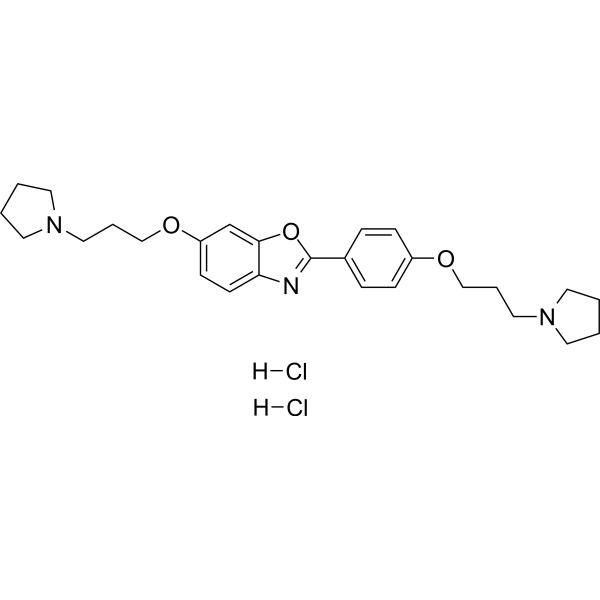
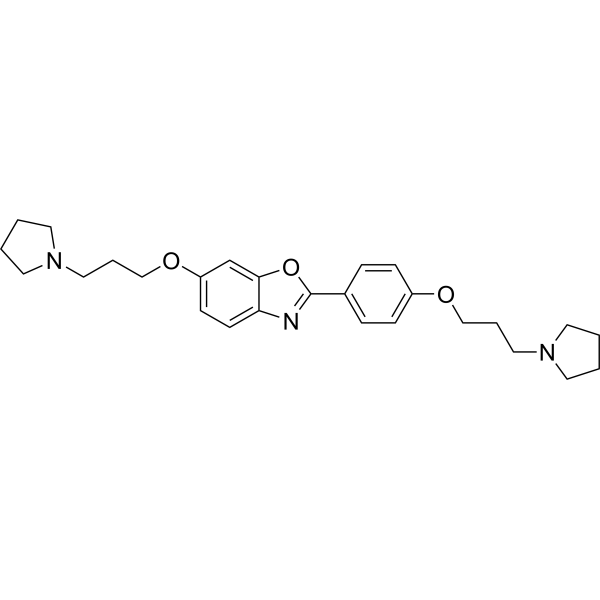
E6446 (dihydrochloride) (Standard) is the analytical standard of E6446 (dihydrochloride). This product is intended for research and analytical applications. E6446 dihydrochloride is a potent and orally acitve TLR7 and TLR9 antagonist, used in the research of deleterious inflammatory responses. E6446 dihydrochloride is also a potent SCD1 inhibitor (KD: 4.61 μM), significantly inhibiting adipogenic differentiation and hepatic lipogenesis through SCD1-ATF3 signaling. E6446 dihydrochloride also improves liver pathology in high-fat diet (HFD)-fed mice and may be useful in the study of non-alcoholic fatty liver disease (NAFLD).
For research use only. We do not sell to patients.
- Purity : 98%
- CAS No.: 1345675-25-3
- Formula: C27H37Cl2N3O3
- Molecular Weight:522.51
-
Storage:
Please store the product under the recommended conditions in the Certificate of Analysis.


To place orders, for customer services and technical support, please contact: MedChemExpress USA
Tel: 609-228-6898 E-mail: [email protected] [email protected]


-
 Product Information
-
Chemical Information
- Purity & Documentation
-
 Help & FAQs




Product Information
Information
Application
The compound is the grade of analytical standard, which is the reference standard supplied assay. It is commonly used in qualitative, quantitative and methodological research experiments in HPLC, GC and MS.


Chemical Information
-
CAS No. 1345675-25-3
-
Molecular Weight 522.51
-
Formula C27H37Cl2N3O3
-
SMILES
[H]Cl.[H]Cl.C1(C2=CC=C(OCCCN3CCCC3)C=C2)=NC4=CC=C(OCCCN5CCCC5)C=C4O1
-
Shipping
Room temperature in continental US; may vary elsewhere.
-
Storage
Please store the product under the recommended conditions in the Certificate of Analysis.


Purity & Documentation
References
[1]. Lamphier M, et al. Novel small molecule inhibitors of TLR7 and TLR9: mechanism of action and efficacy in vivo. Mol Pharmacol. 2014 Mar;85(3):429-40. [Content Brief]
[2]. Franklin BS, et al. Therapeutical targeting of nucleic acid-sensing Toll-like receptors prevents experimental cerebral malaria. Proc Natl Acad Sci U S A. 2011 Mar 1;108(9):3689-94. [Content Brief]
[3]. Wang W, et al. Identification of novel SCD1 inhibitor alleviates nonalcoholic fatty liver disease: critical role of liver-adipose axis. Cell Commun Signal. 2023 Sep 30;21(1):268. [Content Brief]

Calculators
Concentration (start) × Volume (start) = Concentration (final) × Volume (final)


E6446 dihydrochloride (Standard) Related Classifications
HY-12756AR Related Classifications
 Powered by Bioz