



TRV-7019

Based on 1 Customer Validation
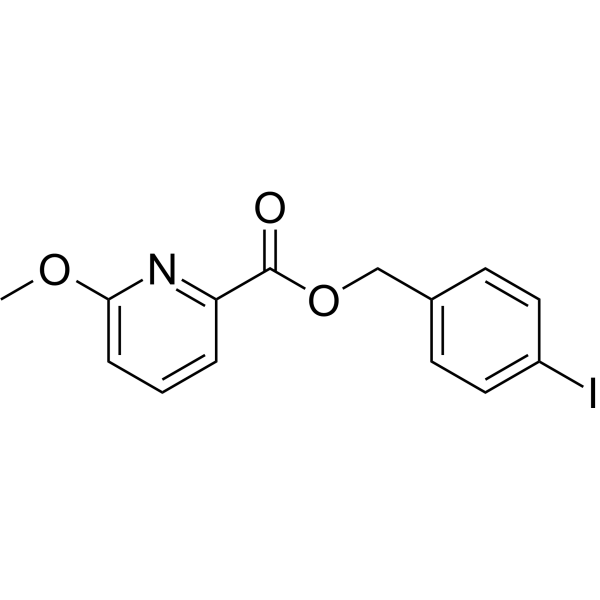
TRV-7019 is a BBB-penetrable radioligand for brain imaging that target butyrylcholinesterase. TRV-7019 can be used for the diagnosis of an amyloid disease, multiple sclerosis, a brain tumor, or butyrylcholinesterase activity.
For research use only. We do not sell to patients.
- Purity : 98.00%
- CAS No.: 2598164-15-7
- Formula: C14H12INO3
- Molecular Weight:369.15
-
Storage:Powder -20°C, 3 years , 4°C, 2 years ; In solvent -80°C, 6 months , -20°C, 1 month

To place orders, for customer services and technical support, please contact: MedChemExpress USA
Tel: 609-228-6898 E-mail: [email protected] [email protected]


-
 Biological Activity
-
Chemical Information
-
Solvent & Solubility
- Protocols
- Purity & Documentation
- References
-
 Help & FAQs




Biological Activity
Description
IC50 & Target
[1]|
BChE |


Chemical Information
-
CAS No. 2598164-15-7
-
Appearance Solid
-
Molecular Weight 369.15
-
Formula C14H12INO3
-
Color White to off-white
-
SMILES
O=C(C1=NC(OC)=CC=C1)OCC2=CC=C(I)C=C2
-
Shipping
Room temperature in continental US; may vary elsewhere.
-
Storage
Powder -20°C 3 years 4°C 2 years In solvent -80°C 6 months -20°C 1 month


Solvent & Solubility
In Vitro:
DMSO : 100 mg/mL (270.89 mM; Need ultrasonic; Hygroscopic DMSO has a significant impact on the solubility of product, please use newly opened DMSO)
Please refer to the solubility information to select the appropriate solvent. Once prepared, please aliquot and store the solution to prevent product inactivation from repeated freeze-thaw cycles.
Storage method and period of stock solution: -80°C, 6 months; -20°C, 1 month. When stored at -80°C, please use it within 6 months. When stored at -20°C, please use it within 1 month.
Please refer to the solubility information to select the appropriate solvent. Once prepared, please aliquot and store the solution to prevent product inactivation from repeated freeze-thaw cycles.
Storage method and period of stock solution: -80°C, 6 months; -20°C, 1 month. When stored at -80°C, please use it within 6 months. When stored at -20°C, please use it within 1 month.
Concentration (start) × Volume (start) = Concentration (final) × Volume (final)

Protocols
-
Glioma/Brain Tumor 3D Invasion Assay
The glioma/brain tumor 3D invasion assay measures outward migration and matrix invasion from multicellular tumor spheroids into a 3D extracellular matrix or organotypic brain slice. The readout is generated by time-lapse brightfield, fluorescence, confocal, or high-content imaging and quantified as invasion distance, invasion area, migration index, single-cell velocity, directionality, cumulative sprout length, or Z-direction invasion into brain tissue. Classic in vitro versions embed glioma or GBM spheroids in collagen I, Matrigel, collagen I/Matrigel, or collagen I/Matrigel/hyaluronic acid matrices, while ex vivo versions implant fluorescent GBM spheroids onto organotypic brain slices to model invasion in a preserved brain microenvironment.
-
Amyloid: Congo Red Amyloid Staining
Congo red amyloid staining is a histochemical method used to detect extracellular amyloid deposits in tissue sections based on the affinity of Congo red dye for β-pleated sheet-rich protein aggregates. When bound to amyloid, Congo red produces characteristic apple-green birefringence under polarized light microscopy, which is widely regarded as a diagnostic feature of amyloid deposition in histopathology. The diagnostic principle relies on the combination of dye binding (congophilia) and optical anisotropy under polarized illumination, which distinguishes amyloid from most non-amyloid eosinophilic extracellular deposits in routine histological evaluation. Amyloid identification by Congo red staining remains a cornerstone in diagnostic pathology despite the availability of adjunct methods such as immunohistochemistry and mass spectrometry, particularly because of its ability to localize deposits directly within tissue architecture. The specificity of Congo red-positive deposits is incre


Purity & Documentation
-
Data Sheet (268 KB)
-
SDS (252 KB)
- English - EN (252 KB)
- Français - FR (252 KB)
- Deutsch - DE (252 KB)
- Norwegian - NO (252 KB)
- Español - ES (252 KB)
- Swedish - SV (252 KB)
- Italian - IT (252 KB)
- Korean - KR (252 KB)
- Portuguese - PT (252 KB)
-
Handling Instructions (2659 KB)
References


Complete Stock Solution Preparation Table
Please refer to the solubility information to select the appropriate solvent. Once prepared, please aliquot and store the solution to prevent product inactivation from repeated freeze-thaw cycles.
Storage method and period of stock solution: -80°C, 6 months; -20°C, 1 month. When stored at -80°C, please use it within 6 months. When stored at -20°C, please use it within 1 month.
| Optional Solvent | Concentration Solvent Mass | 1 mg | 5 mg | 10 mg | 25 mg |
|---|---|---|---|---|---|
| DMSO | 1 mM | 2.7089 mL | 13.5446 mL | 27.0893 mL | 67.7231 mL |
| 5 mM | 0.5418 mL | 2.7089 mL | 5.4179 mL | 13.5446 mL | |
| 10 mM | 0.2709 mL | 1.3545 mL | 2.7089 mL | 6.7723 mL | |
| 15 mM | 0.1806 mL | 0.9030 mL | 1.8060 mL | 4.5149 mL | |
| 20 mM | 0.1354 mL | 0.6772 mL | 1.3545 mL | 3.3862 mL | |
| 25 mM | 0.1084 mL | 0.5418 mL | 1.0836 mL | 2.7089 mL | |
| 30 mM | 0.0903 mL | 0.4515 mL | 0.9030 mL | 2.2574 mL | |
| 40 mM | 0.0677 mL | 0.3386 mL | 0.6772 mL | 1.6931 mL | |
| 50 mM | 0.0542 mL | 0.2709 mL | 0.5418 mL | 1.3545 mL | |
| 60 mM | 0.0451 mL | 0.2257 mL | 0.4515 mL | 1.1287 mL | |
| 80 mM | 0.0339 mL | 0.1693 mL | 0.3386 mL | 0.8465 mL | |
| 100 mM | 0.0271 mL | 0.1354 mL | 0.2709 mL | 0.6772 mL |


TRV-7019 Related Classifications
HY-153432 Related Classifications
 Powered by Bioz