



Indoramin

Based on 1 Customer Validation
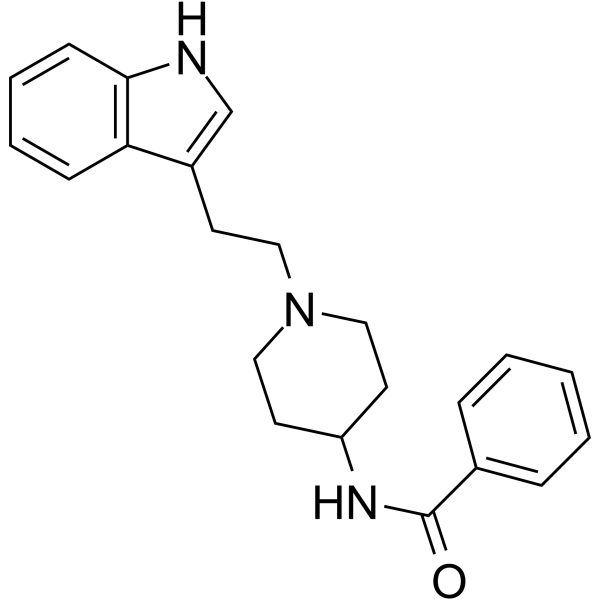
Indoramin (Wy 21901) is a competitive and selective α1-adrenoceptor antagonist. Indoramin reduces peripheral vascular resistance, blood pressure, heart rate and myocardial contractility in experimental animals. Under hypoxic conditions, Indoramin increases ATP synthesis in brain tissue, maintains cerebral ATP levels, and alleviates hypoxia-related swelling of synaptosomes, cerebral microvessels and the whole brain. Indoramin can be used in studies related to hypertension, cardiovascular regulation and cerebral hypoxia.
Para uso exclusivo en investigación. No vendemos a pacientes.
- Pureza : 99.03%
- No. CAS: 26844-12-2
- Fòrmula: C22H25N3O
- Peso molecular:347.45
-
Almacenamiento:Powder -20°C, 3 years , 4°C, 2 years ; In solvent -80°C, 6 months , -20°C, 1 month

To place orders, for customer services and technical support, please contact: MedChemExpress USA
Tel: 609-228-6898 E-mail: [email protected] [email protected]


-
 Actividad biológica
-
Chemical Information
- Protocolo
- Pureza y Documentación
- Referencias
-
 Help & FAQs


Ver todos los productos específicos de isoformas Adrenergic Receptor
More

Actividad biológica
Descripciòn
IC50 & Target
[4]|
α adrenergic receptor |
In Vitro
Indoramin hydrochloride (10−8-3 × 10⁻⁷ M; 20 min; rat vas deferens) competitively antagonizes norepinephrine-induced contractions mediated by α1A-adrenergic receptors, with a pA2 value of 8.52[4].
Indoramin hydrochloride exerts an anti-vasoconstrictive effect in the experiment of norepinephrine-induced renal vasoconstriction in isolated perfused rat kidneys, with a −log ED50 (mol) of 9.97 for half-maximal effect[4].
Indoramin hydrochloride competitively antagonizes norepinephrine-induced contraction mediated by α1B-adrenergic receptors in guinea pig and mouse spleens, with pA2 values of 6.83 and 6.69, respectively; the pA2 value for α1A-adrenergic receptors in rat vas deferens is 8.52[4].
Under hypoxic conditions, indoramin mesylate (0.1 mM; rat cerebral cortical slices) increases the ATP synthesis rate from 58 to 92 μmol ATP/g cortex/h, without significantly altering the ATP utilization rate; accordingly, the ATP synthesis/utilisation ratio increases from 0.44 in hypoxic controls to 0.71[2].
Indoramin mesylate (0.1 mM) attenuates hypoxia-induced swelling of rat brain synaptosomes, reducing the swelling index from 153 to 122; it also partially inhibits the increase in intracellular water content in brain microvascular cells, decreasing the intracellular water volume from 5.1 to 4.0 μL H2O/mg protein[2].
MedChemExpress (MCE) has not independently confirmed the accuracy of these methods. They are for reference only. Further protocols information, click here.
In Vivo
Indoramin hydrochloride (0.1-1.6 mg/kg; i.v.; anaesthetized cats) dose-dependently reduces hindquarter perfusion pressure and increases blood flow, and inhibits vasoconstriction induced by lumbar sympathetic nerve stimulation and norepinephrine; at 1.6 mg/kg, it abolishes the contractile responses induced by norepinephrine and low-frequency sympathetic stimulation[1].
Indoramin hydrochloride (0.1-4.0 mg/kg; i.a.; anaesthetized Red Patas monkeys) dose-dependently reduces hindlimb perfusion pressure and peripheral vascular resistance; a dose of 0.1 mg/kg inhibits norepinephrine- and epinephrine-induced vasoconstriction, without significantly affecting vascular responses induced by serotonin, angiotensin, acetylcholine or isoproterenol[1].
Indoramin mesylate (0.3-3 mg/kg; p.o.; 2 h before hypoxia) dose-dependently maintains the cerebral cortical ATP levels in hypoxic rats; after 5 min of hypoxia, the ATP level of the vehicle group is 1.6 ± 0.02 μmol/g cortex, while those of the 0.3, 1 and 3 mg/kg indoramin groups are 1.8 ± 0.03, 2.3 ± 0.02 and 2.4 ± 0.03 μmol/g cortex, respectively, with an ED50 of 0.45 mg/kg[2].
MedChemExpress (MCE) has not independently confirmed the accuracy of these methods. They are for reference only.


Chemical Information
-
No. CAS 26844-12-2
-
Appearance Solid
-
Peso molecular 347.45
-
Fòrmula C22H25N3O
-
Color Off-white to light yellow
-
SMILES
O=C(NC1CCN(CCC2=CNC3=C2C=CC=C3)CC1)C4=CC=CC=C4
-
Synonyms
Indoramine; Wy 21901
-
Envío
Room temperature in continental US; may vary elsewhere.
-
Almacenamiento
Powder -20°C 3 years 4°C 2 years In solvent -80°C 6 months -20°C 1 month

Protocolo
-
Research Protocol for Cardiovascular Diseases
Cardiovascular disease can be modeled as maladaptive cardiac remodeling, where ischemic injury or pressure overload activates inflammatory signaling, fibroblast activation, extracellular-matrix deposition, cardiomyocyte hypertrophy, vascular remodeling, and progressive ventricular dysfunction. The TGF-β/SMAD axis is a central profibrotic pathway after myocardial injury and pressure overload, while innate immune and cytokine pathways regulate leukocyte recruitment, scar formation, and adverse remodeling. Key unresolved questions include which inflammatory signals are reparative versus harmful, when fibrosis is protective versus maladaptive, and whether pathway inhibition improves function without weakening necessary infarct healing or compensatory remodeling.


Pureza y Documentación
-
Ficha de datos (291 KB)
-
SDS (393 KB)
- English - EN (393 KB)
- Français - FR (393 KB)
- Deutsch - DE (393 KB)
- Norwegian - NO (393 KB)
- Español - ES (393 KB)
- Swedish - SV (393 KB)
- Italian - IT (393 KB)
- Korean - KR (393 KB)
- Portuguese - PT (393 KB)
-
Instrucciones de manejo (2659 KB)
Referencias

Calculators
Concentration (start) × Volume (start) = Concentration (final) × Volume (final)


Indoramin Related Classifications
HY-12760 Related Classifications
 Powered by Bioz