



EN1033

Based on 1 Customer Validation
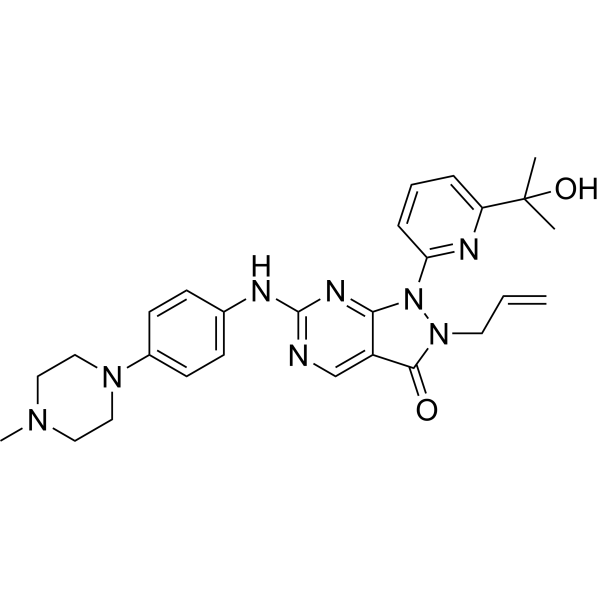
EN1033 is a covalent immune regulatory transcription factor 5/8 (IRF5/8) molecular glue degrader. EN1033 degrades IRF5 in a proteasome-dependent manner. EN1033 engages and degrades IRF8 more robustly and rapidly. EN1033 covalently targets C28 and C223 to destabilize and degrade IRF5 and IRF8 respectively, thereby inhibiting their pro-inflammatory transcriptional activity. EN1033 serves as a promising tool for the study of autoimmune and inflammatory disorders.
For research use only. We do not sell to patients.
- Purity : 99.96%
- CAS No.: 2193367-28-9
- Formula: C15H18N2O
- Molecular Weight:242.32
-
Storage:
-20°C, protect from light
* In solvent : -80°C, 6 months; -20°C, 1 month (protect from light)


To place orders, for customer services and technical support, please contact: MedChemExpress USA
Tel: 609-228-6898 E-mail: [email protected] [email protected]


-
 Biological Activity
-
Chemical Information
-
Solvent & Solubility
- Protocols
- Purity & Documentation
- References
-
 Help & FAQs




Biological Activity
Description
In Vitro
EN1033 (6.25-100 μM) does not exhibit cytotoxicity in THP1 macrophage leukemia cancer cells, nor does it induce stress granules formation[1].
EN1033 (1-µM, 24 h) induces on-pathway inhibition of IRF5 transcriptional activity[1].
EN1033 (100 μM, 18 h) degrades IRF8 in THP1 cells, which is proteasome-dependent[1].
EN1033 (12.5-100 μM, 2-24 h) degrades both IRF8 and IRF5, in a dose-responsive and time-dependent manner[1].
EN1033 (100 μM, 6 h) engages IRF8 more robustly than IRF5, while EN1033 and its analog TH3-189 exert only moderate effects across the proteome[1].
EN1033 (50 μM, 18-24 h) causes the degradation of IRF5 and IRF8 by targeting C28 and C223, respectively[1].
EN1033 (12.5-100 μM, 24 h) degrades IRF8 in IRF5 Knockout cells, suggesting IRF5 does not regulate IRF8. In contrast, IRF8 knockdown markedly reduces IRF5 levels, indicating IRF8 regulates IRF5 in THP1 cells[1].
MedChemExpress (MCE) has not independently confirmed the accuracy of these methods. They are for reference only. Further protocols information, click here.
-
Cell Line:THP1 cells
-
Concentration:12.5, 25, 50, 75, 100 μM
-
Incubation Time:24 h
-
Result:Decreased the levels of IRF8 and IRF5 gradually as the concentration increased.
Triggered the most prominent degradation of IRF8 and IRF5 at a concentration of 100 μM.
-
Cell Line:THP1 cells
-
Concentration:100 μM
-
Incubation Time:0, 2, 4, 8, 20, 24 h
-
Result:Induced the degradation of IRF8 and IRF5 starting at 8 h, and this effect was gradually strengthened over time.
-
Cell Line:HEK293T cells
-
Concentration:50 μM
-
Incubation Time:18, 24 h
-
Result:Induced IRF5 degradation, which was fully rescued in C28S and C28S/C121S variants, but not in the C121S mutant.
Triggered IRF8 loss, which was fully rescued in C223S and C223S/C385S IRF8 mutants, but not in the C385S mutant-expressing cells.


Chemical Information
-
CAS No. 2193367-28-9
-
Appearance Solid-Liquid Mixture
-
Molecular Weight 242.32
-
Formula C15H18N2O
-
Color Light yellow to yellow
-
SMILES
C=CC(N1C2=CC=CC=C2CN3C(CCC3)C1)=O
-
Shipping
Room temperature in continental US; may vary elsewhere.
-
Storage
-20°C, protect from light
* In solvent : -80°C, 6 months; -20°C, 1 month (protect from light)


Solvent & Solubility
In Vitro:
DMSO : 100 mg/mL (412.68 mM; Need ultrasonic; Hygroscopic DMSO has a significant impact on the solubility of product, please use newly opened DMSO)
Please refer to the solubility information to select the appropriate solvent. Once prepared, please aliquot and store the solution to prevent product inactivation from repeated freeze-thaw cycles.
Storage method and period of stock solution: -80°C, 6 months; -20°C, 1 month (protect from light). When stored at -80°C, please use it within 6 months. When stored at -20°C, please use it within 1 month.
Please refer to the solubility information to select the appropriate solvent. Once prepared, please aliquot and store the solution to prevent product inactivation from repeated freeze-thaw cycles.
Storage method and period of stock solution: -80°C, 6 months; -20°C, 1 month (protect from light). When stored at -80°C, please use it within 6 months. When stored at -20°C, please use it within 1 month.
Concentration (start) × Volume (start) = Concentration (final) × Volume (final)
In Vivo:
Select the appropriate dissolution method based on your experimental animal and administration route.
- For the following dissolution methods, please ensure to first prepare a clear stock solution using an In Vitro approach and then sequentially add co-solvents:
- To ensure reliable experimental results, the clarified stock solution can be appropriately stored based on storage conditions. As for the working solution for In Vivo experiments, it is recommended to prepare freshly and use it on the same day.
- The percentages shown for the solvents indicate their volumetric ratio in the final prepared solution. If precipitation or phase separation occurs during preparation, heat and/or sonication can be used to aid dissolution.
Add each solvent one by one: 10% DMSO 40% PEG300 5% Tween-80 45% Saline
Solubility: ≥ 2.5 mg/mL (10.32 mM); Clear solution
This protocol yields a clear solution of ≥ 2.5 mg/mL (saturation unknown).
Taking 1 mL working solution as an example, add 100 μL DMSO stock solution (25.0 mg/mL) to 400 μL PEG300, and mix evenly; then add 50 μL Tween-80 and mix evenly; then add 450 μL Saline to adjust the volume to 1 mL.
Preparation of Saline: Dissolve 0.9 g sodium chloride in ddH₂O and dilute to 100 mL to obtain a clear Saline solution.
Add each solvent one by one: 10% DMSO 90% (20% SBE-β-CD in Saline)
Solubility: ≥ 2.5 mg/mL (10.32 mM); Clear solution
This protocol yields a clear solution of ≥ 2.5 mg/mL (saturation unknown).
Taking 1 mL working solution as an example, add 100 μL DMSO stock solution (25.0 mg/mL) to 900 μL 20% SBE-β-CD in Saline, and mix evenly.
Preparation of 20% SBE-β-CD in Saline (4°C, storage for one week): 2 g SBE-β-CD powder is dissolved in 10 mL Saline, completely dissolve until clear.
In Vivo Dissolution Calculator
Please enter the basic information of animal experiments:
-
-
-
-
Recommended: Prepare an additional quantity of animals to account for potential losses during experiments.
Please enter your animal formula composition:
-
%DMSO +
Recommended: Keep the proportion of DMSO in working solution below 2% if your animal is weak.
-
%+
-
+%Tween-80 + +
-
%Saline +
The co-solvents required include: DMSO, . All of co-solvents are available by MedChemExpress (MCE). , Tween 80. All of co-solvents are available by MedChemExpress (MCE).
Working solution concentration: 0.22 mg/mL
Method for preparing stock solution: mg drug dissolved in μL DMSO. Stock solution concentration: mg/mL. * In solvent : -80°C, 6 months; -20°C, 1 month (protect from light)
1. Take μL DMSO stock solution;
2. Add μL .
μL , mix evenly;
3. Then add μL Tween 80, mix evenly;
4. Then add μL
Please ensure that the stock solution in the first step is dissolved to a clear state, and add co-solvents in sequence. You can use ultrasonic heating (ultrasonic cleaner, recommended frequency 20-40 kHz), vortexing, etc. to assist dissolution.

Protocols
-
Nuclear Protein Extraction (High-Salt/Hypotonic Fractionation)
The high-salt/hypotonic fractionation method for nuclear protein extraction is based on the differential solubility of cellular components. Cytoplasmic proteins are extracted first using a hypotonic buffer that causes cell swelling and membrane rupture, followed by centrifugation to separate the cytoplasmic supernatant from the nuclear pellet. The nuclear pellet is then subjected to high-salt extraction (e. g. , 0. 4 M (NH4)2SO4 or 1 M NaCl) to solubilize tightly bound nuclear matrix proteins, including transcription factors, histones, and structural proteins associated with chromatin and the nuclear scaffold. This approach allows for the isolation of both soluble cytoplasmic proteins and salt-resistant nuclear proteins while minimizing cross-contamination.
-
Dual Luciferin reporter gene assay
Luciferin reporter gene assay is a reporting system to detect the activity of Firefly Luciferase using luciferin as a substrate, which is often used in the research of miRNA target gene verification and promoter transcriptive activity regulation. Dual luciferase usually refers to Firefly luciferase and Renilla luciferase.
-
Research Protocol for Inflammation-related Diseases
The NLRP3 inflammasome is a cytosolic innate immune signaling platform that integrates priming signals and danger-signal activation to promote caspase-1 activation, maturation of IL-1β and IL-18, and gasdermin D-mediated pyroptotic cell death. The core experimental logic is to determine whether inflammatory disease phenotypes are driven by increased NLRP3 expression, ASC-containing inflammasome assembly, caspase-1 cleavage, GSDMD cleavage, and extracellular release of IL-1β/IL-18 rather than by nonspecific cell injury alone. The pathway is strongly linked to inflammation-related disease phenotypes because monosodium urate crystals activate NALP3/NLRP3 inflammasome signaling in gout-like crystal inflammation, cholesterol crystals activate NLRP3 inflammasomes in atherogenesis models, and DSS-induced intestinal inflammation has been reported to involve NLRP3 inflammasome activity. However, experimental colitis studies also show context-dependent protective effects of NLRP3 inflammasome co


Purity & Documentation
-
Data Sheet (278 KB)
-
SDS (252 KB)
- English - EN (252 KB)
- Français - FR (252 KB)
- Deutsch - DE (252 KB)
- Norwegian - NO (252 KB)
- Español - ES (252 KB)
- Swedish - SV (252 KB)
- Italian - IT (252 KB)
- Korean - KR (252 KB)
- Portuguese - PT (252 KB)
-
Handling Instructions (2659 KB)
References


Complete Stock Solution Preparation Table
Please refer to the solubility information to select the appropriate solvent. Once prepared, please aliquot and store the solution to prevent product inactivation from repeated freeze-thaw cycles.
Storage method and period of stock solution: -80°C, 6 months; -20°C, 1 month (protect from light). When stored at -80°C, please use it within 6 months. When stored at -20°C, please use it within 1 month.
| Optional Solvent | Concentration Solvent Mass | 1 mg | 5 mg | 10 mg | 25 mg |
|---|---|---|---|---|---|
| DMSO | 1 mM | 4.1268 mL | 20.6339 mL | 41.2677 mL | 103.1694 mL |
| 5 mM | 0.8254 mL | 4.1268 mL | 8.2535 mL | 20.6339 mL | |
| 10 mM | 0.4127 mL | 2.0634 mL | 4.1268 mL | 10.3169 mL | |
| 15 mM | 0.2751 mL | 1.3756 mL | 2.7512 mL | 6.8780 mL | |
| 20 mM | 0.2063 mL | 1.0317 mL | 2.0634 mL | 5.1585 mL | |
| 25 mM | 0.1651 mL | 0.8254 mL | 1.6507 mL | 4.1268 mL | |
| 30 mM | 0.1376 mL | 0.6878 mL | 1.3756 mL | 3.4390 mL | |
| 40 mM | 0.1032 mL | 0.5158 mL | 1.0317 mL | 2.5792 mL | |
| 50 mM | 0.0825 mL | 0.4127 mL | 0.8254 mL | 2.0634 mL | |
| 60 mM | 0.0688 mL | 0.3439 mL | 0.6878 mL | 1.7195 mL | |
| 80 mM | 0.0516 mL | 0.2579 mL | 0.5158 mL | 1.2896 mL | |
| 100 mM | 0.0413 mL | 0.2063 mL | 0.4127 mL | 1.0317 mL |


EN1033 Related Classifications
HY-175759 Related Classifications
 Powered by Bioz