



Levoleucovorin

Based on 1 Customer Validation
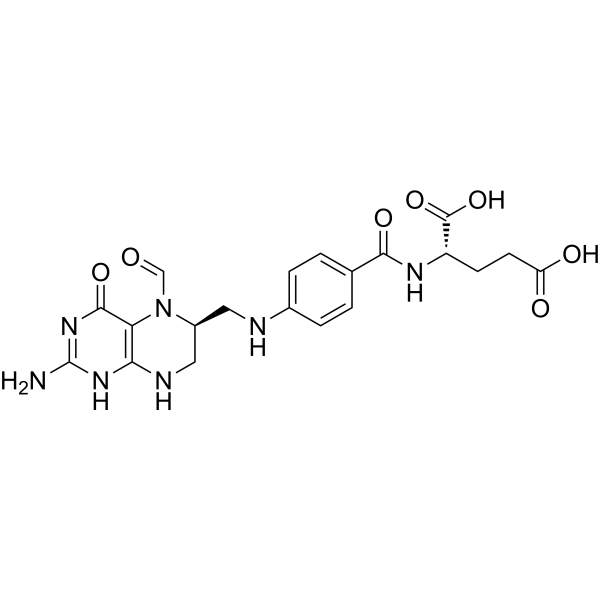
Levoleucovorin (Levofolinic acid; Levofolene) is the pharmacologically and orally active levoisomer of Folinic acid (HY-17556), a synthetic folate analogue. Levoleucovorin can inhibit LOXL2 with an IC50 of 68.81 μM. Levoleucovorin can inhibit cancer cells proliferation, migration and induce apoptosis. Levoleucovorin can be used as a rescue agent for high-dose Methotrexate (HY-14519). Levoleucovorin can reduce the frequency of embryonic malformations. Levoleucovorin can be used for the research of can and endocrinology, such as breast cancer and osteosarcoma.
For research use only. We do not sell to patients.
- Purity : 98.53%
- CAS No.: 68538-85-2
- Formula: C20H23N7O7
- Molecular Weight:473.44
-
Storage:Powder -20°C, 3 years , 4°C, 2 years ; In solvent -80°C, 6 months , -20°C, 1 month

To place orders, for customer services and technical support, please contact: MedChemExpress USA
Tel: 609-228-6898 E-mail: [email protected] [email protected]


-
 Biological Activity
-
Chemical Information
-
Solvent & Solubility
- Protocols
- Purity & Documentation
- References
-
 Help & FAQs




Biological Activity
Description
IC50 & Target
[1]|
LOXL2 68.81 nM (IC50) |
In Vitro
Levoleucovorin inhibits recombinant human LOXL2 protein with an IC50 of 68.81 μM[1].
Levoleucovorin (72 h) inhibits proliferation of MDA-MB 231 breast cancer cells with a GI50 of 55.91 μM and MCF-7 breast cancer cells with a GI50 of 79.20 μM[1].
Levoleucovorin (15-60 μM; 12 h) dose-dependently inhibits HGF-induced trans-endothelial migration of MDA-MB 231 and MCF-7 breast cancer cells across HUVEC cell layers[1].
Levoleucovorin (30-80 μM;72 h) induces dose-dependent apoptosis in MDA-MB 231 and MCF-7 breast cancer cells[1].
MedChemExpress (MCE) has not independently confirmed the accuracy of these methods. They are for reference only. Further protocols information, click here.
-
Cell Line:MDA-MB 231 breast cancer cell line, MCF-7 breast cancer cell line
-
Concentration:30 μM, 60 μM (MDA-MB 231); 40 μM, 80 μM (MCF-7)
-
Incubation Time:72 h
-
Result:Significantly increased Annexin V-positive early and late apoptotic populations in MDA-MB 231 cells in a dose-dependent manner, with total apoptosis increasing 17.93% at 30 μM and 33.11% at 60 μM.
Significantly increased Annexin V-positive early and late apoptotic populations in MCF-7 cells in a dose-dependent manner, with total apoptosis increasing 15.36% at 40 μM and 30.38% at 80 μM.
In Vivo
MedChemExpress (MCE) has not independently confirmed the accuracy of these methods. They are for reference only.
-
Animal Model:Folbp1 knockout (female; mated to Folbp1-/- males; prenatal developmental model)[3]
-
Dosage:10.75 μmol/kg per day; 21.5 μmol/kg per day; 43 μmol/kg per day
-
Administration:I.g.; daily; initiated 2 weeks pre-mating through gestation
-
Result:Reduced malformation frequency to 66.7% at 10.75 μmol/kg per day, 65.8% at 21.5 μmol/kg per day, and 33.3% at 43 μmol/kg per day.
Decreased neural tube defects to 35.2% (10.75 and 21.5 μmol/kg), 16.7% (43 μmol/kg).
Decreased craniofacial defects to 46.2% (10.75 and 21.5 μmol/kg), 19.4% (43 μmol/kg).
Demonstrated significant inverse dose-dependent relationship with all malformation categories.
Resulted in a mean litter size of 3.70 ± 2.63 at 43 μmol/kg per day, significantly lower than wild-type controls.


Chemical Information
-
CAS No. 68538-85-2
-
Appearance Solid
-
Molecular Weight 473.44
-
Formula C20H23N7O7
-
Color Off-white to light yellow
-
SMILES
O=CN1C2=C(NC(N)=NC2=O)NC[C@@H]1CNC3=CC=C(C=C3)C(N[C@H](C(O)=O)CCC(O)=O)=O
-
Synonyms
Levofolinic acid; Levofolene
-
Initial Source
-
Shipping
Room temperature in continental US; may vary elsewhere.
-
Storage
Powder -20°C 3 years 4°C 2 years In solvent -80°C 6 months -20°C 1 month


Solvent & Solubility
In Vitro:
DMSO : 35 mg/mL (73.93 mM; Need ultrasonic; Hygroscopic DMSO has a significant impact on the solubility of product, please use newly opened DMSO)
H2O : 33.33 mg/mL (70.40 mM; ultrasonic and adjust pH to 11 with 1 M NaOH)
Please refer to the solubility information to select the appropriate solvent. Once prepared, please aliquot and store the solution to prevent product inactivation from repeated freeze-thaw cycles.
Storage method and period of stock solution: -80°C, 6 months; -20°C, 1 month. When stored at -80°C, please use it within 6 months. When stored at -20°C, please use it within 1 month.
* Note: If you choose water as the stock solution, please dilute it to the working solution, then filter and sterilize it with a 0.22 μm filter before use.
Please refer to the solubility information to select the appropriate solvent. Once prepared, please aliquot and store the solution to prevent product inactivation from repeated freeze-thaw cycles.
Storage method and period of stock solution: -80°C, 6 months; -20°C, 1 month. When stored at -80°C, please use it within 6 months. When stored at -20°C, please use it within 1 month.
* Note: If you choose water as the stock solution, please dilute it to the working solution, then filter and sterilize it with a 0.22 μm filter before use.
Concentration (start) × Volume (start) = Concentration (final) × Volume (final)

Protocols
-
Apoptosis
Apoptosis, also called programmed cell death, is generally characterized by distinct morphological characteristics.
-
TUNEL staining for apoptotic DNA fragmentation
TUNEL staining detects DNA strand breaks by using terminal deoxynucleotidyl transferase to add labeled nucleotides to exposed 3′-OH DNA termini, generating either microscopic staining in fixed cells or tissue sections, or fluorescence/cytometric signal in cell suspensions. TUNEL positivity reflects DNA fragmentation but should not be interpreted alone as definitive apoptosis, because TUNEL can also label necrotic, autolytic, mechanically damaged, or DNA-repair-associated DNA breaks.
-
Cell Cytotoxicity Assay
Cytotoxicity assays are usually based on the assessment of cell membrane damage, which can also be indirectly detected by measuring cell viability. Detection methods include MTT assay, CKK-8 assay, LDH assay and ATP assay, etc.
-
Annexin V plus membrane-impermeant dye apoptosis staining
Annexin V-based apoptosis assays rely on the detection of phosphatidylserine (PS) externalization from the inner leaflet of the plasma membrane to the outer leaflet, an early biochemical hallmark of apoptosis. Fluorescently labeled Annexin V binds PS in a calcium-dependent manner, enabling identification of early apoptotic cells by flow cytometry or fluorescence microscopy. When combined with a membrane-impermeant DNA-binding dye (e. g. , propidium iodide), this approach allows discrimination between viable (Annexin V−/dye−), early apoptotic (Annexin V+/dye−), and late apoptotic or necrotic (Annexin V+/dye+) cell populations by assessing membrane integrity and PS exposure.
-
Cell migration
Cell migration is a method that plays an important role in wound healing, cell differentiation, embryonic development, etc.
-
Apoptosis Solutions
Apoptosis is a regulated, generally non-lytic cell-death pathway that removes unwanted, damaged, infected, or abnormal cells through coordinated morphological changes, caspase activation, DNA fragmentation, and membrane remodeling. The intrinsic apoptosis pathway is controlled mainly by mitochondrial outer membrane permeabilization, BCL-2 family proteins, cytochrome c release, apoptosome formation, caspase-9 activation, and downstream executioner caspase-3/7 activation. The extrinsic apoptosis pathway is initiated by death receptors such as Fas, TNFR, and TRAIL receptors, which recruit adaptor proteins and activate caspase-8 before engaging executioner caspases or mitochondrial amplification through BID cleavage. Apoptosis is linked to many phenotypes, including cancer cell killing, tissue homeostasis, immune regulation, neurodegeneration, infection response, and treatment-induced cytotoxicity; unresolved questions include how apoptosis interacts with necroptosis, pyroptosis, ferroptos
-
Breast Cancer Modeling
Breast cancer is a heterogeneous cancer, and it has been distinguished into four subtypes: luminal A, luminal B, HER2-positive and basal-like. Molecular mutations, epigenetic alterations, hormone exposure and immune microenvironment are related to the progression of breast cancer.
-
Cell Viability Determination by MTT Colorimetric Assay
The following protocol uses the MTT colorimetric assay as a classic literature-established method for assessing cell viability/metabolic activity in cultured mammalian cells. MTT[3-(4,5-dimethylthiazol-2-yl)-2,5-diphenyltetrazolium bromide] is reduced by metabolically active cells to a colored formazan product; the amount of formazan is quantified spectrophotometrically and provides an indirect measure of metabolically active viable cells. Importantly, MTT reduction reflects cellular oxidoreductase/metabolic activity rather than an absolute direct count of living cells, so changes in cellular metabolism can alter the signal independently of cell number.


Purity & Documentation
-
Data Sheet (273 KB)
-
SDS (393 KB)
- English - EN (393 KB)
- Français - FR (393 KB)
- Deutsch - DE (393 KB)
- Norwegian - NO (393 KB)
- Español - ES (393 KB)
- Swedish - SV (393 KB)
- Italian - IT (393 KB)
- Korean - KR (393 KB)
- Portuguese - PT (393 KB)
-
Handling Instructions (2659 KB)
References
[1]. Deshpande H, et al. Levoleucovorin inhibits LOXL2 (lysyl oxidase like-2) to control breast cancer proliferation: a repurposing approach. J Biomol Struct Dyn. 2024;42(10):5104-5113. [Content Brief]
[2]. Chuang VT, et al. Levoleucovorin as replacement for leucovorin in cancer treatment. Ann Pharmacother. 2012;46(10):1349-1357. [Content Brief]
[3]. Spiegelstein O, et al. Embryonic development of folate binding protein-1 (Folbp1) knockout mice: Effects of the chemical form, dose, and timing of maternal folate supplementation. Dev Dyn. 2004;231(1):221-231. [Content Brief]


Complete Stock Solution Preparation Table
Please refer to the solubility information to select the appropriate solvent. Once prepared, please aliquot and store the solution to prevent product inactivation from repeated freeze-thaw cycles.
Storage method and period of stock solution: -80°C, 6 months; -20°C, 1 month. When stored at -80°C, please use it within 6 months. When stored at -20°C, please use it within 1 month.
| Optional Solvent | Concentration Solvent Mass | 1 mg | 5 mg | 10 mg | 25 mg |
|---|---|---|---|---|---|
| H2O / DMSO | 1 mM | 2.1122 mL | 10.5610 mL | 21.1220 mL | 52.8050 mL |
| 5 mM | 0.4224 mL | 2.1122 mL | 4.2244 mL | 10.5610 mL | |
| 10 mM | 0.2112 mL | 1.0561 mL | 2.1122 mL | 5.2805 mL | |
| 15 mM | 0.1408 mL | 0.7041 mL | 1.4081 mL | 3.5203 mL | |
| 20 mM | 0.1056 mL | 0.5281 mL | 1.0561 mL | 2.6403 mL | |
| 25 mM | 0.0845 mL | 0.4224 mL | 0.8449 mL | 2.1122 mL | |
| 30 mM | 0.0704 mL | 0.3520 mL | 0.7041 mL | 1.7602 mL | |
| 40 mM | 0.0528 mL | 0.2640 mL | 0.5281 mL | 1.3201 mL | |
| 50 mM | 0.0422 mL | 0.2112 mL | 0.4224 mL | 1.0561 mL | |
| 60 mM | 0.0352 mL | 0.1760 mL | 0.3520 mL | 0.8801 mL |
* Note: If you choose water as the stock solution, please dilute it to the working solution, then filter and sterilize it with a 0.22 μm filter before use.


Levoleucovorin Related Classifications
HY-127009 Related Classifications
 Powered by Bioz