



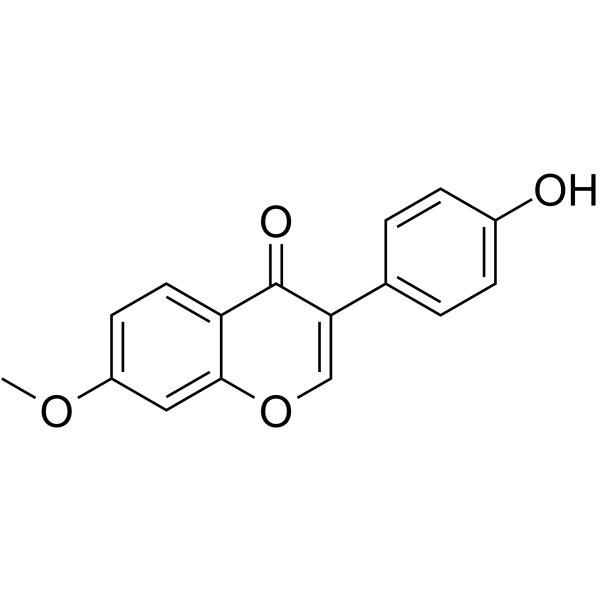
Isoformononetin
Based on 1 publication(s) in Google Scholar
Isoformononetin is an analog of Daidzein (HY-N0019) and has immunoprotective effects. Isoformononetin inhibits the differentiation of Th17 and B-cells lymphopoesis to promote osteogenesis in estrogen-deficient bone loss conditions.
연구목적의 판매만을 진행합니다. 환자를 대상으로 한 판매는 하지 않습니다.
- Purity : 99.47%
- CAS No.: 486-63-5
- 화학식: C16H12O4
- 분자량:268.26
-
보관:
4°C, protect from light
* In solvent : -80°C, 6 months; -20°C, 1 month (protect from light)

To place orders, for customer services and technical support, please contact: MedChemExpress USA
Tel: 609-228-6898 E-mail: [email protected] [email protected]


-
 Biological Activity
-
Chemical Information
-
용액&용해도
- Protocol
- 순도&문서
- References
-
 Help & FAQs


Publications Citing Use of MedChemExpress (MCE) Isoformononetin
More

Biological Activity
제품 설명


Chemical Information
-
CAS No. 486-63-5
-
Appearance Solid
-
분자량 268.26
-
화학식 C16H12O4
-
Color White to off-white
-
SMILES
O=C1C(C2=CC=C(O)C=C2)=COC3=CC(OC)=CC=C13
-
Structure Classification
-
Initial Source
-
선적
Room temperature in continental US; may vary elsewhere.
-
보관
4°C, protect from light
* In solvent : -80°C, 6 months; -20°C, 1 month (protect from light)


Publications (1)
-
Journal Impact Factor
-
Most Recent
-
J Nat Prod
Discovery and Characterization of Moracin C as an Anti-Gouty Arthritis/Hyperuricemia Candidate by Docking-Based Virtual Screening and Pharmacological Evaluation. [Abstract]2023 Sep 22;86(9):2091-2101. PMID: 37625387


용액&용해도
In Vitro:
DMSO : 250 mg/mL (931.93 mM; Need ultrasonic; Hygroscopic DMSO has a significant impact on the solubility of product, please use newly opened DMSO)
Please refer to the solubility information to select the appropriate solvent. Once prepared, please aliquot and store the solution to prevent product inactivation from repeated freeze-thaw cycles.
Storage method and period of stock solution: -80°C, 6 months; -20°C, 1 month (protect from light). When stored at -80°C, please use it within 6 months. When stored at -20°C, please use it within 1 month.
Please refer to the solubility information to select the appropriate solvent. Once prepared, please aliquot and store the solution to prevent product inactivation from repeated freeze-thaw cycles.
Storage method and period of stock solution: -80°C, 6 months; -20°C, 1 month (protect from light). When stored at -80°C, please use it within 6 months. When stored at -20°C, please use it within 1 month.
Concentration (start) × Volume (start) = Concentration (final) × Volume (final)

Protocol
-
Naïve CD4+ T-cell subset differentiation/polarization
Naïve CD4+ T-cell subset differentiation/polarization is an in vitro assay in which purified naïve CD4+ T cells are activated through TCR and CD28 costimulation and cultured with defined cytokines and neutralizing antibodies to generate Th0, Th1, Th2, Th17, or induced Treg-like populations. Differentiation is detected by subset-associated cytokines and transcription factors: IFN-γ/T-bet for Th1, IL-4/GATA3 for Th2, IL-17A/RORγt for Th17, and Foxp3 for induced Treg cells. The assay readout is usually generated by intracellular cytokine staining after restimulation, transcription-factor staining by flow cytometry, ELISA of secreted cytokines, or gene-expression analysis. The result reflects cytokine-directed lineage commitment or polarization rather than antigen-specific immune protection by itself.
-
Mesenchymal stromal/stem cell osteogenic differentiation
Mesenchymal stromal/stem cells can be induced toward an osteoblast-like lineage in vitro by culture in osteogenic medium containing dexamethasone, ascorbic acid or ascorbate-2-phosphate, and β-glycerophosphate; the differentiation process is commonly evaluated by alkaline phosphatase activity, osteogenic marker expression, collagenous matrix formation, and calcium-rich matrix mineralization. The main readouts are alkaline phosphatase activity as an early osteogenic marker and Alizarin Red S staining as a calcium-deposit readout for mineralized extracellular matrix; Alizarin Red S can be inspected microscopically or extracted and measured colorimetrically at 405 nm.
-
Research Protocol for Endocrine Diseases
Endocrine diseases often arise from disrupted hormone production, hormone signaling, or target-tissue responsiveness; for diabetes-focused endocrine disease models, insulin signaling regulates glucose uptake, hepatic glucose output, lipid metabolism, and β-cell compensation. Type 2 diabetes develops through interacting defects in insulin resistance, β-cell dysfunction, adipose inflammation, hepatic glucose overproduction, altered incretin signaling, and ectopic lipid metabolism. A major unresolved question is whether endocrine dysfunction is driven primarily by target-tissue insulin resistance, intrinsic β-cell failure, immune/inflammatory stress, or combined multi-organ failure that differs by disease stage.


순도&문서
-
Data Sheet (269 KB)
-
SDS (393 KB)
- English - EN (393 KB)
- Français - FR (393 KB)
- Deutsch - DE (393 KB)
- Norwegian - NO (393 KB)
- Español - ES (393 KB)
- Swedish - SV (393 KB)
- Italian - IT (393 KB)
- Korean - KR (393 KB)
- Portuguese - PT (393 KB)
-
Handling Instructions (2659 KB)
References


Complete Stock Solution Preparation Table
Please refer to the solubility information to select the appropriate solvent. Once prepared, please aliquot and store the solution to prevent product inactivation from repeated freeze-thaw cycles.
Storage method and period of stock solution: -80°C, 6 months; -20°C, 1 month (protect from light). When stored at -80°C, please use it within 6 months. When stored at -20°C, please use it within 1 month.
| Optional Solvent | Concentration Solvent Mass | 1 mg | 5 mg | 10 mg | 25 mg |
|---|---|---|---|---|---|
| DMSO | 1 mM | 3.7277 mL | 18.6386 mL | 37.2773 mL | 93.1932 mL |
| 5 mM | 0.7455 mL | 3.7277 mL | 7.4555 mL | 18.6386 mL | |
| 10 mM | 0.3728 mL | 1.8639 mL | 3.7277 mL | 9.3193 mL | |
| 15 mM | 0.2485 mL | 1.2426 mL | 2.4852 mL | 6.2129 mL | |
| 20 mM | 0.1864 mL | 0.9319 mL | 1.8639 mL | 4.6597 mL | |
| 25 mM | 0.1491 mL | 0.7455 mL | 1.4911 mL | 3.7277 mL | |
| 30 mM | 0.1243 mL | 0.6213 mL | 1.2426 mL | 3.1064 mL | |
| 40 mM | 0.0932 mL | 0.4660 mL | 0.9319 mL | 2.3298 mL | |
| 50 mM | 0.0746 mL | 0.3728 mL | 0.7455 mL | 1.8639 mL | |
| 60 mM | 0.0621 mL | 0.3106 mL | 0.6213 mL | 1.5532 mL | |
| 80 mM | 0.0466 mL | 0.2330 mL | 0.4660 mL | 1.1649 mL | |
| 100 mM | 0.0373 mL | 0.1864 mL | 0.3728 mL | 0.9319 mL |


Isoformononetin Related Classifications
HY-N7501 Related Classifications
 Powered by Bioz