



Talotrexin

Based on 1 Customer Validation
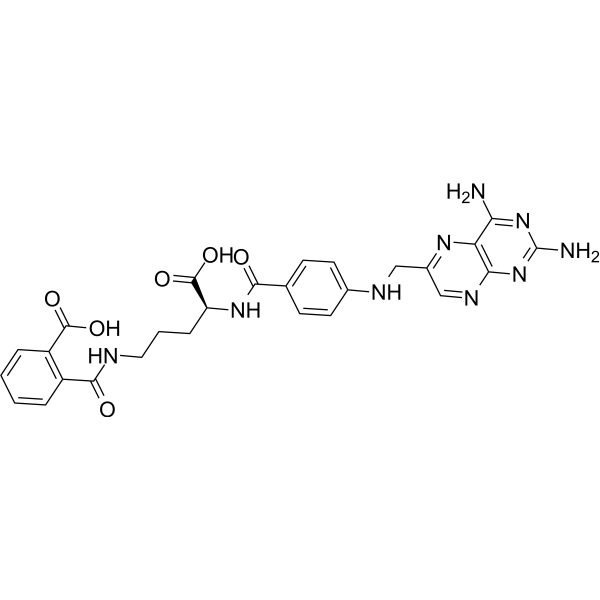
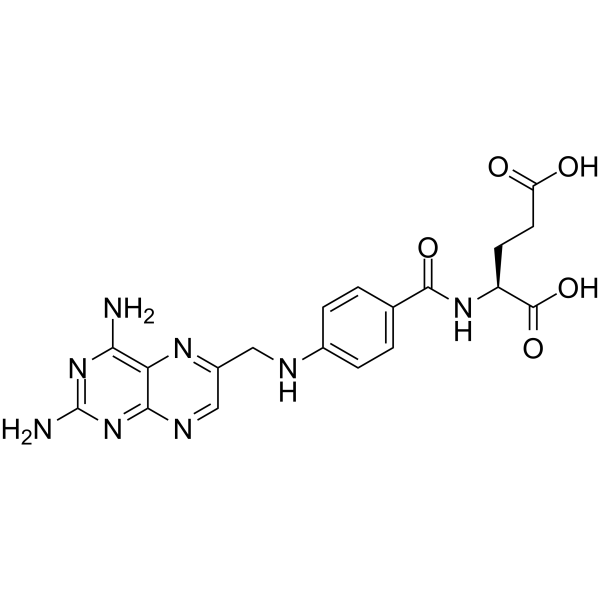
Talotrexin (PT523), an analog of Aminopterin (HY-14518), is a nonpolyglutamatable classic antifolate. Talotrexin is a RFC (reduced folate carrier) specific inhibitor and selectively inhibits RFC transport. Talotrexin shows antitumor activity by targeting DHFR to inhibit tumor growth.
연구목적의 판매만을 진행합니다. 환자를 대상으로 한 판매는 하지 않습니다.
- Purity : 99.27%
- CAS No.: 113857-87-7
- 화학식: C27H27N9O6
- 분자량:573.56
-
보관:Powder -20°C, 3 years ; In solvent -80°C, 6 months , -20°C, 1 month

To place orders, for customer services and technical support, please contact: MedChemExpress USA
Tel: 609-228-6898 E-mail: [email protected] [email protected]


-
 Biological Activity
-
Chemical Information
-
용액&용해도
- Protocol
- 순도&문서
- References
-
 Help & FAQs




Biological Activity
제품 설명
Cellular Effect
|
Cell Line

|
Type | Value | Description | References |
|---|---|---|---|---|
| IGROV-1 | IC50 |
2.47 nM
Compound: 8, PT523
|
Growth inhibition of human IGROV1 cells expressing RFC, FRalpha and PCFT in presence of 200 nM folic acid after 96 hrs
Growth inhibition of human IGROV1 cells expressing RFC, FRalpha and PCFT in presence of 200 nM folic acid after 96 hrs
|
[PMID: 20085328] |
| IGROV-1 | IC50 |
3.47 nM
Compound: 8, PT523
|
Growth inhibition of human IGROV1 cells expressing RFC, FRalpha and PCFT after 96 hrs
Growth inhibition of human IGROV1 cells expressing RFC, FRalpha and PCFT after 96 hrs
|
[PMID: 20085328] |
| IGROV-1 | IC50 |
2.47 nM
Compound: 9, PT523
|
Antiproliferative activity against human IGROV1 cells expressing human RFC, FRalpha and PCFT assessed as reduction of viable cells after 96 hrs in the presence of 200 nM folic acid
Antiproliferative activity against human IGROV1 cells expressing human RFC, FRalpha and PCFT assessed as reduction of viable cells after 96 hrs in the presence of 200 nM folic acid
|
[PMID: 21879757] |
| IGROV-1 | IC50 |
3.47 nM
Compound: 9, PT523
|
Antiproliferative activity against human IGROV1 cells expressing human RFC, FRalpha and PCFT assessed as reduction of viable cells after 96 hrs
Antiproliferative activity against human IGROV1 cells expressing human RFC, FRalpha and PCFT assessed as reduction of viable cells after 96 hrs
|
[PMID: 21879757] |
| KB | IC50 |
2.9 nM
Compound: 8, PT523
|
Growth inhibition of human KB cells expressing RFC, FRalpha and PCFT in presence of 200 nM folic acid after 96 hrs
Growth inhibition of human KB cells expressing RFC, FRalpha and PCFT in presence of 200 nM folic acid after 96 hrs
|
[PMID: 20085328] |
| KB | IC50 |
5.26 nM
Compound: 8, PT523
|
Growth inhibition of human KB cells expressing RFC, FRalpha and PCFT after 96 hrs
Growth inhibition of human KB cells expressing RFC, FRalpha and PCFT after 96 hrs
|
[PMID: 20085328] |
| KB | IC50 |
2.9 nM
Compound: 9, PT523
|
Antiproliferative activity against human KB cells expressing human RFC, FRalpha and PCFT assessed as reduction of viable cells after 96 hrs in the presence of 200 nM folic acid
Antiproliferative activity against human KB cells expressing human RFC, FRalpha and PCFT assessed as reduction of viable cells after 96 hrs in the presence of 200 nM folic acid
|
[PMID: 21879757] |
| KB | IC50 |
5.26 nM
Compound: 9, PT523
|
Antiproliferative activity against human KB cells expressing human RFC, FRalpha and PCFT assessed as reduction of viable cells after 96 hrs
Antiproliferative activity against human KB cells expressing human RFC, FRalpha and PCFT assessed as reduction of viable cells after 96 hrs
|
[PMID: 21879757] |
| R2 | IC50 |
>1000 nM
Compound: 8, PT523
|
Growth inhibition of Chinese hamster R2 cells expressing human RFC and human PCFT4 after 96 hrs
Growth inhibition of Chinese hamster R2 cells expressing human RFC and human PCFT4 after 96 hrs
|
[PMID: 20085328] |
| R2 | IC50 |
>1000 nM
Compound: 8, PT523
|
Growth inhibition of Chinese hamster R2 cells expressing human RFC after 96 hrs
Growth inhibition of Chinese hamster R2 cells expressing human RFC after 96 hrs
|
[PMID: 20085328] |
| R2 | IC50 |
>1000 nM
Compound: 9, PT523
|
Antiproliferative activity against chinese hamster R2 cells expressing human PCFT assessed as reduction of viable cells after 96 hrs
Antiproliferative activity against chinese hamster R2 cells expressing human PCFT assessed as reduction of viable cells after 96 hrs
|
[PMID: 21879757] |
| R2 | IC50 |
>1000 nM
Compound: 9, PT523
|
Antiproliferative activity against chinese hamster R2 cells assessed as reduction of viable cells after 96 hrs
Antiproliferative activity against chinese hamster R2 cells assessed as reduction of viable cells after 96 hrs
|
[PMID: 21879757] |
In Vitro
In Vivo
MedChemExpress (MCE) has not independently confirmed the accuracy of these methods. They are for reference only.
-
Animal Model:NSCLC xenografts in athymic female nude mice (6-8 weeks)[2]
-
Dosage:15, 25, and 35 mg/kg, combined with Paclitaxel (HY-B0015, 7.5 mg/kg)
-
Administration:IV injection, once weekly for 4 weeks
-
Result:Inhibited A549 tumor growth.


Chemical Information
-
CAS No. 113857-87-7
-
Appearance Solid
-
분자량 573.56
-
화학식 C27H27N9O6
-
Color Light yellow to yellow
-
SMILES
NC1=NC(N)=NC2=C1N=C(CNC3=CC=C(C=C3)C(N[C@H](C(O)=O)CCCNC(C4=C(C=CC=C4)C(O)=O)=O)=O)C=N2
-
Synonyms
PT523
-
선적
Room temperature in continental US; may vary elsewhere.
-
보관
Powder -20°C 3 years In solvent -80°C 6 months -20°C 1 month


용액&용해도
In Vitro:
DMSO : 125 mg/mL (217.94 mM; Need ultrasonic; Hygroscopic DMSO has a significant impact on the solubility of product, please use newly opened DMSO)
Please refer to the solubility information to select the appropriate solvent. Once prepared, please aliquot and store the solution to prevent product inactivation from repeated freeze-thaw cycles.
Storage method and period of stock solution: -80°C, 6 months; -20°C, 1 month. When stored at -80°C, please use it within 6 months. When stored at -20°C, please use it within 1 month.
Please refer to the solubility information to select the appropriate solvent. Once prepared, please aliquot and store the solution to prevent product inactivation from repeated freeze-thaw cycles.
Storage method and period of stock solution: -80°C, 6 months; -20°C, 1 month. When stored at -80°C, please use it within 6 months. When stored at -20°C, please use it within 1 month.
Concentration (start) × Volume (start) = Concentration (final) × Volume (final)


순도&문서
-
Data Sheet (272 KB)
-
SDS (251 KB)
- English - EN (251 KB)
- Français - FR (251 KB)
- Deutsch - DE (251 KB)
- Norwegian - NO (251 KB)
- Español - ES (251 KB)
- Swedish - SV (251 KB)
- Italian - IT (251 KB)
- Korean - KR (251 KB)
- Portuguese - PT (251 KB)
-
Handling Instructions (2659 KB)
References


Complete Stock Solution Preparation Table
Please refer to the solubility information to select the appropriate solvent. Once prepared, please aliquot and store the solution to prevent product inactivation from repeated freeze-thaw cycles.
Storage method and period of stock solution: -80°C, 6 months; -20°C, 1 month. When stored at -80°C, please use it within 6 months. When stored at -20°C, please use it within 1 month.
| Optional Solvent | Concentration Solvent Mass | 1 mg | 5 mg | 10 mg | 25 mg |
|---|---|---|---|---|---|
| DMSO | 1 mM | 1.7435 mL | 8.7175 mL | 17.4350 mL | 43.5874 mL |
| 5 mM | 0.3487 mL | 1.7435 mL | 3.4870 mL | 8.7175 mL | |
| 10 mM | 0.1743 mL | 0.8717 mL | 1.7435 mL | 4.3587 mL | |
| 15 mM | 0.1162 mL | 0.5812 mL | 1.1623 mL | 2.9058 mL | |
| 20 mM | 0.0872 mL | 0.4359 mL | 0.8717 mL | 2.1794 mL | |
| 25 mM | 0.0697 mL | 0.3487 mL | 0.6974 mL | 1.7435 mL | |
| 30 mM | 0.0581 mL | 0.2906 mL | 0.5812 mL | 1.4529 mL | |
| 40 mM | 0.0436 mL | 0.2179 mL | 0.4359 mL | 1.0897 mL | |
| 50 mM | 0.0349 mL | 0.1743 mL | 0.3487 mL | 0.8717 mL | |
| 60 mM | 0.0291 mL | 0.1453 mL | 0.2906 mL | 0.7265 mL | |
| 80 mM | 0.0218 mL | 0.1090 mL | 0.2179 mL | 0.5448 mL | |
| 100 mM | 0.0174 mL | 0.0872 mL | 0.1743 mL | 0.4359 mL |


Talotrexin Related Classifications
HY-10824 Related Classifications
 Powered by Bioz