



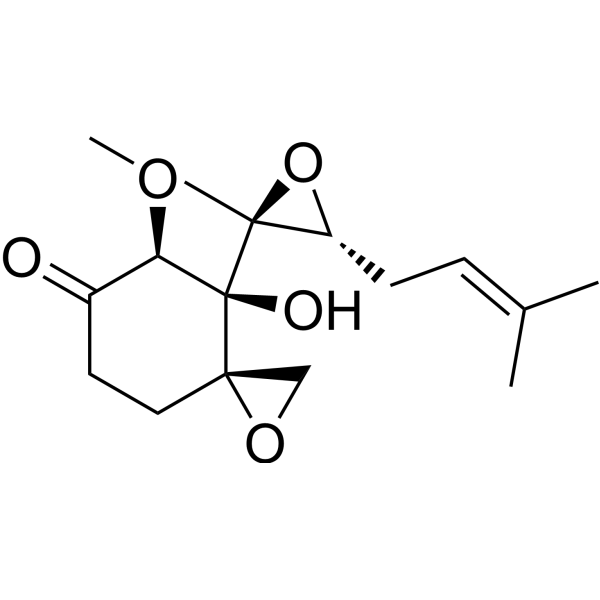
Ovalicin
Ovalicin is a multi-target inhibitor that targets MetAP2, HRH2, JAK2 and TRPV1, with anti-inflammatory and anti-atopic dermatitis activities. Ovalicin covalently binds to MetAP2 to inhibit its function, thereby blocking the replication of Enterocytozoon bieneusi and Vittaforma corneae. Ovalicin alleviates intestinal injury and prolongs survival in infected mouse models, without showing obvious hepatorenal toxicity. Ovalicin attenuates LPS-induced calcium influx, reduces the infiltration of macrophages and mast cells in the skin, and regulates the expression of inflammation-related genes such as IL-31, effectively relieving allergic symptoms in mouse models. Ovalicin can be used for the research of microsporidiosis and atopic dermatitis.
For research use only. We do not sell to patients.
- CAS No.: 19683-98-8
- Formula: C16H24O5
- Molecular Weight:296.36
-
Storage:
Please store the product under the recommended conditions in the Certificate of Analysis.

To place orders, for customer services and technical support, please contact: MedChemExpress USA
Tel: 609-228-6898 E-mail: [email protected] [email protected]


-
 Biological Activity
-
Chemical Information
- Protocols
- Purity & Documentation
- References
-
 Help & FAQs




Biological Activity
Description
IC50 & Target
|
JAK2 |
MetAp2 |
TRPV1 |
Cellular Effect
|
Cell Line

|
Type | Value | Description | References |
|---|---|---|---|---|
| A-431 | IC50 |
7.5 μM
Compound: 1 (Ovalicin)
|
In vitro antiproliferative effect against A431 human epidermoid carcinoma cells
In vitro antiproliferative effect against A431 human epidermoid carcinoma cells
|
10.1016/S0960-894X(96)00564-1 |
| A549 | GI50 |
4.1 μM
Compound: 8
|
Cytotoxicity against human A549 cells after 72 hrs by SRB assay
Cytotoxicity against human A549 cells after 72 hrs by SRB assay
|
[PMID: 23964677] |
In Vitro
Treatment of RK-13 rabbit kidney cells with Ovalicin (10 μM; 10 d) at a non-toxic concentration for 10 days results in over 70% replication inhibition of Encephalitozoon intestinalis (IC50=0.004 μM) and Vittaforma corneae (IC50=0.002 μM)[1].
Ovalicin (1-200 μg/mL; 24-72 h) reduces the viability of DH82 cells in a dose-dependent manner[2].
Ovalicin (2-8 μg/mL; 1 d) dose-dependently reduces the increased cell viability of DH82 cells pretreated with LPS[2].
Ovalicin (2-10 μg/mL; 1 d) dose-dependently inhibits the LPS-induced upregulation of IL4, IFNG, TRPV1, HRH2 and IL31RA mRNA expression in DH82 cells, with the inhibitory effect of 10 μg/mL Ovalicin being stronger than that of Dexamethasone (HY-14648)[2].
Ovalicin (2-10 μg/mL; 1 d) dose-dependently inhibits LPS-induced activation of the IL-31 signaling pathway in DH82 cells by reducing the expression of IL31RA, OSMR, JAK2 and p-STAT3; at concentrations of 4 and 10 μg/mL, its inhibitory effect is stronger than that of Dexamethasone (HY-14648)[2].
Ovalicin (10 μg/mL; 1 d) attenuates LPS-induced calcium influx in DH82 cells, and its efficacy is stronger than that of Dexamethasone (HY-14648) and Ruxolitinib (HY-50856)[2].
Ovalicin (2-10 μg/mL; 1 d) inhibits LPS-induced inflammatory responses in DH82 cells in a dose-dependent manner by reducing the levels of iNOS, COX2, NF-κB and ROS, and its inhibitory effect is stronger than that of Dexamethasone (HY-14648)[2].
MedChemExpress (MCE) has not independently confirmed the accuracy of these methods. They are for reference only.
-
Cell Line:canine macrophage cell line DH82
-
Concentration:1-200 μg/mL
-
Incubation Time:24 h; 48 h; 72 h
-
Result:Decreased DH82 cell viability dose-dependently.
Maintained more than 90% cell survival at 1 and 10 μg/mL after 24 and 48 hours.
-
Cell Line:LPS-pretreated canine macrophage cell line DH82
-
Concentration:2-8 μg/mL
-
Incubation Time:1 day
-
Result:Decreased cell viability dose-dependently in LPS-pretreated DH82 cells, where LPS pretreatment had increased cell viability compared to LPS-untreated cells.
-
Cell Line:LPS-pretreated canine macrophage cell line DH82
-
Concentration:2-10 μg/mL
-
Incubation Time:1 day
-
Result:Significantly attenuated LPS-induced upregulation of IL4 and IFNG mRNA expression.
Exerted a stronger inhibitory effect on these mRNA levels at 10 μg/mL than Dexamethasone.\nSignificantly inhibited LPS-induced increases in TRPV1 and HRH2 mRNA expression.
Exerted a stronger inhibitory effect than dexamethasone and ruxolitinib.
More significantly inhibited LPS-induced increases in IL31RA, TRPV1, and HRH2 mRNA expression than ruxolitinib.
-
Cell Line:LPS-pretreated canine macrophage cell line DH82
-
Concentration:2-10 μg/mL
-
Incubation Time:1 day
-
Result:Significantly inhibited LPS-induced IL-31 protein expression in DH82 cells.
Exerted a stronger inhibitory effect than dexamethasone treatment.
In Vivo
Ovalicin (1-10 μg/mL; topical; daily; 5 days) dose-dependently alleviates atopic dermatitis symptoms in DNCB-induced BALB/C mice by reducing dermal immune cell infiltration, normalizing serum parameters, and inhibiting IL-31 signaling and pruritus-related gene expression[2].
Ovalicin (10 μg/mL; topical; daily; 5 days) does not induce skin morphologic changes or dermatitis in healthy BALB/C mice[2].
MedChemExpress (MCE) has not independently confirmed the accuracy of these methods. They are for reference only.
-
Animal Model:CRL:CD-1nuBR (7-week-old male, intraperitoneally inoculated with Vittaforma corneae spores)[1]
-
Dosage:5 mg/kg; 10 mg/kg; 20 mg/kg
-
Administration:s.c.; daily
-
Result:Prolonged mean survival time to 19.9 days and reduced mean number of parasite-associated small intestinal lesions to 11.6 at 5 mg/kg.
Showed no statistically significant increases in survival time relative to controls at 10 mg/kg or 20 mg/kg.
Showed no significant differences in mean numbers of lesions in the small intestine, liver, and pancreas relative to controls at 10 mg/kg or 20 mg/kg.
Resulted in full study duration survival with no drug-associated lesions in uninfected mice at 20 mg/kg.
-
Animal Model:BALB/C (female, 5 weeks old, atopic dermatitis induced by DNCB)[2]
-
Dosage:1 μg/mL; 10 μg/mL
-
Administration:topical; daily; 5 days
-
Result:Decreased the number of IBA1-positive macrophages and mast cells infiltrated in the dermis in a dose-dependent manner.
Significantly reduced dermatitis lesion scores (assessed by hemorrhage, scarring, edema, and erosion).
Reversed elevated serum albumin and total protein levels.
Decreased elevated serum IL-31 concentration in a dose-dependent manner.
Reduced mRNA expression of TRPV1 and HRH2 in skin tissue.
Decreased expression of IL-31 receptor (IL-31R) in skin tissue.
Enhanced re-epithelialization and granulation tissue formation in skin.


Chemical Information
-
CAS No. 19683-98-8
-
Molecular Weight 296.36
-
Formula C16H24O5
-
SMILES
O[C@@]([C@@H]1OC)([C@]([C@H]2C/C=C(C)\C)(O2)C)[C@]3(CCC1=O)CO3
-
Shipping
Room temperature in continental US; may vary elsewhere.
-
Storage
Please store the product under the recommended conditions in the Certificate of Analysis.


Purity & Documentation
References
[1]. Didier PJ, et al. Antimicrosporidial activities of fumagillin, TNP-470, ovalicin, and ovalicin derivatives in vitro and in vivo. Antimicrob Agents Chemother. 2006;50(6):2146-2155. [Content Brief]
[2]. Hwang SH, et al. Ovalicin attenuates atopic dermatitis symptoms by inhibiting IL-31 signaling and intracellular calcium influx. J Biomed Res. 2021;35(6):448-458. [Content Brief]

Calculators
Concentration (start) × Volume (start) = Concentration (final) × Volume (final)


Ovalicin Related Classifications
HY-156959 Related Classifications
 Powered by Bioz