



PDEδ autophagic degrader 1
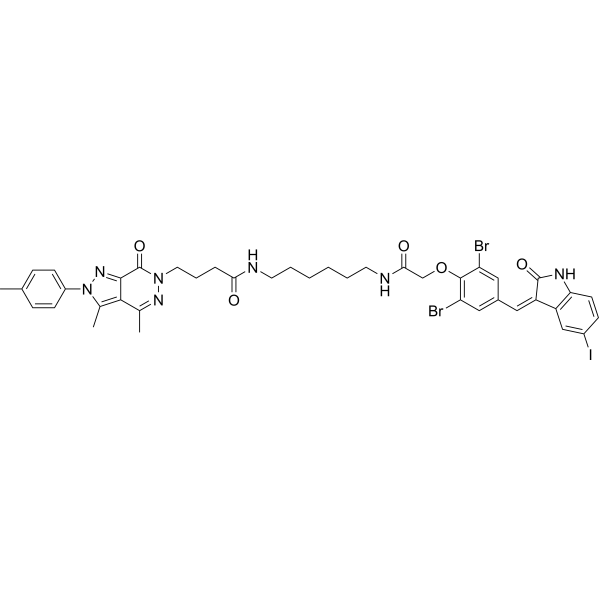
PDEδ autophagic degrader 1 (compound 12c), an autophagosome-tethering compound (ATTEC). is a potent PDEδ autophagic degrader. PDEδ autophagic degrader 1 reduces the PDEδ protein level through lysosome-mediated autophagy without affecting the PDEδ mRNA expression. PDEδ autophagic degrader 1 suppresses the growth in KRAS mutant pancreatic cancer cells.
For research use only. We do not sell to patients.
- CAS No.: 3054112-59-0
- Formula: C41H42Br2IN7O5
- Molecular Weight:999.53
-
Storage:
Please store the product under the recommended conditions in the Certificate of Analysis.

To place orders, for customer services and technical support, please contact: MedChemExpress USA
Tel: 609-228-6898 E-mail: [email protected] [email protected]


-
 Biological Activity
-
Chemical Information
- Purity & Documentation
- References
-
 Help & FAQs




Biological Activity
Description
IC50 & Target
Kd: 56 nM (PDEδ)[1]
Cellular Effect
|
Cell Line

|
Type | Value | Description | References |
|---|---|---|---|---|
| CAPAN-1 | IC50 |
0.8 μM
Compound: 12c
|
Antiproliferative activity against human CAPAN-1 cells harboring KRAS mutant assessed as reduction in cell proliferation incubated for 72 hrs by CCK-8 assay
Antiproliferative activity against human CAPAN-1 cells harboring KRAS mutant assessed as reduction in cell proliferation incubated for 72 hrs by CCK-8 assay
|
[PMID: 38229750] |
| MIA PaCa-2 | IC50 |
1.4 μM
Compound: 12c
|
Antiproliferative activity against human MIA PaCa-2 cells harboring KRAS mutant assessed as reduction in cell proliferation incubated for 72 hrs by CCK-8 assay
Antiproliferative activity against human MIA PaCa-2 cells harboring KRAS mutant assessed as reduction in cell proliferation incubated for 72 hrs by CCK-8 assay
|
[PMID: 38229750] |
In Vitro
Autophagosome-binding compounds (ATTECs) are small molecule compounds that simultaneously bind to both the target protein and the autophagosome membrane surface protein LC3. They directly tether the target protein to the autophagosome membrane via a molecular glue mechanism, allowing for selective degradation of the target protein through the autophagy-lysosome pathway. This differs from PROTACs, which achieve targeted protein clearance without relying on ubiquitination labeling. Subsequently, under lysosome-mediated autophagy, the cell forms a double-membrane structure called autophagosomes, which encapsulate the target protein or damaged organelle to be degraded. These autophagosomes then fuse with lysosomes to form autolysosomes, where degradation and recycling are completed under the action of acidic hydrolases. This cell self-renewal and quality control mechanism is crucial for maintaining cellular homeostasis, clearing abnormal protein aggregates, and resisting nutrient stress.
MedChemExpress (MCE) has not independently confirmed the accuracy of these methods. They are for reference only.
-
Cell Line:MiaPaCa-2 human pancreatic cancer cells
-
Concentration:0.3-20 μM (dose-dependent assay); 10 μM (time-dependent assay); 5 μM (inhibitor preincubation assays); 20 μM (single dose assay)
-
Incubation Time:2-24 h (time-dependent assay); 24 h (dose-dependent, single dose, and inhibitor preincubation assays)
-
Result:Induced 85% PDEδ degradation at 20 μM after 24 h.
Degraded PDEδ in a dose-dependent manner with a DC50 of 1.7 μM.
Degraded PDEδ in a time-dependent manner, with significant degradation observed starting at 4 h.
Reversed PDEδ degradation induced by 5 μM compound 12c when preincubated with 100 nM Baf-A1.
Blocked PDEδ degradation induced by 5 μM compound 12c when preincubated with 10 μM PDEδ inhibitor 1 or 20 μM LC3 ligand 4.
-
Cell Line:MiaPaCa-2 human pancreatic cancer cells
-
Concentration:1-10 μM
-
Incubation Time:24 h
-
Result:Induced total apoptosis in 22.23% of cells at 1 μM after 24 h.
Induced total apoptosis in 33.25% of cells at 10 μM after 24 h.


Chemical Information
-
CAS No. 3054112-59-0
-
Molecular Weight 999.53
-
Formula C41H42Br2IN7O5
-
SMILES
O=C(NCCCCCCNC(COC1=C(Br)C=C(/C=C2C(NC3=C\2C=C(I)C=C3)=O)C=C1Br)=O)CCCN4N=C(C)C5=C(C)N(C6=CC=C(C)C=C6)N=C5C4=O
-
Shipping
Room temperature in continental US; may vary elsewhere.
-
Storage
Please store the product under the recommended conditions in the Certificate of Analysis.


Purity & Documentation
References

Calculators
Concentration (start) × Volume (start) = Concentration (final) × Volume (final)


PDEδ autophagic degrader 1 Related Classifications
HY-157458 Related Classifications
 Powered by Bioz