



Ranibizumab (anti-VEGF)
Based on 2 publication(s) in Google Scholar
Ranibizumab (RG-6321) (anti-VEGF) is a humanized anti-VEGF monoclonal antibody fragment and can recognize all VEGF-A isoforms (VEGF110, VEGF121, and VEGF165). Ranibizumab (anti-VEGF) slows vision loss in vivo and is used for wet age-related macular degeneration (AMD) research.
For research use only. We do not sell to patients.
- Purity : 99.60%
- CAS No.: 347396-82-1
- Molecular Weight:49.19 kDa
-
Storage:
Please store the product under the recommended conditions in the Certificate of Analysis.

To place orders, for customer services and technical support, please contact: MedChemExpress USA
Tel: 609-228-6898 E-mail: [email protected] [email protected]


-
 Biological Activity
-
Chemical Information
- Purity & Documentation
- References
-
 Help & FAQs







Publications Citing Use of MedChemExpress (MCE) Ranibizumab (anti-VEGF)
More Customer Validation & Images

-
WB
All VEGFR Isoforms
More

Biological Activity
Description
Isotype
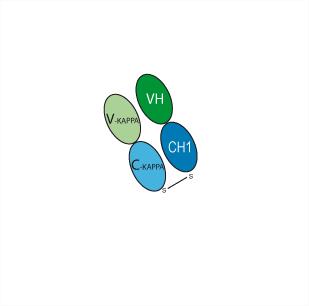
Fab-G1-kappa
Species Reactivity
Human
IC50 & Target
VEGFA
In Vitro
Ranibizumab (RG-6321) is a humanized anti-VEGF monoclonal antibody fragment (IgG antigen-binding fragment (Fab-Y0317)[2]. Ranibizumab (0.0625-0.25 mg/ml; 72 hours) results in increased necrosis and apoptosis at in rat retinal cell cultures[3].
MedChemExpress (MCE) has not independently confirmed the accuracy of these methods. They are for reference only.
In Vivo
MedChemExpress (MCE) has not independently confirmed the accuracy of these methods. They are for reference only.
Gene ID
Accession
Conjugated
Unconjugated
Reconsititution
The product can be reconstituted/diluted with sterile PBS or saline.
Format
-
Fab-G1-kappa
Application
ELISA, FACS, Functional assay
Verified Bioactivity
-
 Immobilized VEGFA-FC can bind Ranibizumab (anti-VEGF). The EC50 for this effect is 10.14 ng/mL.
 -
 Flow cytometric analysis of 1X10⁶ Hela cells with Ranibizumab (anti-VEGF) (HY-P9951A, red). Cells were fixed with 4% paraformaldehyde and permeabilised with 90% methanol. Then stained with the primary antibody at 1/200 dilution for an hour at 4℃. Alexa Fluor 488-conjugated AffiniPure Goat Anti-Human IgG H&L (HY-P83776) was used as the secondary antibody at 1/1,000 dilution for 30 minutes at 4℃. Human IgG1 kappa (HY-P99001, blue) was used as the isotype control, cells without incubation with primary antibody were used as the unlabeled control (black).


Chemical Information
-
CAS No. 347396-82-1
-
Appearance Liquid
-
Molecular Weight 49.19 kDa
-
Color Colorless to light yellow
-
SMILES
[Ranibizumab (anti-VEGF)]
-
Synonyms
RG-6321 (anti-VEGF)
-
Shipping
Shipping with dry ice.
-
Formulation
Please refer to the lot-specific COA for specific buffer information.
-
Storage
Please store the product under the recommended conditions in the Certificate of Analysis.


Publications (2)
-
Journal Impact Factor
-
Most Recent
-
Diabetologia
MAP4K4 aggravates microvascular anomalies in diabetic retinopathy in a YTHDF2-dependent manner. [Abstract]2025 Jun;68(6):1335-1351. PMID: 40072537
Ranibizumab (anti-VEGF) purchased from MedChemExpress. Usage Cited in: Diabetologia. 2025 Jun;68(6):1335-1351. [Abstract]
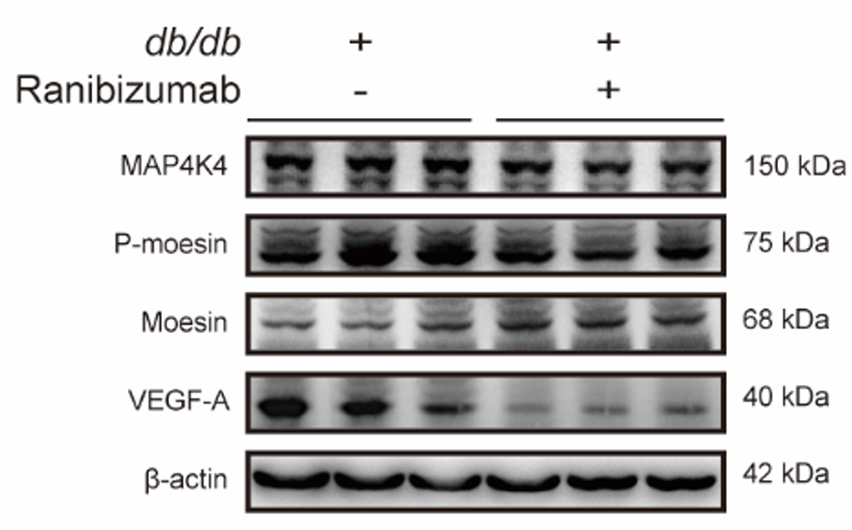
Retina lysates from db/db mice treated with anti-VEGF (Ranibizumab) (500 ng/mouse; intravitreal injection; single injection into 20-week-old mice) or vehicle (PBS) were analyzed for MAP4K4 expression and activity by immunoblotting. Moesin is a direct substrate of MAP4K4.
-


Purity & Documentation
-
Data Sheet (261 KB)
-
SDS (394 KB)
- English - EN (394 KB)
- Français - FR (394 KB)
- Deutsch - DE (394 KB)
- Norwegian - NO (394 KB)
- Español - ES (394 KB)
- Swedish - SV (394 KB)
- Italian - IT (394 KB)
- Korean - KR (394 KB)
- Portuguese - PT (394 KB)
-
Inhibitory Antibodies User Guide (603 KB)
References
[1]. Mustafa Şahiner, et al. The Effects of Anti-Vascular Endothelial Growth Factor Drugs on Retinal Pigment Epithelial Cell Culture. Turk J Ophthalmol. 2018 Aug;48(4):190-195. [Content Brief]
[2]. K J Kim, et al. The vascular endothelial growth factor proteins: identification of biologically relevant regions by neutralizing monoclonal antibodies. Growth Factors. 1992;7(1):53-64. [Content Brief]
[3]. Richard Filek, et al. Safety of anti-VEGF treatments in a diabetic rat model and retinal cell culture. Clin Ophthalmol. 2019 Jul 1;13:1097-1114. [Content Brief]

Calculators
Concentration (start) × Volume (start) = Concentration (final) × Volume (final)


Ranibizumab (anti-VEGF) Related Classifications
HY-P9951A Related Classifications
 Powered by Bioz