



C-Reactive Protein, Human (HEK293, solution)
Based on 1 Customer Validation
C-Reactive Protein, an acute-phase protein, is a marker of inflammatory cytokines that assists in complement binding and phagocytosis by macrophages, originated from the liver. C-Reactive Protein is also the first pattern recognition receptor (PRR) to be identified. C-Reactive Protein is significantly associated with the risk of having a first ischemic stroke, especially for small-vessel disease. C-Reactive Protein (Human, solution) is a recombinant protein with tag free and is expressed in HEK293.
- Species: Human
- Source: HEK293
-
Storage:Stored at -80°C for 1 year from date of receipt. It is stable at -20°C for 3 months after opening. It is recommended to freeze aliquots at -80°C for extended storage. Avoid repeated freeze-thaw cycles.


To place orders, for customer services and technical support, please contact: MedChemExpress USA
Tel: 609-228-6898 E-mail: [email protected] [email protected]


-
 Biological Activity
-
Technical Parameters
-
Product Properties
- Documentation
- References
- Help & FAQs




Biological Activity
Description
C-Reactive Protein, an acute-phase protein, is a marker of inflammatory cytokines that assists in complement binding and phagocytosis by macrophages, originated from the liver. C-Reactive Protein is also the first pattern recognition receptor (PRR) to be identified. C-Reactive Protein is significantly associated with the risk of having a first ischemic stroke, especially for small-vessel disease. C-Reactive Protein (Human, solution) is a recombinant protein with tag free and is expressed in HEK293[1][2][3][4][5][6][7][8][9][10][11].
Background
C-reactive protein (Human) is an annular (ring-shaped) pentameric protein found in blood plasma, whose circulating concentrations rise in response to inflammation. C-reactive protein (Human) binds to lysophosphatidylcholine expressed on the surface of dead or dying cells (and some types of bacteria) in order to activate the classical complement pathway via C1q binding[2].
C-reactive protein (Human) is synthesized by the liver in response to factors released by macrophages, T cells and fat cells (adipocytes), which is a member of the pentraxin family of proteins with signal peptide[3].
C-reactive protein (Human) binds to the phosphocholine expressed on the surface of bacterial cells such as pneumococcus bacteria, which activates the complement system to promote phagocytosis by macrophages and then clear necrotic and apoptotic cells and bacteria[4,5].
C-reactive protein (Human) binds to phosphocholine on micro-organisms which assists in complement binding to foreign, damaged cells and enhances phagocytosis by macrophages. C-reactive protein (Human) plays a role in innate immunity as an early defense system against infections[4].
C-reactive protein (Human) is a prehistoric antibody and binds to the Fc-gamma receptor IIa[6].
MCE Validation Data
-
Purity - SDS-PAGE
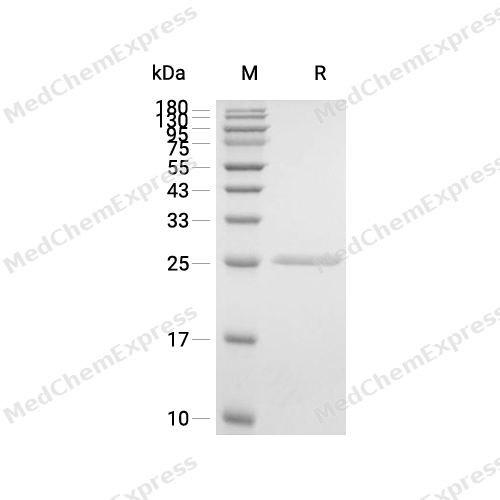
Purity - SDS-PAGE


Technical Parameters
-
Species Human
-
Source HEK293
-
Tag Tag Free
-
Accession
P02741-1 (Q19-P224)
-
Molecular Construction
-
N-term
-
C-Reactive (Q19-P224)
Accession # P02741-1 -
C-term
-
-
Protein Length
Full Length of Isoform-1
-
Synonyms
CRP; C-Reactive Protein, Pentraxin-Related; C-Reactive Protein; Pentraxin 1; PTX1
-
AA Sequence
QTDMSRKAFVFPKESDTSYVSLKAPLTKPLKAFTVCLHFYTELSSTRGYSIFSYATKRQDNEILIFWSKDIGYSFTVGGSEILFEVPEVTVAPVHICTSWESASGIVEFWVDGKPRVRKSLKKGYTVGAEASIILGQEQDSFGGNFEGSQSLVGDIGNVNMWDFVLSPDEINTIYLGGPFSPNVLNWRALKYEVQGEVFTKPQLWP
-
Predicted Molecular Mass
23 kDa
-
Molecular Weight
25 kDa
-
Purity
≥ 90%, as determined by reducing SDS-PAGE.


Product Properties
Solution
Supplied as a 0.22 μm filtered solution of 20 mM Tris, 0.2M NaCl, 5 mM CaCl2, pH 8.0.
Note: For SPR assay, please replace the buffer. Primary amine components (e.g., Tris, imidazole) can affect protein-coupled chips.
<1 EU/μg, determined by LAL method.
Stored at -80°C for 1 year from date of receipt. It is stable at -20°C for 3 months after opening. It is recommended to freeze aliquots at -80°C for extended storage. Avoid repeated freeze-thaw cycles.
Shipping with dry ice.


Documentation
-
Data Sheet (264 KB)
-
SDS (251 KB)
- English - EN (251 KB)
- Français - FR (251 KB)
- Deutsch - DE (251 KB)
- Norwegian - NO (251 KB)
- Español - ES (251 KB)
- Swedish - SV (251 KB)
- Italian - IT (251 KB)
- Korean - KR (251 KB)
- Portuguese - PT (251 KB)
-
Handling Instructions (2659 KB)


References
[1]. Abdullateef Abdullah Z, et al. Role of Serum Ferritin, D-Dimer, and C-Reactive Protein Parameters in COVID 19 Severity. Arch Razi Inst. 2023 Apr 30;78(2):737-742. [Content Brief]
[2]. Thompson D, et al. The physiological structure of human C-reactive protein and its complex with phosphocholine. Structure. 1999 Feb 15;7(2):169-77. [Content Brief]
[3]. Pepys MB, et al. C-reactive protein: a critical update. J Clin Invest. 2003 Jun;111(12):1805-12. [Content Brief]
[4]. Bray C, et al. Erythrocyte Sedimentation Rate and C-reactive Protein Measurements and Their Relevance in Clinical Medicine. WMJ. 2016 Dec;115(6):317-21. [Content Brief]
[5]. Enocsson H, et al. The Complex Role of C-Reactive Protein in Systemic Lupus Erythematosus. J Clin Med. 2021 Dec 13;10(24):5837. [Content Brief]
[6]. Sheriff A. Special Issue "C-Reactive Protein and Cardiovascular Disease: Clinical Aspects". J Clin Med. 2022 Jun 22;11(13):3610. [Content Brief]
[7]. Chen W, et al. Association of C-reactive protein gene polymorphisms with the risk of ischemic stroke: A systematic review and meta-analysis. Brain Behav. 2023 Jun;13(6):e2976. [Content Brief]
[8]. Li X, et al. Lymphocyte-to-C-Reactive Protein Ratio as an Early Sepsis Biomarker for Neonates with Suspected Sepsis. Mediators Inflamm. 2023 May 8;2023:9077787. [Content Brief]
[9]. Maillard O, et al. C-reactive protein: An easy marker for early differentiation between leptospirosis and dengue fever in endemic area. PLoS One. 2023 May 17;18(5):e0285900. [Content Brief]
[10]. Yang Z, et al. Unrevealing the shared genetic mechanisms underlying C-reactive protein and schizophrenia. Prog Neuropsychopharmacol Biol Psychiatry. 2023 Aug 30;126:110785. [Content Brief]
[11]. Andersson J, et al. C-reactive protein is a determinant of first-ever stroke: prospective nested case-referent study. Cerebrovasc Dis. 2009;27(6):544-51. [Content Brief]

Calculators
Concentration (start) × Volume (start) = Concentration (final) × Volume (final)


 Powered by Bioz

