



CD204/MSR1 Protein, Human (HEK293, His)

Based on 1 Customer Validation
The CD204/MSR1 protein encoded by this gene consists of three isoforms. These integral membrane glycoproteins are mainly expressed in macrophages and play important roles in processes such as atherosclerosis and Alzheimer's disease. CD204/MSR1 Protein, Human (HEK293, His) is the recombinant human-derived CD204/MSR1 protein, expressed by HEK293 , with N-6*His labeled tag.
- Species: Human
- Source: HEK293
-
Storage:Stored at -20°C for 2 years from date of receipt. After reconstitution, it is stable at 4°C for 1 week or -20°C for longer (with carrier protein). It is recommended to freeze aliquots at -20°C or -80°C for extended storage.


To place orders, for customer services and technical support, please contact: MedChemExpress USA
Tel: 609-228-6898 E-mail: [email protected] [email protected]


-
 Biological Activity
-
Technical Parameters
-
Product Properties
- Documentation
- Help & FAQs




Biological Activity
Description
The CD204/MSR1 protein encoded by this gene consists of three isoforms. These integral membrane glycoproteins are mainly expressed in macrophages and play important roles in processes such as atherosclerosis and Alzheimer's disease. CD204/MSR1 Protein, Human (HEK293, His) is the recombinant human-derived CD204/MSR1 protein, expressed by HEK293 , with N-6*His labeled tag.
Background
The CD204/MSR1 protein, encoded by this gene, is a class A macrophage scavenger receptor that comprises three different isoforms (type 1, type 2, and type 3) resulting from alternative splicing. These trimeric integral membrane glycoproteins are mainly expressed in macrophages and play crucial roles in various macrophage-associated physiological and pathological processes, such as atherosclerosis, Alzheimer's disease, and host defense. Both type 1 and type 2 isoforms function as receptors capable of internalizing modified low-density lipoproteins (LDLs). In contrast, the type 3 isoform, despite having the domain responsible for mediating endocytosis, is unable to internalize modified LDLs due to altered intracellular processing and retention within the endoplasmic reticulum. Interestingly, when co-expressed, the type 3 isoform can inhibit the function of type 1 and type 2 isoforms, indicating a dominant negative effect and suggesting a mechanism for regulating scavenger receptor activity in macrophages. Furthermore, this protein exhibits broad expression in various tissues, including lung and gall bladder, as well as 19 other tissues.
Verified Bioactivity
Measured by its binding ability in a functional ELISA. Immobilized Human CD204 at 5 µg/mL (100 µL/well) can bind biotinylated advanced glycation endproducts of bovine serum albumin (AGE-BSA).The ED50 for this effect is < 400 ng/mL.
MCE Validation Data
-
Purity - SDS-PAGE
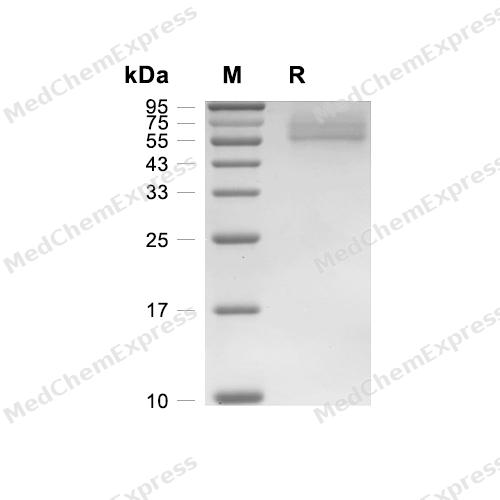
Purity - SDS-PAGE
-
Bioactivity - ELISA
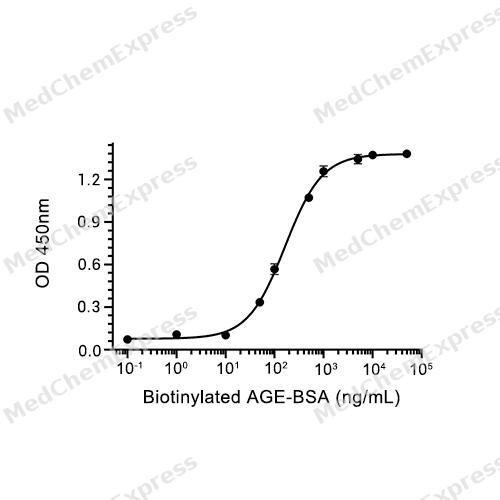
Bioactivity - ELISA


Technical Parameters
-
Species Human
-
Source HEK293
-
Tag N-6*His
-
Accession
P21757-1/NP_619729.1 (K77-L451)
-
Molecular Construction
-
N-term
-
6*His
-
MSR1 (K77-L451)
Accession # NP_619729.1 -
C-term
-
-
Protein Length
Full Length of Isoform-1
-
Synonyms
MSR1; Macrophage Acetylated LDL Receptor I And II; Macrophage Scavenger Receptor 1; Scavenger Receptor Class A Member 1; SCARA1; CDNA FLJ55770, Highly Similar To Macrophage Scavenger Receptor Types I And II; SR-AIII; Macrophage Scavenger Receptor Type III; SR-AII; CD204 Antigen; SR-AI; PhSR2; CD204; PhSR1; SR-A; SRA; Macrophage Scavenger Receptor Types I And II
-
AA Sequence
KWETKNCSVSSTNANDITQSLTGKGNDSEEEMRFQEVFMEHMSNMEKRIQHILDMEANLMDTEHFQNFSMTTDQRFNDILLQLSTLFSSVQGHGNAIDEISKSLISLNTTLLDLQLNIENLNGKIQENTFKQQEEISKLEERVYNVSAEIMAMKEEQVHLEQEIKGEVKVLNNITNDLRLKDWEHSQTLRNITLIQGPPGPPGEKGDRGPTGESGPRGFPGPIGPPGLKGDRGAIGFPGSRGLPGYAGRPGNSGPKGQKGEKGSGNTLTPFTKVRLVGGSGPHEGRVEILHSGQWGTICDDRWEVRVGQVVCRSLGYPGVQAVHKAAHFGQGTGPIWLNEVFCFGRESSIEECKIRQWGTRACSHSEDAGVTCTL
-
Molecular Weight
Approximately 55-65 kDa, based on SDS-PAGE under reducing conditions, due to the glycosylation.
-
Glycosylation
Yes
-
Purity
≥ 95%, as determined by reducing SDS-PAGE.


Product Properties
Lyophilized powder
Lyophilized from a 0.22 μm filtered solution of PBS, pH 7.4.
<1 EU/μg, determined by LAL method.
It is not recommended to reconstitute to a concentration less than 100 μg/mL in ddH2O. For long term storage it is recommended to add a carrier protein (0.1% BSA, 5% HSA, 10% FBS or 5% Trehalose).
Stored at -20°C for 2 years from date of receipt. After reconstitution, it is stable at 4°C for 1 week or -20°C for longer (with carrier protein). It is recommended to freeze aliquots at -20°C or -80°C for extended storage.
Room temperature in continental US; may vary elsewhere.


Documentation
-
Data Sheet (238 KB)
-
SDS (254 KB)
- English - EN (254 KB)
- Français - FR (254 KB)
- Deutsch - DE (254 KB)
- Norwegian - NO (254 KB)
- Español - ES (254 KB)
- Swedish - SV (254 KB)
- Italian - IT (254 KB)
- Korean - KR (254 KB)
- Portuguese - PT (254 KB)
-
Handling Instructions (2659 KB)

Calculators
Concentration (start) × Volume (start) = Concentration (final) × Volume (final)


 Powered by Bioz

