



CHI3L1 Protein, Mouse (HEK293, His)
Based on 1 publication(s) in Google Scholar
The CHI3L1 protein is a carbohydrate-binding lectin with a preference for chitin that is involved in tissue remodeling and cellular adaptation to environmental changes. It is involved in Th2 inflammation, IL-13-induced inflammation, allergen sensitization, inflammatory cell apoptosis, dendritic cell accumulation, M2 macrophage differentiation and pathogenic intestinal bacterial invasion. CHI3L1 Protein, Mouse (HEK293, His) is the recombinant mouse-derived CHI3L1 protein, expressed by HEK293 , with C-10*His labeled tag.
- Species: Mouse
- Source: HEK293
-
Storage:Stored at -20°C for 2 years from date of receipt. After reconstitution, it is stable at 4°C for 1 week or -20°C for longer (with carrier protein). It is recommended to freeze aliquots at -20°C or -80°C for extended storage.


To place orders, for customer services and technical support, please contact: MedChemExpress USA
Tel: 609-228-6898 E-mail: [email protected] [email protected]


-
 Biological Activity
-
Technical Parameters
-
Product Properties
- Documentation
- Help & FAQs


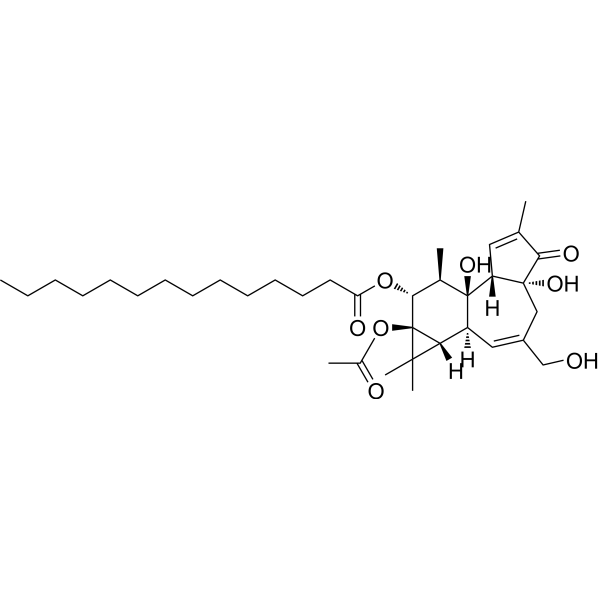


Biological Activity
Description
The CHI3L1 protein is a carbohydrate-binding lectin with a preference for chitin that is involved in tissue remodeling and cellular adaptation to environmental changes. It is involved in Th2 inflammation, IL-13-induced inflammation, allergen sensitization, inflammatory cell apoptosis, dendritic cell accumulation, M2 macrophage differentiation and pathogenic intestinal bacterial invasion. CHI3L1 Protein, Mouse (HEK293, His) is the recombinant mouse-derived CHI3L1 protein, expressed by HEK293 , with C-10*His labeled tag.
Background
CHI3L1 Protein is a carbohydrate-binding lectin that exhibits a specific preference for chitin. Although it lacks chitinase activity, it plays crucial roles in tissue remodeling and enables cells to adapt and respond to environmental changes. It is involved in various processes, such as T-helper cell type 2 (Th2) inflammatory response, IL-13-induced inflammation, regulation of allergen sensitization, modulation of inflammatory cell apoptosis, dendritic cell accumulation, and promotion of M2 macrophage differentiation. Furthermore, it facilitates the invasion of pathogenic enteric bacteria into the colonic mucosa and lymphoid organs. In colonic epithelial cells, it mediates the activation of the AKT1 signaling pathway, leading to subsequent production of IL8. CHI3L1 also regulates antibacterial responses in the lung by enhancing macrophage bacterial killing, controlling bacterial dissemination, and promoting host tolerance. Additionally, it plays a role in regulating hyperoxia-induced injury, inflammation, and epithelial apoptosis in the lung. It exists as a monomer.
Verified Bioactivity
Measured by the ability of the immobilized protein to support the adhesion of FaDu human squamous cell carcinoma cells. The ED50 for this effect is 3.232 μg/ml, corresponding to a specific activity is 309.4059 units/mg.
MCE Validation Data
-
Purity - SDS-PAGE
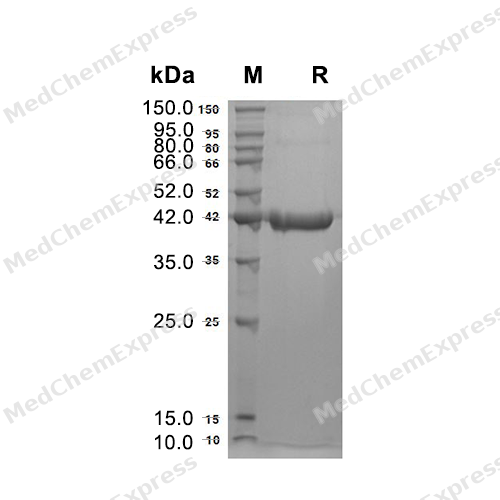
Purity - SDS-PAGE
-
Bioactivity - Cell-Based Assay
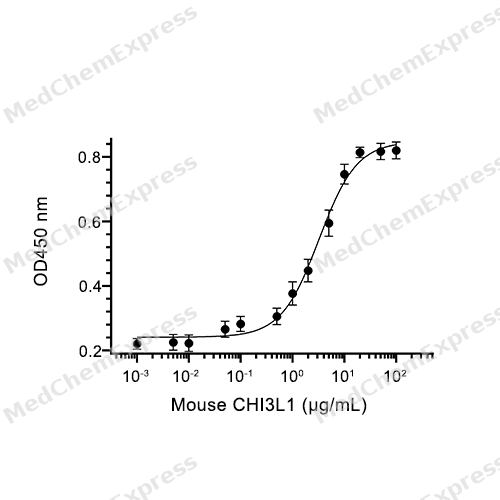
Bioactivity - Cell-Based Assay


Publications (1)
-
Journal Impact Factor
-
Most Recent
-
Adv Sci (Weinh)
Aberrant Chitinase 3-Like 1 Expression in Basal Cells Contributes to Systemic Sclerosis Fibrosis. [Abstract]2025 Feb;12(6):e2310169. PMID: 39686726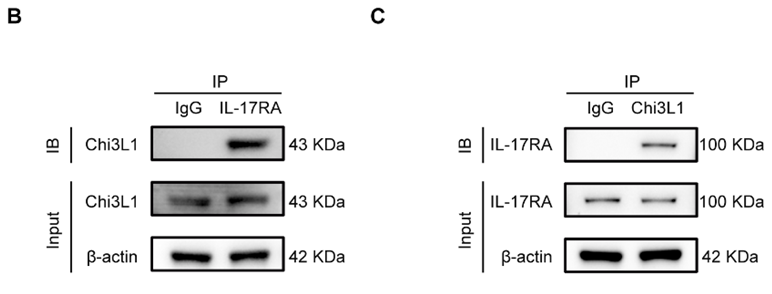
CHI3L1 Protein, Mouse (HEK293, His) purchased from MedChemExpress. Usage Cited in: Adv Sci (Weinh). 2025 Feb;12(6):e2310169. [Abstract]
Cellular CO-IP assays of Chi3L1 (CHI3L1 Protein, Mouse (HEK293, His)) (10 min) and IL-17RA. BLM-SSc WT mice DFs lysates were immunoprecipitated with antibody against IL-17RA, immunoblot with Chi3L1 antibody (B) and vice versa (C).


Technical Parameters
-
Species Mouse
-
Source HEK293
-
Tag C-10*His
-
Accession
Q61362-2 (Y22-A381)
-
Molecular Construction
-
N-term
-
CHI3L1 (Y22-A381)
Accession # Q61362-2 -
10*His
-
C-term
-
-
Protein Length
Partial
-
Synonyms
CHI3L1; HCGP-39; Chitinase 3 Like 1; CGP-39; Chitinase-3-Like Protein 1; YKL-40; YKL40; GP-39; YK-40; CHI3L1 Protein; GP39; HC-Gp39; Chitinase 3-Like 1 (Cartilage Glycoprotein-39); HCGP-3P; Cartilage Glycoprotein-39; YYL-40; Cartilage Glycoprotein 39; ASR
-
AA Sequence
YKLVCYFTSWSQYREGVGSFLPDAIQPFLCTHIIYSFANISSDNMLSTWEWNDESNYDKLNKLKTRNTNLKTLLSVGGWKFGEKRFSEIASNTERRTAFVRSVAPFLRSYGFDGLDLAWLYPRLRDKQYFSTLIKELNAEFTKEVQPGREKLLLSAALSAGKVAIDTGYDIAQIAQHLDFINLMTYDFHGVWRQITGHHSPLFQGQKDTRFDRYSNVNYAVQYMIRLGAQASKLLMGIPTFGKSFTLASSENQLGAPISGEGLPGRFTKEAGTLAYYEICDFLKGAEVHRLSNEKVPFATKGNQWVGYEDKESVKNKVGFLKEKKLAGAMVWALDLDDFQGTCQPKEFFPLTNAIKDALA
-
Molecular Weight
Approximately 42-50 kDa, based on SDS-PAGE under reducing conditions, due to the glycosylation.
-
Glycosylation
Yes
-
Purity
≥ 95%, as determined by reducing SDS-PAGE.


Product Properties
Lyophilized powder.
Lyophilized from a 0.22 μm filtered solution of 20 mM PB, 150 mM NaCl, pH 7.4.
<1 EU/μg, determined by LAL method.
It is not recommended to reconstitute to a concentration less than 100 μg/mL in ddH2O. For long term storage it is recommended to add a carrier protein (0.1% BSA, 5% HSA, 10% FBS or 5% Trehalose).
Stored at -20°C for 2 years from date of receipt. After reconstitution, it is stable at 4°C for 1 week or -20°C for longer (with carrier protein). It is recommended to freeze aliquots at -20°C or -80°C for extended storage.
Room temperature in continental US; may vary elsewhere.


Documentation
-
Data Sheet (238 KB)
-
SDS (251 KB)
- English - EN (251 KB)
- Français - FR (251 KB)
- Deutsch - DE (251 KB)
- Norwegian - NO (251 KB)
- Español - ES (251 KB)
- Swedish - SV (251 KB)
- Italian - IT (251 KB)
- Korean - KR (251 KB)
- Portuguese - PT (251 KB)
-
Handling Instructions (2659 KB)

Calculators
Concentration (start) × Volume (start) = Concentration (final) × Volume (final)


 Powered by Bioz

