



FGF-4 Protein, Human
Based on 12 publication(s) in Google Scholar
FGF-4 Protein is an important member of the fibroblast growth factor (FGF) family. By binding to FGFRs (especially FGFR1 and FGFR2), FGF-4 Protein can activate downstream signaling pathways such as RAS-MAPK and PI3K-AKT. FGF-4 Protein plays a key role in physiological processes such as cell growth, differentiation, migration, and angiogenesis. FGF-4 Protein, Human is a recombinant FGF-4 protein expressed by E. coli without a tag.
- Species: Human
- Source: E. coli
-
Storage:Stored at -20°C for 2 years from date of receipt. After reconstitution, it is stable at 4°C for 1 week or -20°C for longer (with carrier protein). It is recommended to freeze aliquots at -20°C or -80°C for extended storage.


To place orders, for customer services and technical support, please contact: MedChemExpress USA
Tel: 609-228-6898 E-mail: [email protected] [email protected]


-
 Biological Activity
-
Technical Parameters
-
Product Properties
- Documentation
- References
- Help & FAQs


-

HY-P7007
BMP-4 Protein, Human -
HY-P70311
Activin A Protein, Human/Mouse/Rat (HEK293) -
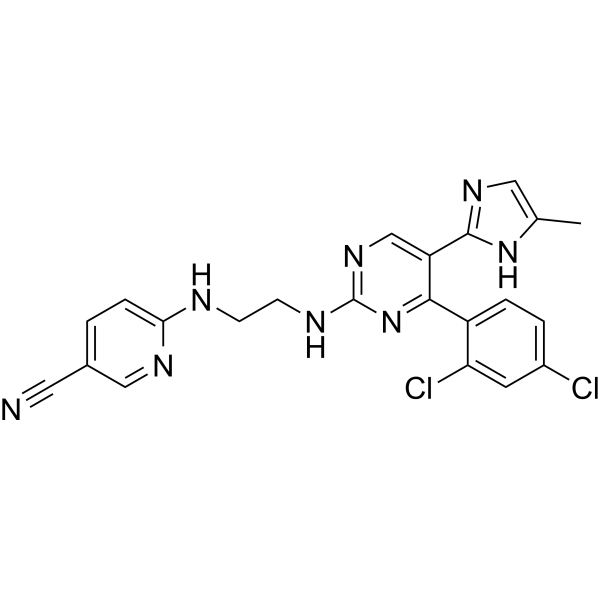
HY-10182
Laduviglusib -
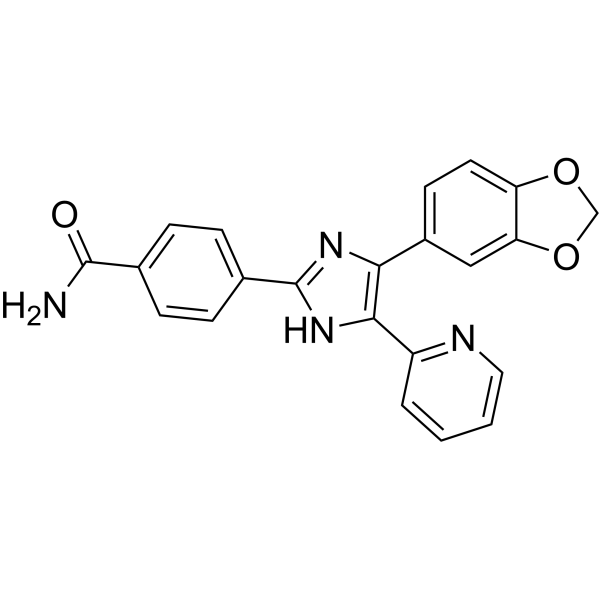
HY-10431
SB-431542 -
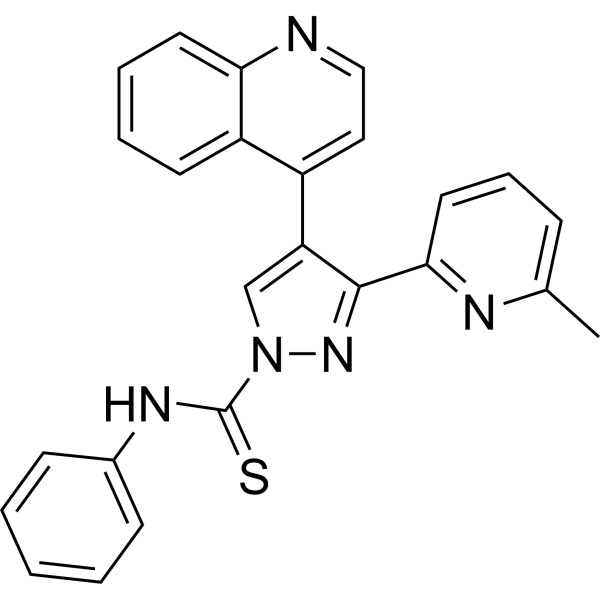
HY-10432
A 83-01 -
HY-P7109
EGF Protein, Human -
HY-P7121
HGF Protein, Human (CHO) -
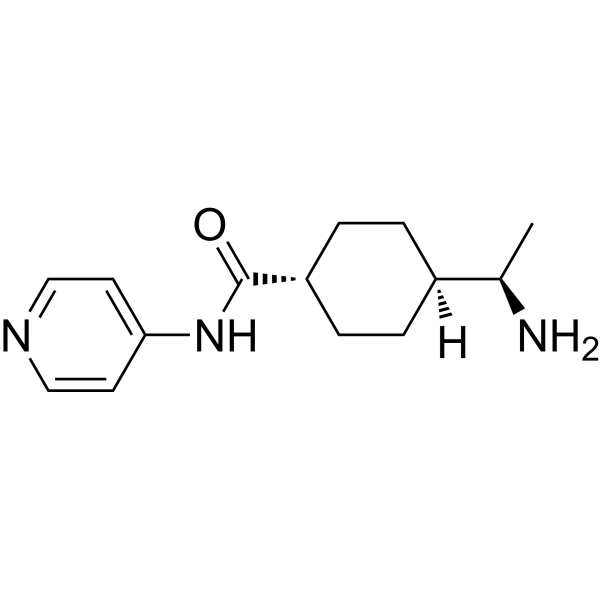
HY-10071
Y-27632 -
HY-P7048
KGF-2/FGF-10 Protein, Human (169a.a) -
HY-14648
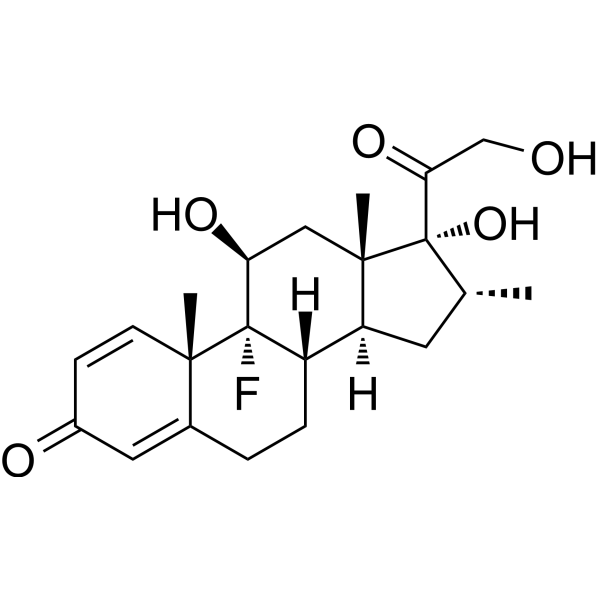
Dexamethasone -
HY-17567A
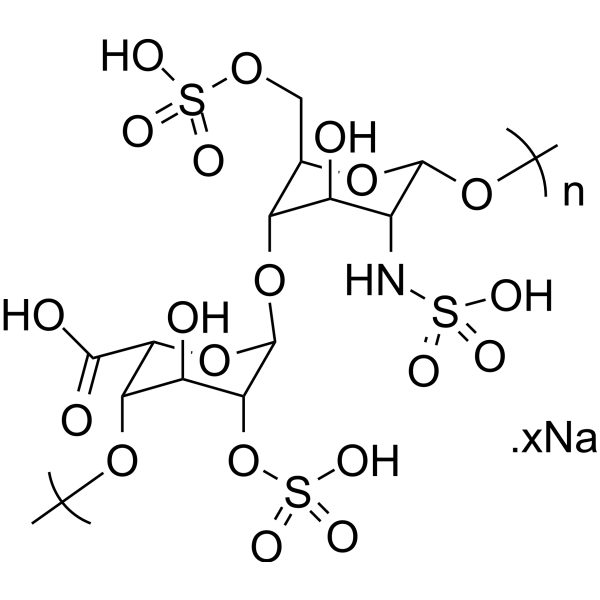
Heparin sodium salt -
HY-P7006
BMP-2 Protein, Human/Mouse/Rat


Biological Activity
Description
FGF-4 Protein is an important member of the fibroblast growth factor (FGF) family. By binding to FGFRs (especially FGFR1 and FGFR2), FGF-4 Protein can activate downstream signaling pathways such as RAS-MAPK and PI3K-AKT. FGF-4 Protein plays a key role in physiological processes such as cell growth, differentiation, migration, and angiogenesis. FGF-4 Protein, Human is a recombinant FGF-4 protein expressed by E. coli without a tag[1][2][3].
Background
FGF-4 Protein is encoded by the hst oncogene. FGF-4 Protein can bind to the FGFR2 receptor through autocrine/paracrine actions to stimulate endothelial cell proliferation and angiogenesis. However, when overexpressed, its ability to induce cell transformation and invasion is weaker than that of FGF-2, and it cannot trigger hemangiomas[1].
In Vitro
FGF-4 Protein (1.0-10 ng/mL; 20 min-22 h) can stimulate DNA synthesis and ERK1/2 phosphorylation in mouse aortic endothelial cells[1].
FGF-4 Protein (Human; 25 ng/mL) can be used for the preparation of trophoblast stem cell (TSCs) culture medium to maintain the proliferation and stemness of TSCs[2].
FGF-4 Protein (Human; 5-25 ng/mL; 12-24 days) can promote the proliferation of human bone marrow-derived mesenchymal stem cells without affecting cell phenotype and pluripotency[3].
Verified Bioactivity
The ED50 is ≤1.5 ng/mL as measured by 3T3 cells, corresponding to a specific activity of ≥6.67 × 10⁵ units/mg.


Publications (12)
-
Journal Impact Factor
-
Most Recent
-
Cell Stem Cell
Mouse totipotent blastomere-like cells model embryogenesis from zygotic genome activation to post implantation. [Abstract]2025 Mar 6;32(3):391-408.e11. PMID: 39826539 -
Trends Biotechnol
Rationally designed light-inducible RNA-releasing protein for translational regulation and optogenetic control of gene therapies. [Abstract]2026 Apr 8:S0167-7799(26)00089-2. PMID: 41956945 -
Adv Sci (Weinh)
Depletion of Sorcs3 Activates Totipotency in Mouse Embryonic Stem Cells by Modulating Key Signaling Pathways. [Abstract]2025 Nov 3:e09151. PMID: 41178446 -
Adv Sci (Weinh)
2025 Feb;12(6):e2408852. PMID: 39630006 -
Cell Rep Med
An Automated Organoid Platform with Inter-organoid Homogeneity and Inter-patient Heterogeneity. [Abstract]2020 Dec 22;1(9):100161. PMID: 33377132 -
Small
2020 Jun;16(22):e2001371. PMID: 32338439 -
Fundam Res
Droplet-engineered organoids recapitulate parental tissue transcriptome with inter-organoid homogeneity and inter-tumor cell heterogeneity. [Abstract]2022 Jun 3;4(6):1506-1514. PMID: 39734523 -
-
-
-
-


Technical Parameters
-
Species Human
-
Source E. coli
-
Tag Tag Free
-
Accession
P08620-1 (A31-L206)
-
Molecular Construction
-
N-term
-
FGF-4 (A31-L206)
Accession # P08620 -
C-term
-
-
Protein Length
Full Length of Isoform-1
-
Synonyms
FGF4; Heparin-Binding Growth Factor 4; Prev. HSTF1; HSTF-1; HBGF-4; FGF-4; HST-1; Heparin Secretory-Transforming Protein 1; HST; Fibroblast Growth Factor; Transforming Protein KS3; Oncogene HST; K-FGF; SRTD22; KFGF; KS3; Human Stomach Cancer, Transforming
-
AA Sequence
APTAPNGTLEAELERRWESLVALSLARLPVAAQPKEAAVQSGAGDYLLGIKRLRRLYCNVGIGFHLQALPDGRIGGAHADTRDSLLELSPVERGVVSIFGVASRFFVAMSSKGKLYGSPFFTDECTFKEILLPNNYNAYESYKYPGMFIALSKNGKTKKGNRVSPTMKVTHFLPRL
-
Predicted Molecular Mass
19.8 kDa
-
Molecular Weight
Approximately 19 kDa, based on SDS-PAGE under reducing conditions.
-
Purity
≥ 95%, as determined by reducing SDS-PAGE.


Product Properties
Lyophilized powder
1.Lyophilized from a 0.22 μm filtered solution of 50 mM HEPES, 750 mM NaCl, pH 7.5.
2.Lyophilized from a 0.22 μm filtered solution of 50 mM HEPES, 750 mM NaCl, pH 7.5, 8% trehalose.
Please refer to the lot-specific COA for specific buffer information.
<0.2 EU/μg, determined by LAL method.
It is not recommended to reconstitute to a concentration less than 100 μg/mL in ddH2O. For long term storage it is recommended to add a carrier protein (0.1% BSA, 5% HSA, 10% FBS or 5% Trehalose).
Stored at -20°C for 2 years from date of receipt. After reconstitution, it is stable at 4°C for 1 week or -20°C for longer (with carrier protein). It is recommended to freeze aliquots at -20°C or -80°C for extended storage.
Room temperature in continental US; may vary elsewhere.


Documentation
-
Data Sheet (262 KB)
-
SDS (251 KB)
- English - EN (251 KB)
- Français - FR (251 KB)
- Deutsch - DE (251 KB)
- Norwegian - NO (251 KB)
- Español - ES (251 KB)
- Swedish - SV (251 KB)
- Italian - IT (251 KB)
- Korean - KR (251 KB)
- Portuguese - PT (251 KB)
-
Handling Instructions (2659 KB)


References
[1]. Dell'Era P, et al. Paracrine and autocrine effects of fibroblast growth factor-4 in endothelial cells. Oncogene. 2001 May 10;20(21):2655-63. [Content Brief]
[2]. Zhang W, et al. Capture of Totipotency in Mouse Embryonic Stem Cells in the Absence of Pdzk1. Adv Sci (Weinh). 2025 Feb;12(6):e2408852. [Content Brief]
[3]. Farré J, et al. FGF-4 increases in vitro expansion rate of human adult bone marrow-derived mesenchymal stem cells. Growth Factors. 2007 Apr;25(2):71-6. [Content Brief]

Calculators
Concentration (start) × Volume (start) = Concentration (final) × Volume (final)


 Powered by Bioz

