



HB-EGF Protein, Mouse
Based on 3 publication(s) in Google Scholar
HB-EGF Protein, Mouse is shown to play a role in wound healing, cardiac hypertrophy, and heart development and function.
- Species: Mouse
- Source: E. coli
-
Storage:Stored at -20°C for 2 years from date of receipt. After reconstitution, it is stable at 4°C for 1 week or -20°C for longer (with carrier protein). It is recommended to freeze aliquots at -20°C or -80°C for extended storage.


To place orders, for customer services and technical support, please contact: MedChemExpress USA
Tel: 609-228-6898 E-mail: [email protected] [email protected]


-
 Biological Activity
-
Technical Parameters
-
Product Properties
- Documentation
- References
- Help & FAQs




Biological Activity
Description
HB-EGF Protein, Mouse is shown to play a role in wound healing, cardiac hypertrophy, and heart development and function.
Background
Heparin-binding epidermal growth factor-like growth factor (HBEGF) is a heparin-binding member of the EGF family. It is a potent mitogen and chemotactic factor for fibroblasts and smooth muscle cells. As with other EGF family members, HB-EGF binds and activates EGF receptors 1 and 4. HB-EGF has been shown to stimulate the growth of a variety of cells in an autocrine or paracrine manner and to be involved in stromal proliferation. HB-EGF is also a potent inducer of tumor growth and angiogenesis[1].
Verified Bioactivity
The ED50 is <1 ng/mL as measured by murine Balb/c 3T3 cells, corresponding to a specific activity of >1.0 × 10⁶IU/mg.
MCE Validation Data
-
Purity - SDS-PAGE
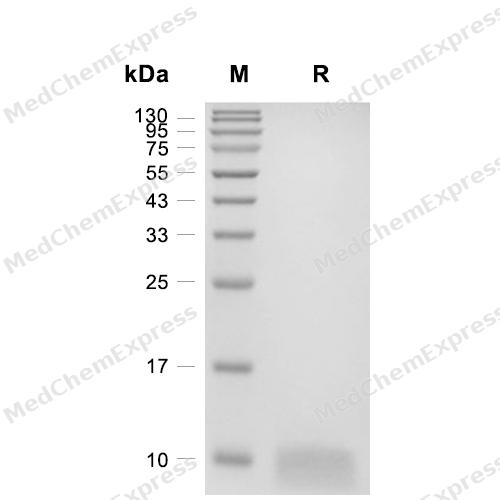
Purity - SDS-PAGE


Publications (3)
-
Journal Impact Factor
-
Most Recent
-
Mol Ther
HBEGF/EGFR pathway activation by hUC-MSCs improves cognitive outcomes in anti-NMDAR encephalitis. [Abstract]2025 Oct 16:S1525-0016(25)00861-5. PMID: 41108076 -
Diabetologia
Single-cell RNA sequencing identifies endothelial-derived HBEGF as promoting pancreatic beta cell proliferation in mice via the EGFR-Kmt5a-H4K20me pathway. [Abstract]2025 Apr;68(4):835-853. PMID: 39694915
HB-EGF Protein, Mouse purchased from MedChemExpress. Usage Cited in: Diabetologia. 2025 Apr;68(4):835-853. [Abstract]
EdU labeling (green) of proliferating beta cells in primary islets from female and male mice treated with 100 ng/ml HBEGF or an equal volume of double-distilled H2O (control) for 72 h.

HB-EGF Protein, Mouse purchased from MedChemExpress. Usage Cited in: Diabetologia. 2025 Apr;68(4):835-853. [Abstract]
qPCR analysis of Kmt5a expression in isolated primary islets treated with 100 ng/ml HBEGF for 72 h.
-
ACS Appl Bio Mater
3D Co-cultured Endothelial Cells and Monocytes Promoted Cancer Stem Cells' Stemness and Malignancy. [Abstract]2021 Jan 18;4(1):441-450. PMID: 35014295


Technical Parameters
-
Species Mouse
-
Source E. coli
-
Tag Tag Free
-
Accession
Q06186 (D63-L148)
-
Molecular Construction
-
N-term
-
HB-EGF (D63-L148)
Accession # Q06186 -
C-term
-
-
Protein Length
Full Length of Heparin-binding EGF-like growth factor Chain
-
Synonyms
HBEGF; Diphtheria Toxin Receptor (Heparin-Binding EGF-Like Growth Factor); Prev. HEGFL; Heparin-Binding Epidermal Growth Factor; Prev. DTR; Short Form Heparin-Binding EGF-Like Growth Factor; Prev. DTS; Heparin-Binding EGF-Like Growth Factor; Diphtheria To
-
AA Sequence
DLEGTDLNLFKVAFSSKPQGLATPSKERNGKKKKKGKGLGKKRDPCLRKYKDYCIHGECRYLQEFRTPSCKCLPGYHGHRCHGLTL
-
Predicted Molecular Mass
9.8 kDa
-
Molecular Weight
Approximately 10 kDa, based on SDS-PAGE under reducing conditions.
-
Purity
≥ 95%, as determined by reducing SDS-PAGE.


Product Properties
Lyophilized powder
1.Lyophilized from a 0.22 μm filtered solution of 10 mM PB, 150 mM NaCl, pH7.4.
2.Lyophilized from a 0.22 μm filtered solution of 10 mM PB, 500 mM NaCl, pH 7.4.
3.Lyophilized from a 0.22 μm filtered solution of 10 mM PB, 500 mM NaCl, 8% trehalose, pH 7.4.
Please refer to the lot-specific COA for specific buffer information.
<1 EU/μg, determined by LAL method.
It is not recommended to reconstitute to a concentration less than 100 μg/mL in ddH2O. For long term storage it is recommended to add a carrier protein (0.1% BSA, 5% HSA, 10% FBS or 5% Trehalose).
Stored at -20°C for 2 years from date of receipt. After reconstitution, it is stable at 4°C for 1 week or -20°C for longer (with carrier protein). It is recommended to freeze aliquots at -20°C or -80°C for extended storage.
Room temperature in continental US; may vary elsewhere.


Documentation
-
Data Sheet (261 KB)
-
SDS (252 KB)
- English - EN (252 KB)
- Français - FR (252 KB)
- Deutsch - DE (252 KB)
- Norwegian - NO (252 KB)
- Español - ES (252 KB)
- Swedish - SV (252 KB)
- Italian - IT (252 KB)
- Korean - KR (252 KB)
- Portuguese - PT (252 KB)
-
Handling Instructions (2659 KB)


References

Calculators
Concentration (start) × Volume (start) = Concentration (final) × Volume (final)


 Powered by Bioz

