



Epiregulin Protein, Mouse (HEK293, hFc)
Based on 1 publication(s) in Google Scholar
Epiregulin Protein, a ligand for EGFR and ERBB4, induces their tyrosine phosphorylation, playing a pivotal role in inflammation, wound healing, tissue repair, and oocyte maturation. It regulates angiogenesis, vascular remodeling, and cell proliferation, emphasizing its involvement in intricate cellular signaling pathways. Epiregulin Protein, Mouse (HEK293, hFc) is the recombinant mouse-derived Epiregulin protein, expressed by HEK293 , with N-hFc labeled tag.
- Species: Mouse
- Source: HEK293
-
Storage:Stored at -80°C for 1 year from date of receipt. It is stable at -20°C for 3 months after opening. It is recommended to freeze aliquots at -80°C for extended storage. Avoid repeated freeze-thaw cycles.


To place orders, for customer services and technical support, please contact: MedChemExpress USA
Tel: 609-228-6898 E-mail: [email protected] [email protected]


-
 Biological Activity
-
Technical Parameters
-
Product Properties
- Documentation
- Help & FAQs




Biological Activity
Description
Epiregulin Protein, a ligand for EGFR and ERBB4, induces their tyrosine phosphorylation, playing a pivotal role in inflammation, wound healing, tissue repair, and oocyte maturation. It regulates angiogenesis, vascular remodeling, and cell proliferation, emphasizing its involvement in intricate cellular signaling pathways. Epiregulin Protein, Mouse (HEK293, hFc) is the recombinant mouse-derived Epiregulin protein, expressed by HEK293 , with N-hFc labeled tag.
Background
Epiregulin protein serves as a ligand for both the EGF receptor (EGFR) and ERBB4, eliciting the tyrosine phosphorylation of these receptors. This versatile protein plays a pivotal role in various physiological processes, including inflammation, wound healing, tissue repair, and oocyte maturation, exerting its influence through the regulation of angiogenesis, vascular remodeling, and cell proliferation. Its interaction with EGFR and ERBB4 highlights its involvement in intricate cellular signaling pathways.
Verified Bioactivity
Measured in a cell proliferation assay using Balb/3T3 mouse embryonic fibroblast cells and the ED50 is typically 0.5-2.5 μg/mL.
MCE Validation Data
-
Purity - SDS-PAGE
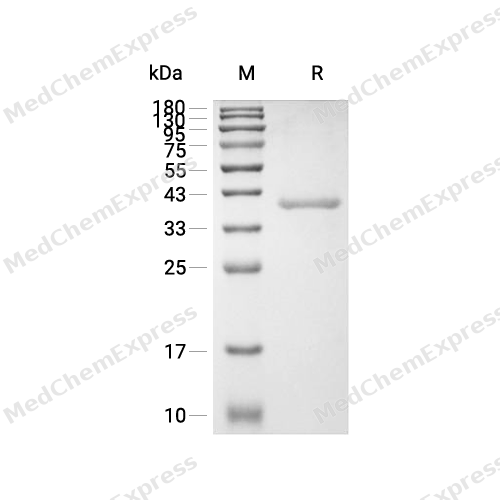
Purity - SDS-PAGE


Publications (1)
-
Journal Impact Factor
-
Most Recent
-
Cell Rep
2026 Mar 24;45(3):117086. PMID: 41831232


Technical Parameters
-
Species Mouse
-
Source HEK293
-
Tag N-hFc
-
Accession
Q61521 (V56-L101)
-
Molecular Construction
-
N-term
-
hFc
-
Epiregulin (V56-L101)
Accession # Q61521 -
C-term
-
-
Protein Length
Full Length of Epiregulin Chain
-
Synonyms
EREG; Alternative Protein EREG; Epiregulin; EPR; ER; Ep; Proepiregulin
-
AA Sequence
VQITKCSSDMDGYCLHGQCIYLVDMREKFCRCEVGYTGLRCEHFFL
-
Predicted Molecular Mass
33.8 kDa
-
Molecular Weight
Approximately 37 kDa, based on SDS-PAGE under reducing conditions.
-
Purity
≥ 95%, as determined by reducing SDS-PAGE.


Product Properties
Solution
Supplied as a 0.22 μm filtered solution of PBS, pH 7.4.
<1 EU/μg, determined by LAL method.
Stored at -80°C for 1 year from date of receipt. It is stable at -20°C for 3 months after opening. It is recommended to freeze aliquots at -80°C for extended storage. Avoid repeated freeze-thaw cycles.
Shipping with dry ice.


Documentation
-
Data Sheet (232 KB)
-
SDS (251 KB)
- English - EN (251 KB)
- Français - FR (251 KB)
- Deutsch - DE (251 KB)
- Norwegian - NO (251 KB)
- Español - ES (251 KB)
- Swedish - SV (251 KB)
- Italian - IT (251 KB)
- Korean - KR (251 KB)
- Portuguese - PT (251 KB)
-
Handling Instructions (2659 KB)

Calculators
Concentration (start) × Volume (start) = Concentration (final) × Volume (final)


 Powered by Bioz

