



HCC-1/CCL14 Protein, Human (HEK293, His)
Based on 1 publication(s) in Google Scholar
HCC-1/CCL14 Protein, Human (HEK293, His) is a CC chemokine with weak activity against human monocytes, promotes monocyte, eosinophil and T-lymphocyte chemotaxis, and mediates allergic airway inflammation and cancer. HCC-1/CCL14 Protein, Human (HEK293, His) is a recombinant human HCC-1/CCL14(T20-N93) expressed by HEK293 with a his tag.
- Species: Human
- Source: HEK293
-
Storage:Stored at -20°C for 2 years from date of receipt. After reconstitution, it is stable at 4°C for 1 week or -20°C for longer (with carrier protein). It is recommended to freeze aliquots at -20°C or -80°C for extended storage.


To place orders, for customer services and technical support, please contact: MedChemExpress USA
Tel: 609-228-6898 E-mail: [email protected] [email protected]


-
 Biological Activity
-
Technical Parameters
-
Product Properties
- Documentation
- References
- Help & FAQs




Biological Activity
Description
HCC-1/CCL14 Protein, Human (HEK293, His) is a CC chemokine with weak activity against human monocytes, promotes monocyte, eosinophil and T-lymphocyte chemotaxis, and mediates allergic airway inflammation and cancer. HCC-1/CCL14 Protein, Human (HEK293, His) is a recombinant human HCC-1/CCL14(T20-N93) expressed by HEK293 with a his tag[1][2].
Background
CCL14, also known as HCC-1, is a human plasma chemokine originally collected and purified from the hemofiltrate of patients with chronic renal failure. CCL14 belongs to the small cytokine family of CC chemokines, a cluster of chemokines located on human chromosome 17 that can be expressed in a variety of tissues, including spleen, bone marrow, liver, muscle, and intestine. CCL14 has weak activity against human monocytes and no activity against T lymphocytes, neutrophils, and eosinophils. CCL14 is weakly active against human monocytes and inactive against T lymphocytes, neutrophils, and eosinophils.CCL14 acts as a protein precursor that requires protein hydrolysis to obtain receptor affinity and is processed to yield a mature active protein containing 74 amino acids. The processed HCC-1(9-74) is a chemokine that attracts monocytes, eosinophils and T cells and binds to CCR1, CCR3 and CCR5 chemokine receptors[2]. Post-translational modifications of CCL14 chemokines, such as N-terminal truncation and glycosylation, also result in differential signaling compared to unmodified ones. For example, both full-length CCL14(1-74) and truncated isoform CCL14(9-74) bind to atypical chemokine receptor 2 (ACKR2), but only truncated CCL14(9-74) shows a propensity for β-restin and induces receptor internalization of ACKR2 compared to CCL14(1-74). Meanwhile, CCL14(1-74) was a weak agonist of chemokine receptor CCR1, but its activity was significantly enhanced after proteolytic cleavage to CCL14(9-74)[1]. CCL14 has been shown to inhibit HCC cell proliferation by inhibiting cell cycle progression and promoting apoptosis in hepatocellular carcinoma (HCC) cells.CCL14 inhibits HCC tumor growth in nude mice in vivo.CCL14 is also involved in the pathogenesis and progression of various diseases, including allergic airway inflammation and some cancers[2].
In Vitro
CCL14 (10 nM, 22 h) can increase trophoblast adhesion to fibronectin by 3-fold and increase expression of extracellular matrix and adhesion molecules such as collagen COL5A1, matrix metalloproteinase MMP12 in human choriocarcinoma-primary trophoblast hybrid AC1M-88 cell line[3].
Verified Bioactivity
Measured by its ability to chemoattract THP-1 human acute monocytic leukemia cells. The ED50 for this effect is 5.559 ng/mL, corresponding to a specific activity is 1.798×10⁵ U/mg.
MCE Validation Data
-
Purity - SDS-PAGE
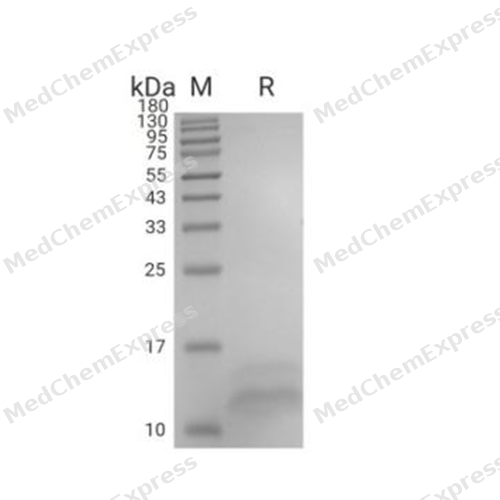
Purity - SDS-PAGE
-
Bioactivity - Cell-Based Assay
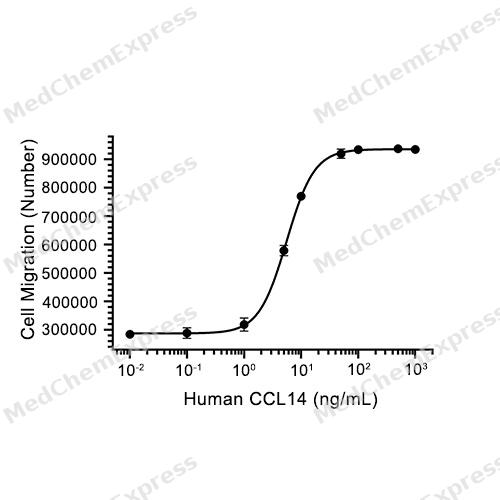
Bioactivity - Cell-Based Assay


Publications (1)
-
Journal Impact Factor
-
Most Recent
-
Immunity
Spatiotemporal dynamics of CXCL10 encode contextual immune information revealed by the genetically encoded fluorescent sensor. [Abstract]2025 Sep 9;58(9):2320-2335.e9. PMID: 40818452


Technical Parameters
-
Species Human
-
Source HEK293
-
Tag C-6*His
-
Accession
Q16627-1 (T20-N93)
-
Molecular Construction
-
N-term
-
CCL14 (T20-N93)
Accession # Q16627-1 -
6*His
-
C-term
-
-
Protein Length
Full Length of Isoform-1
-
Synonyms
CCL14; C-C Motif Chemokine 14; Prev. SCYA14; HCC-1(1-74); NCC-2; HCC-1/HCC-3; HCC-1; NCC2; HCC-3; Hemofiltrate CC Chemokine 1; SCYL2; C-C Motif Chemokine; CKb1; New CC Chemokine 2; MCIF; Chemokine CC-3; Small Inducible Cytokine Subfamily A (Cys-Cys), Memb
-
AA Sequence
TKTESSSRGPYHPSECCFTYTTYKIPRQRIMDYYETNSQCSKPGIVFITKRGHSVCTNPSDKWVQDYIKDMKEN
-
Predicted Molecular Mass
9.7 kDa
-
Molecular Weight
Approximately 12-15 kDa, based on SDS-PAGE under reducing conditions.
-
Glycosylation
Yes
-
Purity
≥ 95%, as determined by reducing SDS-PAGE.


Product Properties
Lyophilized powder.
Lyophilized after extensive dialysis against 20 mM PB, 150 mM NaCl, pH 7.2.
<1 EU/μg, determined by LAL method.
It is not recommended to reconstitute to a concentration less than 100 μg/mL in ddH2O. For long term storage it is recommended to add a carrier protein (0.1% BSA, 5% HSA, 10% FBS or 5% Trehalose).
Stored at -20°C for 2 years from date of receipt. After reconstitution, it is stable at 4°C for 1 week or -20°C for longer (with carrier protein). It is recommended to freeze aliquots at -20°C or -80°C for extended storage.
Room temperature in continental US; may vary elsewhere.


Documentation
-
Data Sheet (264 KB)
-
SDS (252 KB)
- English - EN (252 KB)
- Français - FR (252 KB)
- Deutsch - DE (252 KB)
- Norwegian - NO (252 KB)
- Español - ES (252 KB)
- Swedish - SV (252 KB)
- Italian - IT (252 KB)
- Korean - KR (252 KB)
- Portuguese - PT (252 KB)
-
Handling Instructions (2659 KB)


References
[1]. Siyao Wang, et al. Glycosylation Regulates N-Terminal Proteolysis and Activity of the Chemokine CCL14. ACS Chem Biol. 2021 Jun 18;16(6):973-981. [Content Brief]
[2]. Yurong Gu, et al. CCL14 is a prognostic biomarker and correlates with immune infiltrates in hepatocellular carcinoma. Aging (Albany NY). 2020 Jan 12;12(1):784-807. [Content Brief]
[3]. Mengxuan Zhu, et al. CCL14 serves as a novel prognostic factor and tumor suppressor of HCC by modulating cell cycle and promoting apoptosis. Cell Death Dis. 2019 Oct 22;10(11):796. [Content Brief]
[4]. Natalie J Hannan, et al. CX3CL1 and CCL14 regulate extracellular matrix and adhesion molecules in the trophoblast: potential roles in human embryo implantation. Biol Reprod. 2008 Jul;79(1):58-65. [Content Brief]

Calculators
Concentration (start) × Volume (start) = Concentration (final) × Volume (final)


 Powered by Bioz

