



IFN-alpha 2/IFNA2 Protein, Mouse (HEK293, Fc, solution)

Based on 1 Customer Validation
IFN-alpha 2 (IFNA2), belongs to type I interferon family, is a protein secreted by cells infected by a virus and acting on other cells to inhibit viral infection. IFN-alpha 2 increases the frequencies of cytotoxic CD8+ T cells and induces CD4+ T cell depletion. IFN-alpha 2/IFNA2 Protein, Mouse (HEK293, Fc) contains 167 a.a. (C24-E190), is produced in HEK293 cells with a N-terminal hFc-tag.
- Species: Mouse
- Source: HEK293
-
Storage:Stored at -80°C for 1 year from date of receipt. It is stable at -20°C for 3 months after opening. It is recommended to freeze aliquots at -80°C for extended storage. Avoid repeated freeze-thaw cycles.


To place orders, for customer services and technical support, please contact: MedChemExpress USA
Tel: 609-228-6898 E-mail: [email protected] [email protected]


-
 Biological Activity
-
Technical Parameters
-
Product Properties
- Documentation
- References
- Help & FAQs




Biological Activity
Description
IFN-alpha 2 (IFNA2), belongs to type I interferon family, is a protein secreted by cells infected by a virus and acting on other cells to inhibit viral infection[1]. IFN-alpha 2 increases the frequencies of cytotoxic CD8+ T cells and induces CD4+ T cell depletion[3]. IFN-alpha 2/IFNA2 Protein, Mouse (HEK293, Fc) contains 167 a.a. (C24-E190), is produced in HEK293 cells with a N-terminal hFc-tag.
Background
IFN-alpha 2 (IFNA2; IFN-α2), belongs to the type I interferon family, produced by the plasmacytoid dendritic cells (pDCs) exposure to HIV-1BaL in order to inhibit viral infection[1].
Interferon (IFN) is originally identified as a substance ‘interfering’ with viral replication in vitro. IFN-α/β and related molecules are classified as type I IFNs, as for the other two types of type II IFN (IFN-γ) and type III IFNs (IFN-λ), respectively[2].
IFN-alpha 2 subtype is the only one that is currently licensed to treat infections caused by hepatitis B virus (HBV) and HCV[3].
IFN-alpha 2 shows a Sortilin-dependent trafficking in cells and increases the expression level of interferon-stimulated genes (ISGs) in HIV-infected cells[1][4]. It also exhibits cytotoxic activity against CD8+ T cells and enhances CD4+ T cell depletion[3].
Among the IFN-alpha 2 alleles, IFN-alpha 2b is being the predominant allele while IFNα-2a is less predominant and IFNα-2c only a minor allelic variant[5].
IFN-alpha 2 has a bored application in research of cancer, including some hematological malignancies and solid tumors[6]. As for a wildly use of IFN in animal disease model, the sequence of amino acids in IFNA2a protein of mouse is very different from human (59.57%).
In Vitro
mIFN-alpha 2 (mouse) mediates the interaction with mSortilin via Arg22, and the mIFNa2-mCherry is transiently co-expressed with mSortilin-EGFP in HEK293T cells[4].
Verified Bioactivity
1.Measured in antiviral assays using L929 cells infected with vesicular stomatitisvirus (VSV) and the ED50 is 1-8 ng/mL.
2. Measured by binding ability in a functional ELISA. Immobilized mouse IFNAR1-His at 2 μg/mL (100 μl/well) can bind IFN-alpha 2 Protein, Mouse (HEK293, Fc) and the EC50 is 47.5 ng/mL.
MCE Validation Data
-
Purity - SDS-PAGE
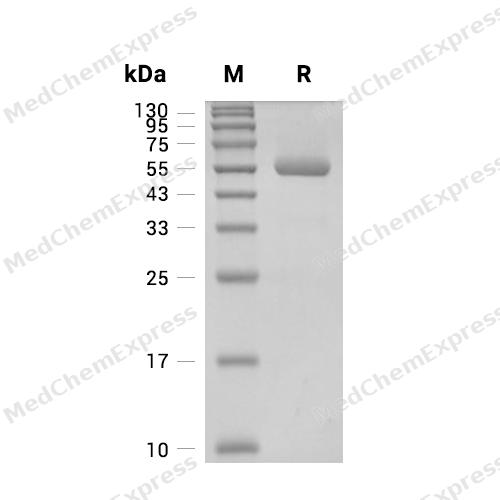
Purity - SDS-PAGE


Technical Parameters
-
Species Mouse
-
Source HEK293
-
Tag N-hFc
-
Accession
P01573 (C24-E190)
-
Molecular Construction
-
N-term
-
hFc
-
IFNA2 (C24-E190)
Accession # P01573 -
C-term
-
-
Protein Length
Full Length of Mature Protein
-
Synonyms
IFNA2; IFN-Alpha-2; Interferon Alpha 2; IFNA2B; IFN-AlphaA; LeIF A; IFNA; Interferon Alpha 2a; Alpha-2a Interferon; Interferon Alpha-A; Interferon Alpha 2b; Interferon 1AB4; Interferon Alpha A; IFNA2C; Interferon Alpha-2; IFNA2A
-
AA Sequence
CDLPHTYNLRNKRALKVLAQMRRLPFLSCLKDRQDFGFPLEKVDNQQIQKAQAIPVLRDLTQQTLNLFTSKASSAAWNATLLDSFCNDLHQQLNDLQTCLMQQVGVQEPPLTQEDALLAVRKYFHRITVYLREKKHSPCAWEVVRAEVWRALSSSVNLLPRLSEEKE
-
Predicted Molecular Mass
47.8 kDa
-
Molecular Weight
Approximately 52 kDa, based on SDS-PAGE under reducing conditions.
-
Glycosylation
Yes
-
Purity
≥ 90%, as determined by reducing SDS-PAGE.


Product Properties
Solution
Supplied as a 0.22 μm filtered solution of PBS, pH 7.4.
<1 EU/μg, determined by LAL method.
Stored at -80°C for 1 year from date of receipt. It is stable at -20°C for 3 months after opening. It is recommended to freeze aliquots at -80°C for extended storage. Avoid repeated freeze-thaw cycles.
Shipping with dry ice.


Documentation
-
Data Sheet (265 KB)
-
SDS (251 KB)
- English - EN (251 KB)
- Français - FR (251 KB)
- Deutsch - DE (251 KB)
- Norwegian - NO (251 KB)
- Español - ES (251 KB)
- Swedish - SV (251 KB)
- Italian - IT (251 KB)
- Korean - KR (251 KB)
- Portuguese - PT (251 KB)
-
Handling Instructions (2659 KB)


References
[1]. Abraham S, et al. Gene therapy with plasmids encoding IFN-β or IFN-α14 confers long-term resistance to HIV-1 in humanized mice. Oncotarget. 2016 Nov 29;7(48):78412-78420. [Content Brief]
[2]. Zhang SY, et al. Inborn errors of interferon (IFN)-mediated immunity in humans: insights into the respective roles of IFN-alpha/beta, IFN-gamma, and IFN-lambda in host defense. Immunol Rev. 2008 Dec;226:29-40. [Content Brief]
[3]. Sutter K, et al. Interferon α subtypes in HIV infection. Cytokine Growth Factor Rev. 2018 Apr;40:13-18. [Content Brief]
[4]. Watanabe H, et al. Detailed structure of mouse interferon α2 and its interaction with Sortilin. J Biochem. 2021 Oct 11;170(2):265-273. [Content Brief]
[5]. Gull I, et al. Heterologous expression, immunochemical and computational analysis of recombinant human interferon alpha 2b. Springerplus. 2013 Jun 15;2(1):264. [Content Brief]
[6]. Paul F, et al. IFNA2: The prototypic human alpha interferon. Gene. 2015 Aug 10;567(2):132-7. [Content Brief]

Calculators
Concentration (start) × Volume (start) = Concentration (final) × Volume (final)


 Powered by Bioz

