



IL-12 Protein, Rat (HEK293, His)

Based on 1 Customer Validation
IL-12 protein forms IL-12 cytokine and IL-35 cytokine. It regulates T cell and natural killer cell responses, stimulates interferon gamma production, and promotes T helper 1 cell differentiation. IL-12 Protein, Rat (HEK293, His) is a recombinant protein dimer complex containing rat-derived IL-12 protein, expressed by HEK293 , with C-6*His labeled tag. IL-12 Protein, Rat (HEK293, His), has molecular weight of 25-35 & 40-50 kDa, respectively.
- Species: Rat
- Source: HEK293
-
Storage:Stored at -20°C for 2 years from date of receipt. After reconstitution, it is stable at 4°C for 1 week or -20°C for longer (with carrier protein). It is recommended to freeze aliquots at -20°C or -80°C for extended storage.


To place orders, for customer services and technical support, please contact: MedChemExpress USA
Tel: 609-228-6898 E-mail: [email protected] [email protected]


-
 Biological Activity
-
Technical Parameters
-
Product Properties
- Documentation
- Help & FAQs




Biological Activity
Description
IL-12 protein forms IL-12 cytokine and IL-35 cytokine. It regulates T cell and natural killer cell responses, stimulates interferon gamma production, and promotes T helper 1 cell differentiation. IL-12 Protein, Rat (HEK293, His) is a recombinant protein dimer complex containing rat-derived IL-12 protein, expressed by HEK293 , with C-6*His labeled tag. IL-12 Protein, Rat (HEK293, His), has molecular weight of 25-35 & 40-50 kDa, respectively.
Background
The IL-12 Protein has the ability to heterodimerize with IL12B to form the IL-12 cytokine, or with EBI3/IL27B to form the IL-35 cytokine. It is primarily produced by professional antigen-presenting cells such as B-cells, dendritic cells, macrophages, and granulocytes, and plays a crucial role in regulating T-cell and natural killer-cell responses. IL-12 stimulates the production of interferon-gamma and promotes the differentiation of T-helper 1 cells, bridging the gap between innate resistance and adaptive immunity. Its biological effects are mediated through a receptor composed of IL12R1 and IL12R2 subunits, leading to the phosphorylation of cellular substrates including TYK2 and JAK2. This, in turn, activates STAT4 and facilitates the regulation of cytokine/growth factor responsive genes. In the context of IL-35, IL-12 Protein contributes to maintaining immune homeostasis in the liver microenvironment and acts as an immune-suppressive cytokine. Its signaling occurs through unconventional receptors composed of IL12RB2 and gp130/IL6ST heterodimers or homodimers, and requires the involvement of transcription factors STAT1 and STAT4. Furthermore, IL-12 Protein can form a disulfide-linked heterodimer with IL12B, known as interleukin IL-12, and a non-disulfide-linked heterodimer with EBI3/IL27B, known as interleukin IL-35. Additionally, it interacts with NBR1, promoting the secretion of IL-12.
Verified Bioactivity
Measured by its ability to induce Interferon gamma secretion by human natural killer lymphoma NK-92 cells. The ED50 for this effect is 0.4193 μg/mL, corresponding to a specific activity is 2384.927 units/mg.
MCE Validation Data
-
Purity - SDS-PAGE
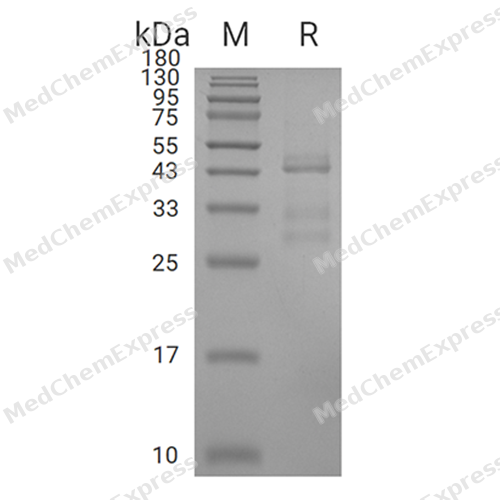
Purity - SDS-PAGE
-
Bioactivity - Cell-Based Assay
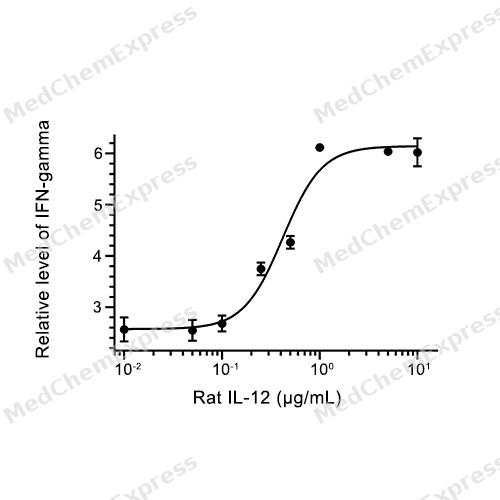
Bioactivity - Cell-Based Assay


Technical Parameters
-
Species Rat
-
Source HEK293
-
Tag C-6*His
-
Molecular Construction
-
N-term
-
IL12B (M23-S335)
Accession # Q9R278 -
C-term
-
N-term
-
IL12A (R23-S215)
Accession # Q9R103 -
6*His
-
C-term
-
-
Synonyms
IL12A; Cytotoxic Lymphocyte Maturation Factor 1, P35; Prev. NKSF1; NK Cell Stimulatory Factor Chain 1; IL-12A; Interleukin-12 Alpha Chain; Interleukin-12 Subunit Alpha; Interleukin 12, P35; CLMF; IL-12, Subunit P35; NFSK; IL35 Subunit; P35; CLMF P35; Inte
-
AA Sequence
MWELEKDVYVVEVDWRPDAPGETVTLTCDSPEEDDITWTSDQRRGVIGSGKTLTITVREFLDAGQYTCHRGGETLSHSHLLLHKKENGIWSTEILKNFKNKTFLKCEAPNYSGRFTCSWLVHRNTDLKFNIKSSSSSPESRAVTCGRASLSAEKVTLNQRDYEKYSVACQEDVTCPTAEETLPIELVVEAQQQNKYENYSTSFFIRDIIKPDPPKNLQVKPLKNSQVEVSWEYPDSWSTPHSYFSLKFFVRIQRKKEKTKETEEECNQKGAFLVEKTSAEVQCKGANICVQAQDRYYNSSCSKWTCVPCRGRS&RVIPVSGPAKCLNQSQNLLKTTDDMVRTAREKLKHYSCTAGDIDHEDITRDKTSTLEACLPLELHKNESCLATKETSSIIRGSCLPPQKTSLMMTLCLGSIYEDLKMYQSEFQAINAALQSHNHQQITLDRNMLMAIDELMRSLNHSGETLHQKAPMGEADPYRVKMKLCILLHAFSTRVMTINRVMNYLSSS
-
Predicted Molecular Mass
36.7 kDa & 22.6 kDa
-
Molecular Weight
Approximately 25-35 kDa & 40-50 kDa, based on SDS-PAGE under reducing conditions.
-
Glycosylation
Yes
-
Purity
≥ 95%, as determined by reducing SDS-PAGE.


Product Properties
Lyophilized powder.
Lyophilized from a 0.22 μm filtered solution of PBS, pH 7.4.
<1 EU/μg, determined by LAL method.
It is not recommended to reconstitute to a concentration less than 100 μg/mL in ddH2O. For long term storage it is recommended to add a carrier protein (0.1% BSA, 5% HSA, 10% FBS or 5% Trehalose).
Stored at -20°C for 2 years from date of receipt. After reconstitution, it is stable at 4°C for 1 week or -20°C for longer (with carrier protein). It is recommended to freeze aliquots at -20°C or -80°C for extended storage.
Room temperature in continental US; may vary elsewhere.


Documentation
-
Data Sheet (239 KB)
-
SDS (252 KB)
- English - EN (252 KB)
- Français - FR (252 KB)
- Deutsch - DE (252 KB)
- Norwegian - NO (252 KB)
- Español - ES (252 KB)
- Swedish - SV (252 KB)
- Italian - IT (252 KB)
- Korean - KR (252 KB)
- Portuguese - PT (252 KB)
-
Handling Instructions (2659 KB)

Calculators
Concentration (start) × Volume (start) = Concentration (final) × Volume (final)


 Powered by Bioz

