



IL-17RA Protein, Human (HEK293, hFc)
Based on 2 publication(s) in Google Scholar
IL-17RA (Interleukin 17 receptor A), a receptor for IL-17A and IL-17F, is a type I membrane glycoprotein. It is expressed ubiquitously and exhibits a broad tissue distribution, and plays a role in many inflammatory and autoimmune diseases. IL-17RA is a common co-receptor subunit for other members of the IL-17 family. IL-17RA associates with IL-17RC to form a signaling receptor complex for IL-17A and IL-17F. IL-17RA Protein, Human (HEK 293, hFc) is produced in HEK293 cells with a C-Terminal hFc-tag.
- Species: Human
- Source: HEK293
-
Storage:Stored at -20°C for 2 years from date of receipt. After reconstitution, it is stable at 4°C for 1 week or -20°C for longer (with carrier protein). It is recommended to freeze aliquots at -20°C or -80°C for extended storage.


To place orders, for customer services and technical support, please contact: MedChemExpress USA
Tel: 609-228-6898 E-mail: [email protected] [email protected]


-
 Biological Activity
-
Technical Parameters
-
Product Properties
- Documentation
- References
- Help & FAQs




Biological Activity
Description
IL-17RA (Interleukin 17 receptor A), a receptor for IL-17A and IL-17F, is a type I membrane glycoprotein. It is expressed ubiquitously and exhibits a broad tissue distribution, and plays a role in many inflammatory and autoimmune diseases. IL-17RA is a common co-receptor subunit for other members of the IL-17 family. IL-17RA associates with IL-17RC to form a signaling receptor complex for IL-17A and IL-17F[1][2]. IL-17RA Protein, Human (HEK 293, hFc) is produced in HEK293 cells with a C-Terminal hFc-tag.
Background
Interleukin-17 receptor A (IL-17RA), also known as CD217, is a cytokine receptor that binds interleukin 17. IL-17RA is a proinflammatory cytokine secreted by activated T-lymphocytes. IL-17 receptor family is composed of five members from IL-17RA to IL-17RE. The subunit IL-17RA is ubiquitous and is a common co-receptor subunit for other members of the IL-17 family. The IL-17RA gene is mapped to human chromosome 22q11.1 and is expressed ubiquitously and exhibits a broad tissue distribution[1][2].
The amino acid sequence of human IL17RA protein has low homology between mouse and rat IL-17A protein.
IL-17A, the prototypic T helper 17 (Th17) cytokine, is important in host defense at mucosal surfaces, but also functions as an important inflammatory mediator involved in the pathogenesis of many autoimmune diseases, including rheumatoid arthritis (RA). IL-17RA pairs with IL-17RC to bind either IL-17A or IL-17F as covalent homodimers, but also IL-17A/IL-17F as heterodimers. IL-17RA offers protection against pathogenic infection as it plays an important role in host defence mechanism. IL-17A activates downstream cellular signaling through IL-17 receptor (IL-17R) complex comprised of the IL-17A receptor (IL-17RA) and IL-17C receptor (IL-17RC) subunits with higher affinity to IL-17RA. The IL-17A/IL-17RA axis has been implicated in the pathogenesis of several acute and chronic airway and lung diseases. However, the association of IL-17RA with other members of the IL-17 receptor family shifts the affinity toward other members of the IL-17 family. Indeed, combination of IL-17RA with IL-17RB binds IL-17E as covalent homodimers. Besides, IL-17RA can also associate with IL-17RE to bind IL-17C as homodimers. However, the involvement of IL-17RA is not compulsory, as IL-17RB forms homodimers to target IL-17B as covalent homodimers[1][2][3].
IL-17RA play a pathogenic role in many inflammatory and autoimmune diseases such as rheumatoid arthritis. IL-17RA involved in antimicrobial host defense and maintenance of tissue integrity. It has been demonstrated in infectious models in which neutrophils are crucial for host defense, that IL-17RA deficiency results in reduced chemokine levels and reduced neutrophil numbers, and increased susceptibility to infection. In addition, IL-17RA is expressed by diverse intestinal cell types, and therapies targeting IL-17A induce adverse intestinal events, suggesting additional tissue-specific functions. Defects in IL17RA are the cause of familial candidiasis type 5 (CANDF5). IL17RA deficiency might lead to the risk of chronic mucocutaneous candidiasis[1][2][3][4].
In Vitro
IL-17RA Protein, Human (10 μg/mL; 72 hours) preincubated with IL-2 plus IL-25 for 30 min before addition to the PBMC cultures, the result shows IL-17RA does not inhibit IL-5 production in response to stimulation by IL-25 plus IL-2[5].
Verified Bioactivity
Measured by its ability to inhibit IL-17-induced IL-6 secretion by NIH-3T3 mouse embryonic fibroblast cells. The ED50 for this effect is 70-200 ng/mL in the presence of 10 ng/mL recombinant human IL-17.
MCE Validation Data
-
Purity - SDS-PAGE
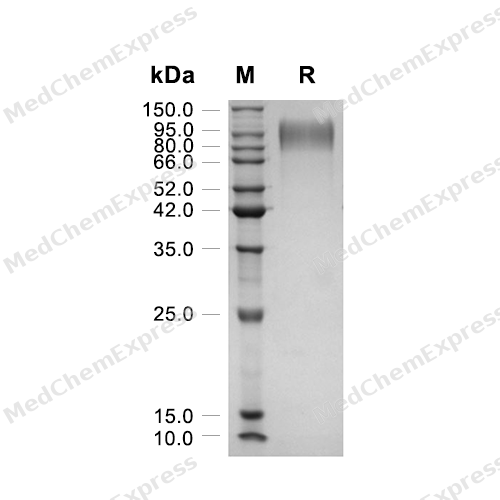
Purity - SDS-PAGE
-
Bioactivity - Cell-Based Assay
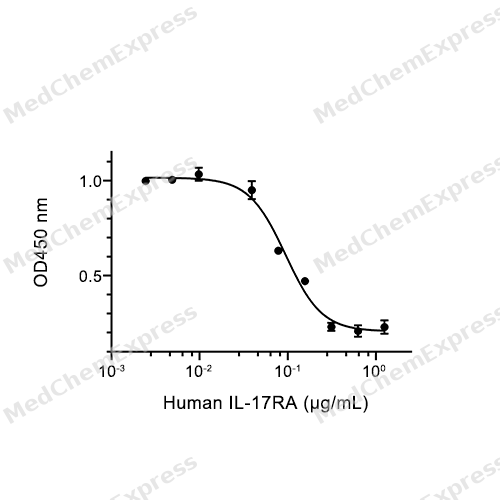
Bioactivity - Cell-Based Assay


Publications (2)
-
Journal Impact Factor
-
Most Recent
-
Adv Sci (Weinh)
Aberrant Chitinase 3-Like 1 Expression in Basal Cells Contributes to Systemic Sclerosis Fibrosis. [Abstract]2025 Feb;12(6):e2310169. PMID: 39686726 -
Phytomedicine
β-elemene directly targets IL-17RA in macrophages to inhibit inflammation and attenuate acute pancreatitis. [Abstract]2026 Jun 24:159:158478. PMID: 42365689


Technical Parameters
-
Species Human
-
Source HEK293
-
Tag C-hFc
-
Accession
Q96F46-1 (L33-W320)
-
Molecular Construction
-
N-term
-
(L33-W320)IL-17RAQ96F46-1(L33-W320)
Accession # Q96F46-1 -
hFc
-
C-term
-
-
Protein Length
Extracellular Domain
-
Synonyms
IL17RA; Interleukin-17 Receptor A; Prev. IL17R; Interleukin 17 Receptor; IL-17RA; CD217 Antigen; CDw217; CANDF5; HIL-17R; IMD51; CD217; Interleukin 17 Receptor A; IL-17 Receptor A
-
AA Sequence
LRLLDHRALVCSQPGLNCTVKNSTCLDDSWIHPRNLTPSSPKDLQIQLHFAHTQQGDLFPVAHIEWTLQTDASILYLEGAELSVLQLNTNERLCVRFEFLSKLRHHHRRWRFTFSHFVVDPDQEYEVTVHHLPKPIPDGDPNHQSKNFLVPDCEHARMKVTTPCMSSGSLWDPNITVETLEAHQLRVSFTLWNESTHYQILLTSFPHMENHSCFEHMHHIPAPRPEEFHQRSNVTLTLRNLKGCCRHQVQIQPFFSSCLNDCLRHSATVSCPEMPDTPEPIPDYMPLW
-
Molecular Weight
Approximately 90-120 kDa, based on SDS-PAGE under reducing conditions.
-
Glycosylation
Yes
-
Purity
≥ 90%, as determined by reducing SDS-PAGE.


Product Properties
Lyophilized powder
1.Lyophilized from a 0.2 μm solution of PBS.
2.Lyophilized from a 0.2 μm solution of 20 mM PB, 150 mM NaCl, pH 7.4.
3.Lyophilized from a 0.2 μm solution of PBS, pH 7.4, 8% trehalose.
<1 EU/μg, determined by LAL method.
It is not recommended to reconstitute to a concentration less than 100 μg/mL in ddH2O.
Stored at -20°C for 2 years from date of receipt. After reconstitution, it is stable at 4°C for 1 week or -20°C for longer (with carrier protein). It is recommended to freeze aliquots at -20°C or -80°C for extended storage.
Room temperature in continental US; may vary elsewhere.


Documentation
-
Data Sheet (266 KB)
-
SDS (252 KB)
- English - EN (252 KB)
- Français - FR (252 KB)
- Deutsch - DE (252 KB)
- Norwegian - NO (252 KB)
- Español - ES (252 KB)
- Swedish - SV (252 KB)
- Italian - IT (252 KB)
- Korean - KR (252 KB)
- Portuguese - PT (252 KB)
-
Handling Instructions (2659 KB)


References
[1]. Stéphane Nesmond, et al. Characteristic Pattern of IL-17RA, IL-17RB, and IL-17RC in Monocytes/Macrophages and Mast Cells From Patients With Bullous Pemphigoid. Front Immunol. 2019 Sep 11;10:2107. [Content Brief]
[2]. Xun Lin, et al. IL-17RA-signaling in Lgr5+ intestinal stem cells induces expression of transcription factor ATOH1 to promote secretory cell lineage commitment. Immunity. 2022 Feb 8;55(2):237-253.e8. [Content Brief]
[3]. Laura Green, et al. Chronic Candidiasis in Children. Curr Allergy Asthma Rep. 2017 May;17(5):31. [Content Brief]
[4]. Jayasri Das Sarma, et al. Functional interleukin-17 receptor A is expressed in central nervous system glia and upregulated in experimental autoimmune encephalomyelitis. J Neuroinflammation. 2009 Apr 28;6:14. [Content Brief]
[5]. Erika A Rickel, et al. Identification of functional roles for both IL-17RB and IL-17RA in mediating IL-25-induced activities. J Immunol. 2008 Sep 15;181(6):4299-310. [Content Brief]

Calculators
Concentration (start) × Volume (start) = Concentration (final) × Volume (final)


 Powered by Bioz

