



RBP4 Protein, Mouse (HEK293, His)
Based on 1 Customer Validation
RBP4 Protein transports retinol in blood plasma, delivering it from liver stores to peripheral tissues. Binding to all-trans retinol, it transfers it to STRA6 for efficient cell membrane transport. RBP4 interacts with TTR, preventing kidney filtration, and further supports STRA6 in retinol transport. RBP4 Protein, Mouse (HEK293, His) is the recombinant mouse-derived RBP4 protein, expressed by HEK293 , with C-His labeled tag.
- Species: Mouse
- Source: HEK293
-
Storage:Stored at -20°C for 2 years from date of receipt. After reconstitution, it is stable at 4°C for 1 week or -20°C for longer (with carrier protein). It is recommended to freeze aliquots at -20°C or -80°C for extended storage.


To place orders, for customer services and technical support, please contact: MedChemExpress USA
Tel: 609-228-6898 E-mail: [email protected] [email protected]


-
 Biological Activity
-
Technical Parameters
-
Product Properties
- Documentation
- Help & FAQs




Biological Activity
Description
RBP4 Protein transports retinol in blood plasma, delivering it from liver stores to peripheral tissues. Binding to all-trans retinol, it transfers it to STRA6 for efficient cell membrane transport. RBP4 interacts with TTR, preventing kidney filtration, and further supports STRA6 in retinol transport. RBP4 Protein, Mouse (HEK293, His) is the recombinant mouse-derived RBP4 protein, expressed by HEK293 , with C-His labeled tag.
Background
RBP4 Protein is a crucial retinol-binding protein responsible for transporting retinol in the blood plasma. It plays a vital role in delivering retinol from the liver stores to the peripheral tissues. RBP4 binds to all-trans retinol and transfers it to STRA6, which facilitates the efficient transport of retinol across the cell membrane. Additionally, RBP4 interacts with TTR, preventing its loss through filtration in the kidney glomeruli. Moreover, RBP4 also interacts with STRA6, further contributing to its role in retinol transport.
Verified Bioactivity
Measured by its ability to bind all-trans retinoic acid. The binding of retinoic acid results in the quenching of Trp fluorescence in RBP4. The 50% binding concentration (BC50) is 0.436 μM, as measured under the described conditions.
MCE Validation Data
-
Purity - SDS-PAGE
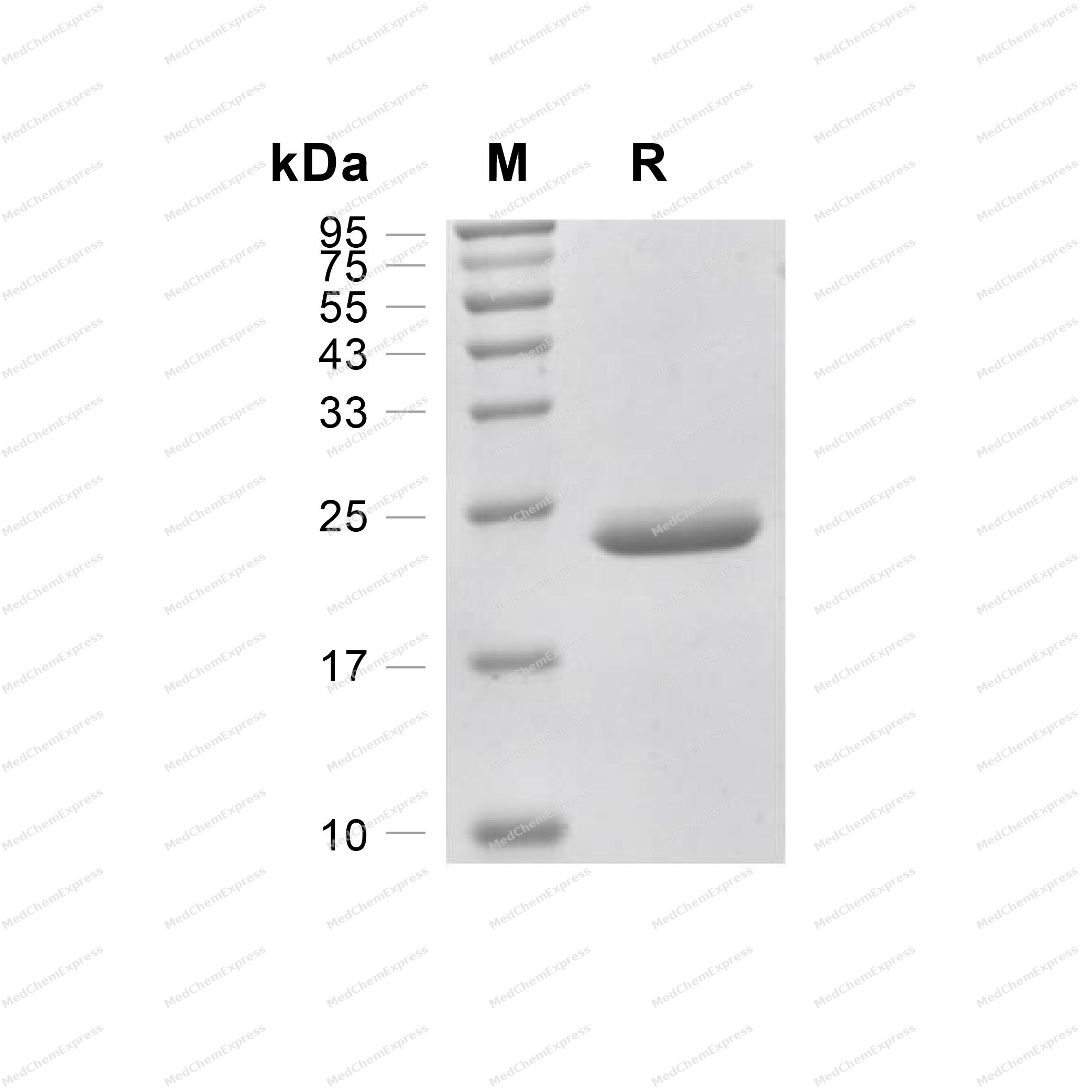
Purity - SDS-PAGE

Assay Procedure
Materials
Assay buffer: 50 mM Tris, 10 mM CaCl2, 150 mM NaCl, pH 7.5 (TCN)
Test protein: RBP4 protein, Mouse (HEK293, His) (HY-P74599)
95% Ethanol
Retinoic acid, 50 mM in DMSO
Procedure
1. Dilute the test protein to 49 μg/mL using the assay buffer.
2. Prepare a series of retinoic acid concentrations using 95% ethanol, with concentrations of 100, 30, 10, 3, 1, and 0 μM.
3. Mix 112.5 μL of the test protein with 12.5 μL of the different retinoic acid concentrations.
4. Incubate at room temperature for 30 minutes.
5. Add 100 μL of the mixture to each well and measure RFU in endpoint mode at an excitation wavelength of 280 nm and an emission wavelength of 340 nm.
6. Calculate the concentration at which Human RBP4 is 50% quenched (BC50) by plotting a 4-PL fit curve of raw RFU versus retinoic acid concentration.


Technical Parameters
-
Species Mouse
-
Source HEK293
-
Tag C-His
-
Accession
Q00724 (E19-L201)
-
Molecular Construction
-
N-term
-
RBP4 (E19-L201)
Accession # Q00724 -
His
-
C-term
-
-
Protein Length
Full Length of Mature Protein
-
Synonyms
RBP4; Retinol-Binding Protein 4, Interstitial; Retinol Binding Protein 4; Retinol-Binding Protein 4, Plasma; Plasma Retinol-Binding Protein; Retinol Binding Protein 4, Plasma; Retinol-Binding Protein 4; Retinol-Binding Protein; PRBP; MCOPCB10; RBP; RDCCAS
-
AA Sequence
ERDCRVSSFRVKENFDKARFSGLWYAIAKKDPEGLFLQDNIIAEFSVDEKGHMSATAKGRVRLLSNWEVCADMVGTFTDTEDPAKFKMKYWGVASFLQRGNDDHWIIDTDYDTFALQYSCRLQNLDGTCADSYSFVFSRDPNGLSPETRRLVRQRQEELCLERQYRWIEHNGYCQSRPSRNSL
-
Molecular Weight
Approximately 22.8 kDa
-
Purity
≥ 95%, as determined by reducing SDS-PAGE.


Product Properties
Lyophilized powder.
Lyophilized from a 0.22 μm filtered solution of PBS, pH 7.4.
<1 EU/μg, determined by LAL method.
It is not recommended to reconstitute to a concentration less than 100 μg/mL in ddH2O. For long term storage it is recommended to add a carrier protein (0.1% BSA, 5% HSA, 10% FBS or 5% Trehalose).
Stored at -20°C for 2 years from date of receipt. After reconstitution, it is stable at 4°C for 1 week or -20°C for longer (with carrier protein). It is recommended to freeze aliquots at -20°C or -80°C for extended storage.
Room temperature in continental US; may vary elsewhere.


Documentation
-
Data Sheet (236 KB)
-
SDS (251 KB)
- English - EN (251 KB)
- Français - FR (251 KB)
- Deutsch - DE (251 KB)
- Norwegian - NO (251 KB)
- Español - ES (251 KB)
- Swedish - SV (251 KB)
- Italian - IT (251 KB)
- Korean - KR (251 KB)
- Portuguese - PT (251 KB)
-
Handling Instructions (2659 KB)

Calculators
Concentration (start) × Volume (start) = Concentration (final) × Volume (final)


 Powered by Bioz

