



REG-3 gamma/REG3G Protein, Human (HEK293, His)

Based on 1 Customer Validation
REG-3 gamma/REG3G protein is a bactericidal C-type lectin that specifically targets Gram-positive bacteria by binding to the peptidoglycan surface moiety, mediating bacterial killing. It limits bacterial colonization of intestinal epithelial surfaces and limits microbiota-induced adaptive immune responses. REG-3 gamma/REG3G Protein, Human (HEK293, His) is the recombinant human-derived REG-3 gamma/REG3G protein, expressed by HEK293 , with C-6*His labeled tag.
- Species: Human
- Source: HEK293
-
Storage:Stored at -20°C for 2 years from date of receipt. After reconstitution, it is stable at 4°C for 1 week or -20°C for longer (with carrier protein). It is recommended to freeze aliquots at -20°C or -80°C for extended storage.


To place orders, for customer services and technical support, please contact: MedChemExpress USA
Tel: 609-228-6898 E-mail: [email protected] [email protected]


-
 Biological Activity
-
Technical Parameters
-
Product Properties
- Documentation
- Help & FAQs




Biological Activity
Description
REG-3 gamma/REG3G protein is a bactericidal C-type lectin that specifically targets Gram-positive bacteria by binding to the peptidoglycan surface moiety, mediating bacterial killing. It limits bacterial colonization of intestinal epithelial surfaces and limits microbiota-induced adaptive immune responses. REG-3 gamma/REG3G Protein, Human (HEK293, His) is the recombinant human-derived REG-3 gamma/REG3G protein, expressed by HEK293 , with C-6*His labeled tag.
Background
REG-3 gamma/REG3G Protein, a bactericidal C-type lectin, acts exclusively against Gram-positive bacteria by binding to surface-exposed carbohydrate moieties of peptidoglycan, thereby mediating bacterial killing. This protein restricts bacterial colonization of the intestinal epithelial surface, consequently limiting the activation of adaptive immune responses by the microbiota. It functions as a hormone in response to various stimuli, including anti-inflammatory signals like IL17A or the gut microbiome. REG-3 gamma/REG3G Protein is secreted by different cell types to activate its receptor EXTL3, leading to the induction of cell-specific signaling pathways. In keratinocytes, it is induced by IL17A and regulates keratinocyte proliferation and differentiation following skin injury while inhibiting skin inflammation by suppressing inflammatory cytokines such as IL6 and TNF. In lung epithelial cells, REG-3 gamma/REG3G Protein is induced by IL22, inhibiting cytokine production and regulating allergic airway inflammation. Additionally, it is induced in the small intestine by an inulin-enriched diet and Lactobacillus gasseri-enriched microbiome, contributing to the improvement of gut barrier function, energy balance, and glucose levels. Moreover, REG-3 gamma/REG3G Protein modulates the composition of the microbiota in duodenal contents. Lastly, it is produced by nociceptors in response to endotoxins and prevents endotoxic death by targeting the kynurenine pathway in microglia.
Verified Bioactivity
REG-3 gamma captured on CM5 Sensor Chip can bind Peptidoglycan with an affinity constant of 1.0-5.0 mM as determined in SPR assay.
MCE Validation Data
-
Purity - SDS-PAGE
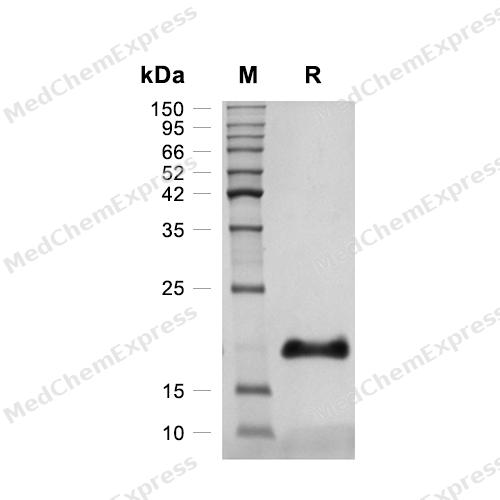
Purity - SDS-PAGE


Technical Parameters
-
Species Human
-
Source HEK293
-
Tag C-6*His
-
Accession
Q6UW15-1 (E27-D175)
-
Molecular Construction
-
N-term
-
REG3G (E27-D175)
Accession # Q6UW15-1 -
6*His
-
C-term
-
-
Protein Length
Full Length of Isoform-1
-
Synonyms
REG3G; Pancreatitis-Associated Protein IB; Regenerating Family Member 3 Gamma; Reg III-Gamma; PAP1B; REG-3-Gamma; LPPM429; REG III; UNQ429; PAP IB; Regenerating Islet-Derived Protein III-Gamma; PAP-1B; Regenerating Islet-Derived Protein 3-Gamma; Regenerating Gene III; Regenerating Islet-Derived 3 Gamma; REG-III; Pancreatitis-Associated Protein 1B; PAPIB
-
AA Sequence
EETQKELPSPRISCPKGSKAYGSPCYALFLSPKSWMDADLACQKRPSGKLVSVLSGAEGSFVSSLVRSISNSYSYIWIGLHDPTQGSEPDGDGWEWSSTDVMNYFAWEKNPSTILNPGHCGSLSRSTGFLKWKDYNCDAKLPYVCKFKD
-
Molecular Weight
Approximately 17-18 kDa, based on SDS-PAGE under reducing conditions, due to the glycosylation.
-
Purity
≥ 95%, as determined by reducing SDS-PAGE.


Product Properties
Lyophilized powder.
Lyophilized from a 0.22 μm filtered solution of 20 mM PB, 150 mM NaCl, pH 7.4.
<1 EU/μg, determined by LAL method.
It is not recommended to reconstitute to a concentration less than 100 μg/mL in ddH2O. For long term storage it is recommended to add a carrier protein (0.1% BSA, 5% HSA, 10% FBS or 5% Trehalose).
Stored at -20°C for 2 years from date of receipt. After reconstitution, it is stable at 4°C for 1 week or -20°C for longer (with carrier protein). It is recommended to freeze aliquots at -20°C or -80°C for extended storage.
Room temperature in continental US;may vary elsewhere.


Documentation
-
Data Sheet (237 KB)
-
SDS (252 KB)
- English - EN (252 KB)
- Français - FR (252 KB)
- Deutsch - DE (252 KB)
- Norwegian - NO (252 KB)
- Español - ES (252 KB)
- Swedish - SV (252 KB)
- Italian - IT (252 KB)
- Korean - KR (252 KB)
- Portuguese - PT (252 KB)
-
Handling Instructions (2659 KB)

Calculators
Concentration (start) × Volume (start) = Concentration (final) × Volume (final)


 Powered by Bioz

