



VEGFR-2 Protein, Mouse (HEK293, His, solution)

Based on 1 Customer Validation
VEGFR-2 protein is an important tyrosine protein kinase receptor.As a cell surface receptor for VEGFA, VEGFC and VEGFD, it plays an important role in the regulation of angiogenesis, vascular development, permeability and embryonic hematopoiesis.It actively promotes endothelial cell proliferation, survival, migration, differentiation, and actin cytoskeletal reorganization.VEGFR-2 Protein, Mouse (HEK293, His) is the recombinant mouse-derived VEGFR-2 protein, expressed by HEK293 , with C-His labeled tag.
- Species: Mouse
- Source: HEK293
-
Storage:Stored at -80°C for 1 year from date of receipt. It is stable at -20°C for 3 months after opening. It is recommended to freeze aliquots at -80°C for extended storage. Avoid repeated freeze-thaw cycles.


To place orders, for customer services and technical support, please contact: MedChemExpress USA
Tel: 609-228-6898 E-mail: [email protected] [email protected]


-
 Biological Activity
-
Technical Parameters
-
Product Properties
- Documentation
- Help & FAQs




Biological Activity
Description
VEGFR-2 protein is an important tyrosine protein kinase receptor.As a cell surface receptor for VEGFA, VEGFC and VEGFD, it plays an important role in the regulation of angiogenesis, vascular development, permeability and embryonic hematopoiesis.It actively promotes endothelial cell proliferation, survival, migration, differentiation, and actin cytoskeletal reorganization.VEGFR-2 Protein, Mouse (HEK293, His) is the recombinant mouse-derived VEGFR-2 protein, expressed by HEK293 , with C-His labeled tag.
Background
VEGFR-2, a tyrosine-protein kinase, serves as a crucial cell-surface receptor for VEGFA, VEGFC, and VEGFD, playing a fundamental role in angiogenesis regulation, vascular development, permeability, and embryonic hematopoiesis. It actively promotes endothelial cell proliferation, survival, migration, and differentiation, as well as the reorganization of the actin cytoskeleton. Isoforms lacking a transmembrane domain, like isoform 2, may function as decoy receptors, particularly in negatively regulating VEGFA- and VEGFC-mediated lymphangiogenesis by limiting the availability of free VEGFA and/or VEGFC and preventing their binding to FLT4. VEGFR-2 modulates FLT1 and FLT4 signaling through heterodimer formation. The binding of vascular growth factors to isoform 1 initiates various signaling cascades, including the activation of PLCG1, resulting in the production of diacylglycerol and inositol 1,4,5-trisphosphate and the activation of protein kinase C. Additionally, it mediates the activation of MAPK1/ERK2, MAPK3/ERK1, AKT1, and the phosphorylation of PIK3R1, contributing to phosphatidylinositol 3-kinase regulation and actin cytoskeleton reorganization. VEGFR-2 is indispensable for VEGFA-induced NOS2 and NOS3 expression, leading to nitric oxide production by endothelial cells, and it phosphorylates PLCG1, FYN, NCK1, NOS3, PIK3R1, PTK2/FAK1, and SRC.
Verified Bioactivity
1.This product does not contain protein kinase domain.
2.Mouse VEGFR-2 immobilized on CM5 Chip can bind Mouse VEGF164 (HY-P70761) with an affinity constant of 1.246 nM as determined in a SPR assay.
MCE Validation Data
-
Bioactivity - SPR
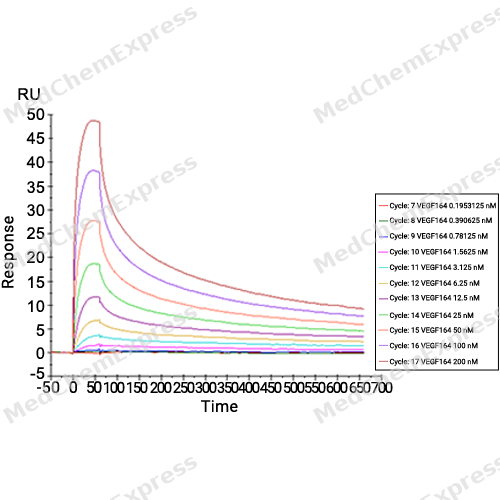
Bioactivity - SPR


Technical Parameters
-
Species Mouse
-
Source HEK293
-
Tag C-10*His
-
Accession
P35918 (A20-E762)
-
Molecular Construction
-
N-term
-
VEGFR-2 (A20-E762)
Accession # P35918 -
10*His
-
C-term
-
-
Protein Length
Extracellular Domain
-
Synonyms
KDR; Fetal Liver Kinase 1; Kinase Insert Domain Receptor; Vascular Endothelial Growth Factor Receptor 2 Variant; Vascular Endothelial Growth Factor Receptor 2; Tyrosine Kinase Growth Factor Receptor; VEGFR2; Receptor Protein-Tyrosine Kinase; FLK1; Fetal L
-
AA Sequence
MESKALLAVALWFCVETRAASVGLPGDFLHPPKLSTQKDILTILANTTLQITCRGQRDLDWLWPNAQRDSEERVLVTECGGGDSIFCKTLTIPRVVGNDTGAYKCSYRDVDIASTVYVYVRDYRSPFIASVSDQHGIVYITENKNKTVVIPCRGSISNLNVSLCARYPEKRFVPDGNRISWDSEIGFTLPSYMISYAGMVFCEAKINDETYQSIMYIVVVVGYRIYDVILSPPHEIELSAGEKLVLNCTARTELNVGLDFTWHSPPSKSHHKKIVNRDVKPFPGTVAKMFLSTLTIESVTKSDQGEYTCVASSGRMIKRNRTFVRVHTKPFIAFGSGMKSLVEATVGSQVRIPVKYLSYPAPDIKWYRNGRPIESNYTMIVGDELTIMEVTERDAGNYTVILTNPISMEKQSHMVSLVVNVPPQIGEKALISPMDSYQYGTMQTLTCTVYANPPLHHIQWYWQLEEACSYRPGQTSPYACKEWRHVEDFQGGNKIEVTKNQYALIEGKNKTVSTLVIQAANVSALYKCEAINKAGRGERVISFHVIRGPEITVQPAAQPTEQESVSLLCTADRNTFENLTWYKLGSQATSVHMGESLTPVCKNLDALWKLNGTMFSNSTNDILIVAFQNASLQDQGDYVCSAQDKKTKKRHCLVKQLIILERMAPMITGNLENQTTTIGETIEVTCPASGNPTPHITWFKDNETLVEDSGIVLRDGNRNLTIRRVRKEDGGLYTCQACNVLGCARAETLFIIEGAQEKTNLE
-
Predicted Molecular Mass
84.5 kDa
-
Molecular Weight
Approximately 100-110 kDa, based on SDS-PAGE under reducing conditions, due to the glycosylation.
-
Glycosylation
Yes
-
Purity
≥ 90%, as determined by reducing SDS-PAGE.


Product Properties
Solution.
Supplied as a 0.22 μm filtered solution of PBS, pH 7.4.
<1 EU/μg, determined by LAL method.
Please use rapid thawing with running water to thaw the protein.
Stored at -80°C for 1 year from date of receipt. It is stable at -20°C for 3 months after opening. It is recommended to freeze aliquots at -80°C for extended storage. Avoid repeated freeze-thaw cycles.
Shipping with dry ice.


Documentation
-
Data Sheet (240 KB)
-
SDS (252 KB)
- English - EN (252 KB)
- Français - FR (252 KB)
- Deutsch - DE (252 KB)
- Norwegian - NO (252 KB)
- Español - ES (252 KB)
- Swedish - SV (252 KB)
- Italian - IT (252 KB)
- Korean - KR (252 KB)
- Portuguese - PT (252 KB)
-
Handling Instructions (2659 KB)

Calculators
Concentration (start) × Volume (start) = Concentration (final) × Volume (final)


 Powered by Bioz

