



VEGFR-2 Protein, Human (HEK293, His)
Based on 1 publication(s) in Google Scholar
VEGFR-2 is a tyrosine-protein kinase of the cell surface receptors of VEGFA, VEGFC, and VEGFD that mediates activation of the MAPK1/ERK2, MAPK3/ERK1, and MAP kinase signaling pathways, as well as the AKT1 signaling pathway. VEGFR-2 can promote the proliferation, survival, migration and differentiation of endothelial cells. Overexpression of VEGFR-2 is associated with the development of tumors. VEGFR-2 Protein, Human (HEK293, His) is the recombinant human-derived VEGFR-2 protein, expressed by HEK293 , with C-His labeled tag.
- Species: Human
- Source: HEK293
-
Storage:Stored at -20°C for 2 years from date of receipt. After reconstitution, it is stable at 4°C for 1 week or -20°C for longer (with carrier protein). It is recommended to freeze aliquots at -20°C or -80°C for extended storage.


To place orders, for customer services and technical support, please contact: MedChemExpress USA
Tel: 609-228-6898 E-mail: [email protected] [email protected]


-
 Biological Activity
-
Technical Parameters
-
Product Properties
- Documentation
- Help & FAQs




Biological Activity
Description
VEGFR-2 is a tyrosine-protein kinase of the cell surface receptors of VEGFA, VEGFC, and VEGFD that mediates activation of the MAPK1/ERK2, MAPK3/ERK1, and MAP kinase signaling pathways, as well as the AKT1 signaling pathway. VEGFR-2 can promote the proliferation, survival, migration and differentiation of endothelial cells. Overexpression of VEGFR-2 is associated with the development of tumors. VEGFR-2 Protein, Human (HEK293, His) is the recombinant human-derived VEGFR-2 protein, expressed by HEK293 , with C-His labeled tag.
Background
VEGF receptors (VEGFRs) are receptors for vascular endothelial growth factor (VEGF), and there are three main subtypes, VEGFR-1, VEGFR-2, and VEGFR-3. VEGFR-2 acts as a tyrosine-protein kinase of the cell surface receptor for VEGFA, VEGFC and VEGFD, and plays an important role in angiogenesis, vascular development, vascular permeability and embryonic hematopoiesis. It can promote the proliferation, survival, migration and differentiation of endothelial cells. Promote actin cytoskeleton recombination. VEGFR-2 regulates VEGFR-1 (FLT1) and VEGFR-3 (FLT40) signaling by forming heterodimers. VEGFR-2 mediates the activation of ,MAPK1/ERK2, MAPK3/ERK1 and MAP kinase signaling pathways, as well as the AKT1 signaling pathway. It mediates phosphorylation of the phosphatidylinositol 3-kinase regulatory subunit PIK3R1, recombination of actin cytoskeleton and activation of PTK2/FAK1. Vegfa-mediated induction of NOS2 and NOS3 is required, resulting in endothelial cell production of the signaling molecule nitric oxide (NO). Phosphorylated PLCG1. Promotes phosphorylation of FYN, NCK1, NOS3, PIK3R1, PTK2/FAK1, and SRC. Overexpression of VEGFR-2 is associated with tumorigenesis[1][2][3][4][5][6].
Verified Bioactivity
1.This product does not contain protein kinase domain.
2.Measured by its ability to inhibit the VEGF-dependent proliferation of HUVEC human umbilical vein endothelial cells. The ED50for this effect is 9-160 ng/mL in the presence of 10 ng/mL recombinant human VEGF165 (HY-P7110A).
3.Immobilized Human VEGFR2-His at 1μg/ml (100 μ l/well)can bind Anti-Human VEGFR2 mAb.The ED50 of Anti-Human VEGFR2 mAb is ≤36.55 ng/ml.
MCE Validation Data
-
Purity - SDS-PAGE
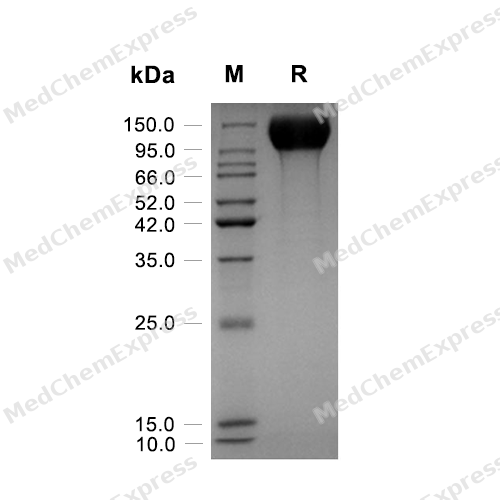
Purity - SDS-PAGE
-
Bioactivity - Cell-Based Assay
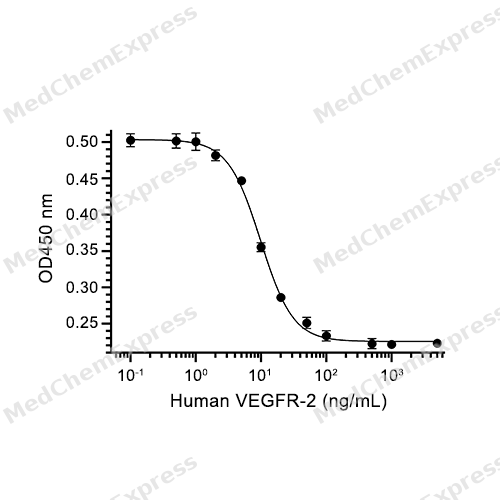
Bioactivity - Cell-Based Assay


Publications (1)
-
Journal Impact Factor
-
Most Recent
-
Chem Biol Drug Des
Flubendazole suppresses VEGF-induced angiogenesis in HUVECs and exerts antitumor effects in PC-3 cells. [Abstract]2024 Mar;103(3):e14503. PMID: 38480495


Technical Parameters
-
Species Human
-
Source HEK293
-
Tag C-His
-
Accession
AAI31823.1 (A20-E764)
-
Molecular Construction
-
N-term
-
VEGFR-2 (A20-E764)
Accession # AAI31823.1 -
His
-
C-term
-
-
Protein Length
Extracellular Domain
-
Synonyms
KDR; Fetal Liver Kinase 1; Kinase Insert Domain Receptor; Vascular Endothelial Growth Factor Receptor 2 Variant; Vascular Endothelial Growth Factor Receptor 2; Tyrosine Kinase Growth Factor Receptor; VEGFR2; Receptor Protein-Tyrosine Kinase; FLK1; Fetal L
-
AA Sequence
ASVGLPSVSLDLPRLSIQKDILTIKANTTLQITCRGQRDLDWLWPNNQSGSEQRVEVTECSDGLFCKTLTIPKVIGNDTGAYKCFYRETDLASVIYVYVQDYRSPFIASVSDQHGVVYITENKNKTVVIPCLGSISNLNVSLCARYPEKRFVPDGNRISWDSKKGFTIPSYMISYAGMVFCEAKINDESYQSIMYIVVVVGYRIYDVVLSPSHGIELSVGEKLVLNCTARTELNVGIDFNWEYPSSKHQHKKLVNRDLKTQSGSEMKKFLSTLTIDGITRSDQGLYTCAASSGLMTKKNSTFVRVHEKPFVAFGSGMESLVEATVGERVRIPAKYLGYPPPEIKWYKNGIPLESNHTIKAGHVLTIMEVSERDTGNYTVILTNPISKEKQSHVVSLVVYVPPQIGEKSLISPVDSYQYGTTQTLTCTVYAIPPPHHIHWYWQLEEECANEPSHAVSVTNPYPCEEWRSVEDFQGGNKIEVNKNQFALIEGKNKTVSTLVIQAANVSALYKCEAVNKVGRGERVISFHVTRGPEITLQPDMQPTEQESVSLWCTADRSTFENLTWYKLGPQPLPIHVGELPTPVCKNLDTLWKLNATMFSNSTNDILIMELKNASLQDQGDYVCLAQDRKTKKRHCVVRQLTVLERVAPTITGNLENQTTSIGESIEVSCTASGNPPPQIMWFKDNETLVEDSGIVLKDGNRNLTIRRVRKEDEGLYTCQACSVLGCAKVEAFFIIEGAQEKTNLE
-
Molecular Weight
Approximately 110-150 kDa, based on SDS-PAGE under reducing conditions, due to the glycosylation.
-
Glycosylation
Yes
-
Purity
≥ 95%, as determined by reducing SDS-PAGE.


Product Properties
Lyophilized powder.
1.Lyophilized from a 0.22 μm filtered solution of PBS, pH 7.4.
2.Lyophilized from a 0.22 μm filtered solution of 20 mM PB, 150 mM NaCl, pH 7.4.
Please refer to the lot-specific COA for specific buffer information.
<1 EU/μg, determined by LAL method.
It is not recommended to reconstitute to a concentration less than 100 μg/mL in ddH2O. For long term storage it is recommended to add a carrier protein (0.1% BSA, 5% HSA, 10% FBS or 5% Trehalose).
Stored at -20°C for 2 years from date of receipt. After reconstitution, it is stable at 4°C for 1 week or -20°C for longer (with carrier protein). It is recommended to freeze aliquots at -20°C or -80°C for extended storage.
Room temperature in continental US; may vary elsewhere.


Documentation
-
Data Sheet (241 KB)
-
SDS (252 KB)
- English - EN (252 KB)
- Français - FR (252 KB)
- Deutsch - DE (252 KB)
- Norwegian - NO (252 KB)
- Español - ES (252 KB)
- Swedish - SV (252 KB)
- Italian - IT (252 KB)
- Korean - KR (252 KB)
- Portuguese - PT (252 KB)
-
Handling Instructions (2659 KB)

Calculators
Concentration (start) × Volume (start) = Concentration (final) × Volume (final)


 Powered by Bioz

