231 Results for "

2-(2-Chlorophenyl)-2-hydroxycyclohexanone

" in MedChemExpress (MCE) Product Catalog:
Products (231)

231 Results for "2-(2-Chlorophenyl)-2-hydroxycyclohexanone" in MCE Product Catalog:

Cat. No.: HY-P11841
Target:  

DNA/RNA Synthesis

Research Areas:  

Cancer

tP4-CPP12 is a RMI1/2 heterodimer inhibitor with an IC50 of 110 nM. tP4-CPP12 binds competitively at the FANCM-RMI interaction site and disrupts endogenous FANCM-RMI protein-protein interactions. tP4-CPP12 induces antiproliferative effects in ALT-positive osteosarcoma cells. tP4-CPP12 is applicable for the research of ALT-positive osteosarcoma .
loading...
    loading...
Cat. No.: HY-N14799
CAS No.: 18524-67-9
Mycobacillin is a peptide antibiotic with anti-antifungal activity .
loading...
    loading...
Cat. No.: HY-P11032
CAS No.: 3106022-48-1
Target:  

SARS-CoV Virus Protease

Research Areas:  

Infection

Mp-4D7-pF2, a cell-penetrating bicyclic peptide, is a noncovalent SARS-CoV-2 main protease inhibitor with an IC50 of 4.51 μM. Mp-4D7-pF2 has an antiviral activity against SARS-CoV-2 with no cytotoxicity. Mp-4D7-pF2 can used for COVID-19 infections research .
loading...
    loading...
Cat. No.: HY-P11924
Research Areas:  

Cancer

TATE-DA-I is a somatostatin receptor 2 (SSTR2) ligand with an IC50 of 25.3 nM. TATE-DA-I binds to albumin to prolong its circulation retention time and also exhibits enhanced tumor accumulation capacity. TATE-DA-I enables clear visualization of SSTR2-positive tumors in SPECT/CT imaging. TATE-DA-I can be used in cancer-related research .
loading...
    loading...
Cat. No.: HY-P10447
CAS No.: 103651-09-8
Synonyms: Fengycin IX; SNA-60-367-3
Target:  

Phospholipase Fungal

Research Areas:  

Infection

Plipastatin A1 (Fengycin IX; SNA-60-367-3) is a lipopeptide with phospholipase A2 inhibitory activity. Plipastatin A1 inhibits conidial germination of Botrytis cinerea in vitro and reduces the incidence of gray mold on tomato leaves. Plipastatin A1 is applicable to research related to gray mold [1][2].
loading...
    loading...
Cat. No.: HY-P11488
JR11-PEG3-DOTA-PSMA-03 (Compound 2) is an RDC-related compound containing the chelating agent DOTA (HY-W053583), the JR11 peptide (SSTR2 antagonist), and the PSMA ligand. JR11-PEG3-DOTA-PSMA-03 shows SSTR2-binding affinities and PSMA-binding affinities, with IC50 s of 94.0 nM, 81.8 nM, respectively. JR11-PEG3-DOTA-PSMA-03 can be radiolabeled with [ 68Ga]. [ 68Ga] radiolabeled JR11-PEG3-DOTA-PSMA-03 can be used in diagnostic studies of neuroendocrine differentiated prostate cancer .
loading...
    loading...
Cat. No.: HY-P11485
JR11-PEG3-HBED-CC-PSMA-03 (Compound 1) is an RDC-related compound containing the chelating agent HBED-CC, the JR11 peptide (SSTR2 antagonist), and the PSMA ligand. JR11-PEG3-HBED-CC-PSMA-03 shows SSTR2-binding affinities and PSMA-binding affinities, with IC50 s of 59.2 nM, 57.0 nM, respectively. JR11-PEG3-HBED-CC-PSMA-03 can be radiolabeled with [ 68Ga]. [ 68Ga] radiolabeled JR11-PEG3-HBED-CC-PSMA-03 can be used in diagnostic studies of neuroendocrine differentiated prostate cancer .
loading...
    loading...
Cat. No.: HY-P5957
CAS No.: 186511-50-2
Target:  

Parasite

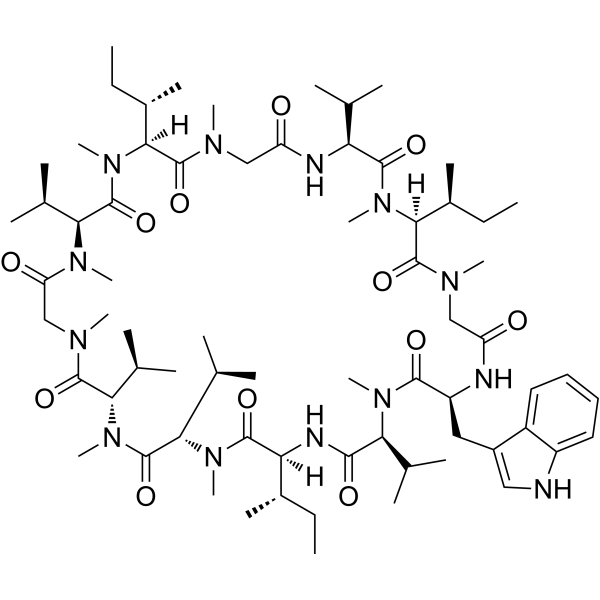
Omphalotin A is a cyclic peptide, and shows nematicidal activity .
loading...
    loading...
Cat. No.: HY-P3440
CAS No.: 1886057-64-2
Research Areas:  

Cancer

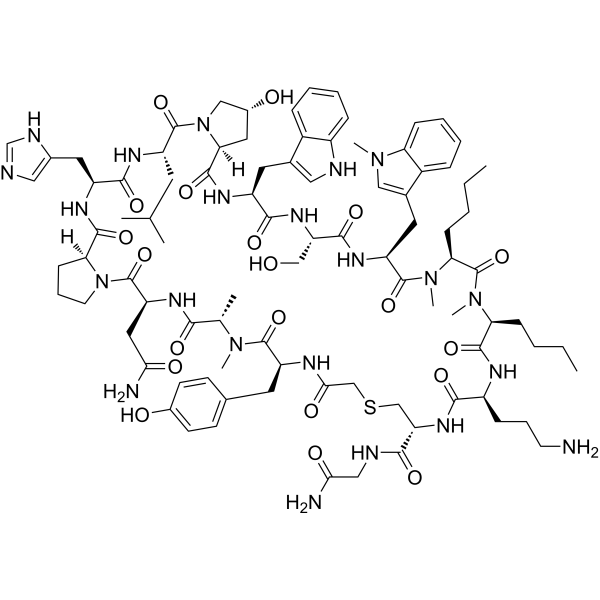
WL12 is a specifically targeting programmed death ligand 1 (PD-L1) binding peptide. WL12 can be radiolabeled by different radionuclides, generating radiotracers, which can assess the tumor PD-L1 expression .
loading...
    loading...
Cat. No.: HY-P11927
Target:  

GSK-3

Research Areas:  

Cancer

BiS3 is a selective hyperbivalent macrocyclic peptide GSK3β inhibitor, with a Kd of 0.28 nM and an IC50 of 4.8 nM against GSK3β. BiS3 is applicable to studies related to GSK3β signaling and colorectal cancer .
loading...
    loading...
Cat. No.: HY-P10563
CAS No.: 2580150-96-3
Synonyms: BHV-1100
Target:  

CD38 IFNAR

Research Areas:  

Cancer

Noraramtide (BHV-1100) is an antibody-recruiting molecule. Noraramtide binds to CD38 and recruits natural killer (NK) cells to mediate antibody-dependent cellular cytotoxicity. Noraramtide enhances the capacity of autologous cytokine-induced memory-like (CIML) NK cells to produce IFNγ and CD107a, thereby improving their cytotoxicity against multiple myeloma cells. Noraramtide can be used in the research of multiple myeloma .
loading...
    loading...

