







Scientific Reviews
Product Guides
Blogs
Topics
Targeted therapy! The Capetin Prize winning "Click Chemistry" can be used like this!Targeted therapy! The Nobel Prize winning "Click Chemistry" can be used like this!2025-02-06



2754 Results for "processes" in MCE Product Catalog:
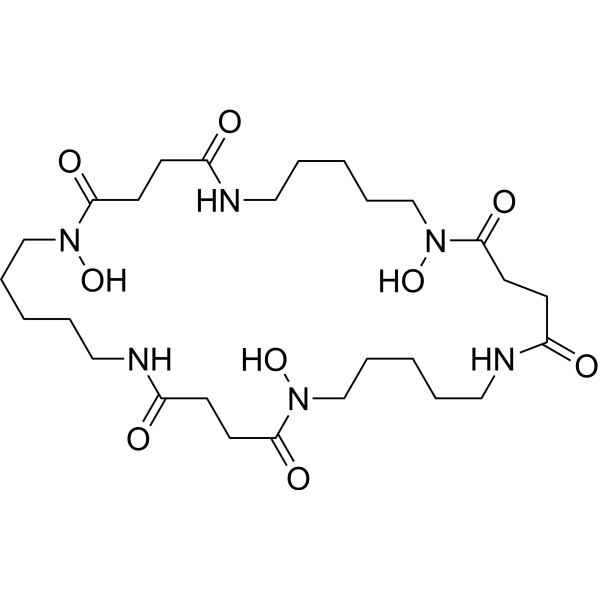
Macrocycles, molecules containing 12-membered or larger rings, are receiving increased attention in small-molecule drug discovery. The reasons are several, including providing access to novel chemical space, challenging new protein targets, showing favorable ADME- and PK-properties. Macrocycles have demonstrated repeated success when addressing targets that have proved to be highly challenging for standard small-molecule drug discovery, especially in modulating macromolecular processes such as protein–protein interactions (PPI). Otherwise, the size and complexity of macrocyclic compounds make possible to ensure numerous and spatially distributed binding interactions, thereby increasing both binding affinity and selectivity.
MCE offers a unique collection of 468 macrocyclic compounds which can be used for drug discovery for high throughput screening (HTS) and high content screening (HCS). MCE Macrocyclic Compound Library is a useful tool for discovering new drugs, especially for “undruggable” targets and protein–protein interactions.
The cytoskeleton is responsible for contraction, cell motility, movement of organelles and vesicles through the cytoplasm, cytokinesis, intracellular signal transduction, and many other functions that are essential for cellular homeostasis and survival. It accomplishes these tasks through three basic structures: F-actin, microtubules, and intermediate filaments (IFs). The cytoskeleton is a dynamic structure where the three major filaments and tubules are under the influence of proteins that regulate their length, state of polymerization, and level of cross-linking. Since cytoskeleton is involved in virtually all cellular processes, cytoskeletal protein aberrations are the underlying reason for many pathological phenotypes, including several cardiovascular disease syndromes, neurodegeneration, cancer, liver cirrhosis, pulmonary fibrosis, and blistering skin diseases.
MCE designs a unique collection of 2,313 cytoskeleton-related compounds mainly focusing on the key targets in the cytoskeleton signal pathway and can be used in the research of cytoskeleton signal pathway and related diseases.
Cell death plays a crucial role in the development of the body and the maintenance of internal balance to prevent the development of diseases. According to the regulation of the involved processes, cell death can be defined as programmed and non-programmed death. Programmed cell death (PCD) can be divided into lytic cell death and nonlytic cell death, mainly including apoptosis, necrotic apoptosis and Pyroptosis. Non-Programmed cell death (Non-PCD) generally refers to necrosis. In stark contrast to Accidental Cell Death (ACD), Regulatory Cell Death (RCD) relies on specialized molecular mechanisms. Cell death includes internal apoptosis, external apoptosis, necrotic apoptosis, ferroptosis, pyroptosis, lysosome-dependent cell death, etc.
MCE designs a unique collection of 3,860 cell death compounds, covering multiple targets, such as Apoptosis, Ferroptosis, Pyroptosis, Necroptosis, etc. It is a useful tool for screening cell death drugs.
Vitamins are a category of trace organic compounds essential for maintaining normal physiological functions in living organisms. They are classified into fat-soluble and water-soluble vitamins. Fat-soluble vitamins play a role in maintaining vision, bone health, reproductive functions, and blood coagulation. Water-soluble vitamins are involved in energy metabolism, nervous system function, and cellular repair processes. Most vitamins cannot be synthesized by the organism and must be obtained through diet. In recent years, vitamins and their derivatives have become increasingly important in the field of drug development due to their extensive physiological activities. Additionally, vitamins and their derivatives can be used to construct research platforms for vitamin metabolism, which helps to delve into the metabolic pathways and dynamic changes of vitamins within the body and aids in identifying new biomarkers for certain diseases.
MCE included 136 vitamins and their derivatives, including Vitamin A, Vitamin B, Vitamin D, etc., which is a good tool for studying vitamin metabolism.
Energy metabolism is the most fundamental biochemical process in living organisms, encompassing glycolysis, the TCA cycle, oxidative phosphorylation, the pentose phosphate pathway, and fatty acid oxidation. These core pathways directly regulate cell survival, proliferation, differentiation, and apoptosis. Dysregulation of energy metabolism is closely linked to major diseases including cancer, diabetes, obesity, cardiovascular diseases, neurodegenerative disorders, and ischemia‑reperfusion injury. Targeting these metabolic pathways has become a frontier in drug discovery and mechanistic research.
The MCE Energy Metabolite Compound Library features 89 structurally defined small‑molecule compounds. It covers energy substrates, pathway intermediates, coenzymes and redox carriers, nucleotide derivatives, and microenvironmental modulators. This library is applicable to research areas including tumor metabolism, insulin resistance, mitochondrial dysfunction, oxidative stress, neuroprotection, and cardiometabolic diseases, providing a high‑quality tool for mechanistic studies, biomarker discovery, and high‑throughput drug screening.
Heterocyclic compounds are cyclic organic compounds which contain at least one hetero atom, the most common heteroatoms are nitrogen, oxygen ,and sulfur. Heterocycles are common in biology, featuring a wide range of structures from enzyme co-factors to amino acids and proteins. On the one hand, heterocycles are common structural units in approved drugs and in medicinal chemistry targets in the drug discovery process. In addition, heterocycles have been found as a key structure in medical chemistry and also they are frequently found in large percent of biomolecules such as vitamins, natural products ,and biologically active compounds including antifungal, anti-inflammatory, antibacterial, antioxidant, antiallergic, anti-HIV, antidiabetic, anticancer activity.
MCE offers a unique collection of 6,553 heterocyclic compounds which can be used for drug discovery for high throughput screening (HTS) and high content screening (HCS). MCE heterocyclic compound library is critical for drug discovery and development.
Chinese Baijiu is one of the oldest alcoholic beverages in the world, with a history of over 2,000 years. It can be classified into 12 aroma types based on its fragrance and flavor characteristics. The specific flavor profile of Baijiu is determined by the composition and concentration of certain compounds. These trace compounds, present in low concentrations yet rich in esters, alcohols, acids, lactones, aldehydes, ketones, acetals, alkenes, and others, significantly influence the flavor of Baijiu. Additionally, some active components in Baijiu possess antioxidant properties, and moderate consumption may help reduce the risk of cardiovascular diseases, dementia, and insulin resistance. Therefore, studying the chemical composition of Baijiu is crucial for promoting its fermentation process and enhancing its flavor and quality.
MCE has compiled included 674 Chinese Baijiu components, which can be used for drug development, Baijiu fermentation, and research related to Baijiu flavor and aroma.
A histone modification, a covalent post-translational modification (PTM) to histone proteins, includes methylation, phosphorylation, acetylation, ubiquitylation, and sumoylation, etc. In general, histone modifications are catalyzed by specific enzymes that act predominantly at the histone N-terminal tails involving amino acids such as lysine or arginine, as well as serine, threonine, tyrosine, etc. The PTMs made to histones can impact gene expression by altering chromatin structure or recruiting histone modifiers. Histone modifications act in diverse biological processes such as transcriptional activation/inactivation, chromosome packaging, and DNA damage/repair. Deregulation of histone modification contributes to many diseases, including cancer and autoimmune diseases.
MCE owns a unique collection of 931 bioactive compounds targeting Epigenetic Reader Domain, HDAC, Histone Acetyltransferase, Histone Demethylase, Histone Methyltransferase, Sirtuin, etc. Histone Modification Research Compound Library is a useful tool for histone modification research and drug screening.
New drug development is a time-consuming and high-cost process. Drug repurposing (also called drug repositioning, reprofiling or re‑tasking) offers various advantages over developing an entirely new drug for a given indication, such as lower risk and less investment. Clinical drugs have confirmed bioactivities, clear mechanisms and high safety that are suitable for drug repurposing.
MCE owns a unique collection of 3,298 clinical compounds that refer to various research areas including anti-cancer, anti-infection, anti-inflammation, nervous disease. Those compounds are of detailed information on clinical development status, research area, targets, etc. Clinical Compound Library Plus, with powerful screening capability, further complements Clinical Compound Library (HY-L026) by adding some compounds with low solubility or solution stability (Part B) to this library. All those supplementary are supplied in powder form.
Oxygen homeostasis regulation is the most fundamental cellular process for adjusting physiological oxygen variations, and its irregularity leads to various human diseases, including cancer. Hypoxia is closely associated with cancer development, and hypoxia/oxygen-sensing signaling plays critical roles in the modulation of cancer progression.
Hypoxia-inducible factor 1 (HIF-1) is a transcription factor that functions as a master regulator of oxygen homeostasis. A variety of HF-1 target genes have been identified thus far which encode proteins that play key roles in critical developmental and physiological processes including angiogenesis/vascular remodeling, erythropoiesis, glucose transport, glycolysis, iron transport, and cell proliferation/survival.
HIF-1 is a heterodimeric transcription factor consisting of a constitutively expressed β-subunit and an oxygen-regulated α-subunit. The unique feature of HIF-1 is the regulation of HIF-1α expression and activity based upon the cellular O2 concentration. Under normoxic conditions, hydroxylation of HIF-1α on these different proline residues is essential for HIF proteolytic degradation by promoting interaction with the von Hippel-Lindau tumor-suppressor protein (pVHL) through hydrogen bonding to the hydroxyproline-binding pocket in the pVHL β-domain. As oxygen levels decrease, hydroxylation of HIF decreases; HIF-1α then no longer binds pVHL, and becomes stabilized, allowing more of the protein to translocate to the cell’s nucleus, where it acts as a transcription factor, upregulating (often within minutes) the production of proteins that stimulate blood perfusion in tissues and thus tissue oxygenation.
MCE offers a unique collection of 4,317 oxygen sensing related compounds targeting HIF/HIF Prolyl-Hydroxylase, MAPK/ERK, PI3K/AKT signaling pathways, etc. MCE Oxygen Sensing Compound Library is a useful tool to study hypoxia, oxidative stress and discover new anti-cancer drugs.
Cardiovascular Disease Infection Metabolic Disease Inflammation/Immunology

Scientific Reviews
Product Guides
Blogs
Topics
Targeted therapy! The Capetin Prize winning "Click Chemistry" can be used like this!Targeted therapy! The Nobel Prize winning "Click Chemistry" can be used like this!2025-02-06
Protocols
Targeted therapy! The Capetin Prize winning "Click Chemistry" can be used like this!Targeted therapy! The Nobel Prize winning "Click Chemistry" can be used like this!2025-02-06



