31 Results for "

Pyocyanin

" in MedChemExpress (MCE) Product Catalog:
Products (31)

31 Results for "Pyocyanin" in MCE Product Catalog:

Cat. No.: HY-162957
Target:  

Bacterial Antibiotic

Research Areas:  

Infection

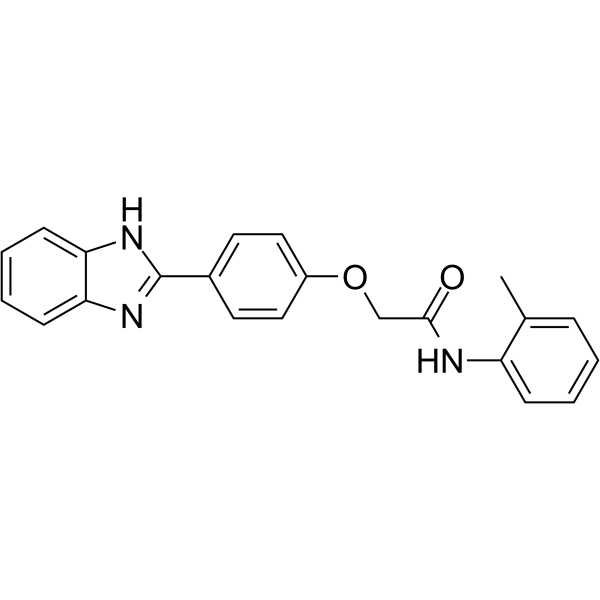
LasR-IN-5 (compound 3C) is a LasR antagonist with an IC50 of 1.37 μM, demonstrating a 77% inhibition of biofilm formation in Pseudomonas aeruginosa. LasR-IN-5 also exhibits quorum sensing (QS) inhibition activity and has potential applications in Pseudomonas aeruginosa infection research .
loading...
    loading...
Cat. No.: HY-151165
CAS No.: 2810894-92-7
Purity:  99.57%
Target:  

Antibiotic Bacterial

Research Areas:  

Infection

LasR-IN-3 is a LasR inhibitor against Pseudomonas aeruginosa. LasR-IN-3 induces LasR structure instability and completely dissociates LasR functioning dimeric form .
loading...
    loading...
Cat. No.: HY-151165R
CAS No.: 2810894-92-7
Research Areas:  

Infection

Quinizarin (Standard) is the analytical standard of Quinizarin. This product is intended for research and analytical applications. Quinizarin (1,4-Dihydroxyanthraquinone), a part of the anticancer agents such as Doxorubicin, Daunorubicin, and Adriamycin, interacts with DNA by intercalating mode (Kd=86.1 μM). Quinizarin is used as a fungicide and pesticide chemical and has shown the ability to inhibit tumor cell growth .
loading...
    loading...
Cat. No.: HY-173270
Target:  

Bacterial

Research Areas:  

Infection

Antibacterial synergist 3 is a dual-acting inhibitor of biofilm (IC50 of PAO1: 0.40 μM and IC50 of PA14: 1.45 μM). Antibacterial synergist 3 reduces virulence production by inhibiting the quorum sensing (QS) system and induces iron deficiency in P. aeruginosa PAO1. Antibacterial synergist 3 enhances the efficacy of Tobramycin (HY-B0441) and Ciprofloxacin (HY-B0356) in a mouse wound infection model. Antibacterial synergist 3 can be used for the research of P. aeruginosa infections .
loading...
    loading...
Cat. No.: HY-181760
CAS No.: 3116844-25-5
Target:  

Bacterial

Research Areas:  

Infection

Quorum sensing-IN-11 is a quorum sensining inhibitor and a LasR antagonist with an IC50 of 0.7399 μM. Quorum sensing-IN-11 inhibits biofilm, pyocyanin formation and swimming motility in Pseudomonas aeruginosa. Quorum sensing-IN-11 can be used for the research of Pseudomonas aeruginosa infection .
loading...
    loading...
Cat. No.: HY-187556
CAS No.: 2581199-68-8
Target:  

Bacterial

Research Areas:  

Infection

Antibiofilm agent-23 is a PqsR-targeting agent, iron chelator, biofilm inhibitor, biofilm dispersant, and anti-virulence agent. Antibiofilm agent-23 selectively binds to PqsR, disrupts the pqs quorum sensing pathway, restricts bacterial iron acquisition, induces intracellular iron deficiency, reduces pyocyanin, elastase, and rhamnolipid production, impairs biofilm formation, and disperses mature biofilms. Antibiofilm agent-23 exhibits low cytotoxicity and shows antibacterial synergy with Ciprofloxacin (HY-B0356) in Caenorhabditis elegans infection models. Antibiofilm agent-23 can be used for the research of biofilm-associated Pseudomonas aeruginosa infections .
loading...
    loading...
Cat. No.: HY-N3043A
CAS No.: 56973-65-0
(E/Z)-Platyphyllenone is a diarylheptanoid compound that can be found in Alnus viridis ssp. viridis. (E/Z)-Platyphyllenone inhibits the biosynthesis of violacein, but stimulates the production of AHL and AHQ quorum-sensing signal molecules as well as the synthesis of pyocyanin in Pseudomonas aeruginosa PAO1, and exhibits strong cytotoxicity against human lung fibroblasts. (E/Z)-Platyphyllenone can be used in studies on Pseudomonas aeruginosa .
loading...
    loading...
Cat. No.: HY-182942
CAS No.: 3112321-20-4
Target:  

Bacterial Elastase

Research Areas:  

Infection

PV-DPD-19 is an autoinducer-2 (AI-2) quorum sensing inhibitor. PV-DPD-19 reduces AI-2 production and inhibits the expression of multiple MSCRAMMs. In co-culture systems with Staphylococcus aureus, PV-DPD-19 decreases the production of pyocyanin and Elastase in Pseudomonas aeruginosa. PV-DPD-19 impairs the adhesion ability of Staphylococcus aureus to lung epithelial cells. PV-DPD-19 inhibits biofilm formation of Pseudomonas aeruginosa (MBIC50 = 27 μg/mL) and Staphylococcus aureus (MBIC50 = 35 μg/mL). PV-DPD-19 shows no cytotoxicity in both in vitro lung epithelial cell models and in vivo Galleria mellonella larva models .
loading...
    loading...
Cat. No.: HY-E71930
Research Areas:  

Others

5-Methylphenazine-1-carboxylate 1-monooxygenase (EC 1.14.13.218) is an oxidoreductase that can convert 5-methyl-phenazine-1-carboxylate, NADH, O2 and 2 H + into pyocyanin, CO2, NAD + and H2O.
loading...
    loading...
Cat. No.: HY-183361
Target:  

Bacterial Elastase

Research Areas:  

Infection

Antibiofilm agent-22 is an FpvA receptor-targeting antibacterial agent. Antibiofilm agent-22 chelates iron, disrupts las, pqs, and rhl pathways, reduces elastase, pyocyanin, and rhamnolipid production, and induces bacterial iron starvation. Antibiofilm agent-22 can be used for the research of Pseudomonas aeruginosa infection .
loading...
    loading...
Cat. No.: HY-76705S
CAS No.: 2562378-12-3
Methyl N-methylanthranilate-d3 is the deuterated-labeled Methyl N-methylanthranilate (HY-76705). Methyl N-methylanthranilate is an N-alkylated anthranilate with a sweet citrus aroma, which is commonly used in perfume manufacturing. Methyl N-methylanthranilate is the dominant component in the defensive secretion of the millipede Typhloiulus orpheus. Methyl N-methylanthranilate exhibits quorum sensing inhibition and anti-biofilm activity against P. aeruginosa; it interferes with PQS synthesis via competitive inhibition of PqsA, but lacks bactericidal activity. Methyl N-methylanthranilate is sensitive to UVA/sunlight in human skin cells, and generates O2- through type I photodynamic reactions, leading to lysosomal/mitochondrial damage, double-strand DNA breaks and apoptosis, with potential phototoxicity .
loading...
    loading...

