31 Results for "

ionic surfactants

" in MedChemExpress (MCE) Product Catalog:
Products (31)

31 Results for "ionic surfactants" in MCE Product Catalog:

Cat. No.: HY-W142692
CAS No.: 59122-55-3
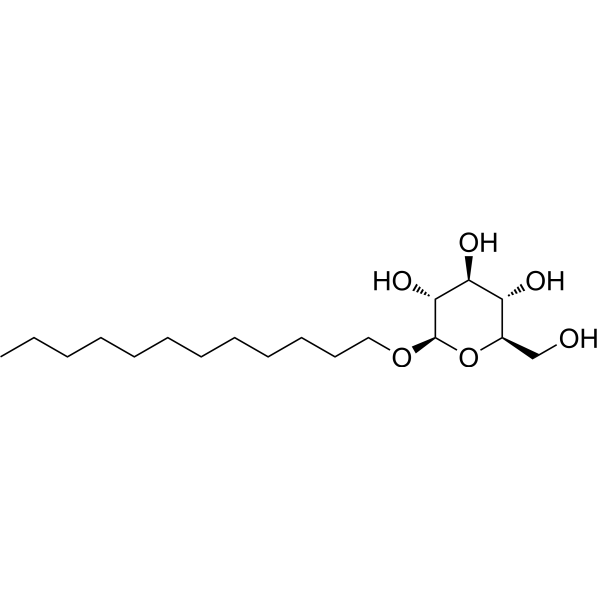
Dodecyl β-D-glucopyranoside is a non-ionic detergent and surfactant commonly used to solubilize and purify membrane proteins in biochemical research. Dodecyl β-D-glucopyranoside also interacts with bovine serum albumin (BSA) to quench its intrinsic fluorescence. The critical micelle concentration (CMC) of Dodecyl β-D-glucopyranoside (DG) and DG/BSA complex is 2.0 mM and 2.34 mM, respectively. Micelles can be formed in aqueous solutions above this concentration .
loading...
    loading...
Cat. No.: HY-100557H
CAS No.: 9004-64-2
Synonyms: Hydroxypropyl Cellulose, Viscosity(2%):95000-105000mPa.s
Research Areas:  

Others

HPC, Viscosity (2%): 95000-105000 mPa.s (Hydroxypropyl Cellulose, Viscosity (2%): 95000-105000 mPa.s) is a nonionic, biocompatible cellulose derivative. Hydroxypropyl Cellulose serves as a thickener or gelling agent, lubricant, and emulsion stabilizer, and is also used in the preparation of capsules and films .
loading...
    loading...
Cat. No.: HY-100557E
CAS No.: 9004-64-2
Synonyms: Hydroxypropyl Cellulose, Viscosity(1%):1275-3500mPa.s
Research Areas:  

Others

HPC, Viscosity (1%):1275-3500mPa.s (Hydroxypropyl Cellulose, Viscosity (1%):1275-3500mPa.s) is a nonionic, biocompatible cellulose derivative. Hydroxypropyl Cellulose serves as a thickener or gelling agent, lubricant, and emulsion stabilizer, and is also used in the preparation of capsules and films .
loading...
    loading...
Cat. No.: HY-D1739
Research Areas:  

Others

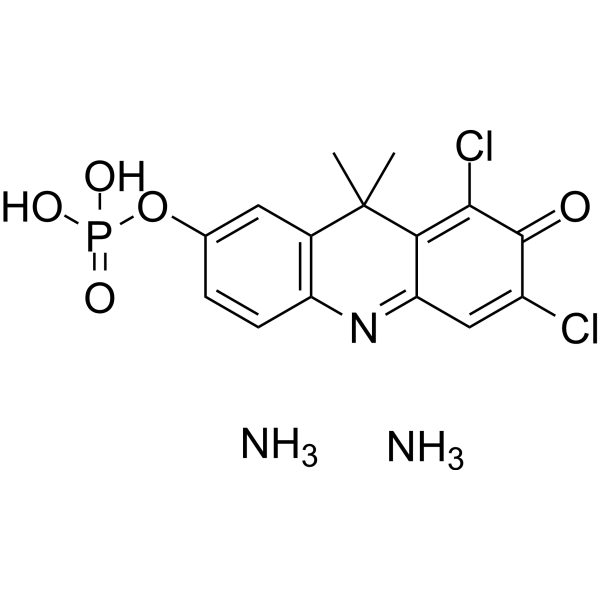
DDAO phosphate diTEA is an amphoteric surfactant derived from DDAO (dimethyldodecylamine oxide). The head group of DDAO in DDAO phosphate diTEA exists in a non-ionic state at pH > 7 and in a cationic state at pH < 5 due to protonation of the oxygen atom. When combined with the anionic surfactant SDS, DDAO can incorporate into mixed micelles, reducing the net micellar charge and attenuating electrostatic repulsion between SDS head groups. DDAO can be used to formulate the ONOO⁻-targeting probe DDAO-PN, which generates significant near-infrared fluorescence at 657 nm .
loading...
    loading...
Cat. No.: HY-W131101
CAS No.: 26658-19-5
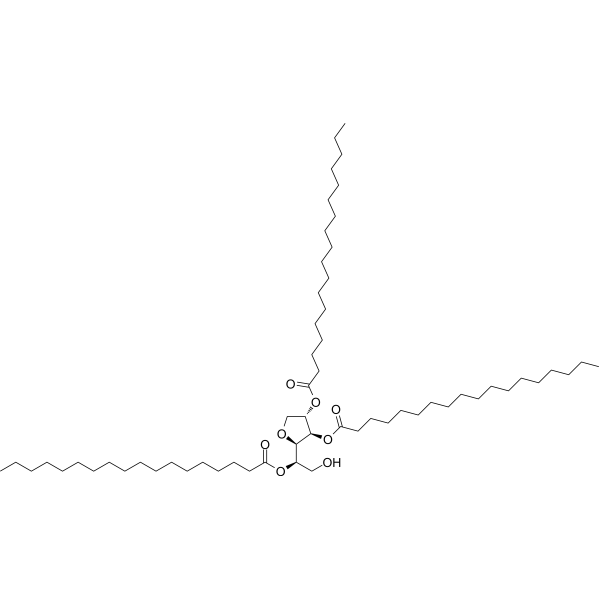
Sorbitan tristearate is a non-ionic surfactant, with a synergistic effect on skin permeability. Sorbitan tristearate can be used as an excipient, such as emulsifier. Pharmaceutical excipients, or pharmaceutical auxiliaries, refer to other chemical substances used in the pharmaceutical process other than pharmaceutical ingredients. Pharmaceutical excipients generally refer to inactive ingredients in pharmaceutical preparations, which can improve the stability, solubility and processability of pharmaceutical preparations. Pharmaceutical excipients also affect the absorption, distribution, metabolism, and elimination (ADME) processes of co-administered drugs .
loading...
    loading...
Cat. No.: HY-W338581
CAS No.: 2315-67-5
Target:  

Estrogen Receptor/ERR

Research Areas:  

Others

4-tert-Octylphenol monoethoxylate is an alkylphenolethoxylate (APE) and a degradation product of non-ionic surfactants (such as 4-tert-octylphenol polyethoxylate). 4-tert-Octylphenol monoethoxylate also possesses non-steroidal estrogenic activity. Additionally, 4-tert-Octylphenol monoethoxylate has been found in wastewater effluent .
loading...
    loading...
Cat. No.: HY-B2106DR
CAS No.: 9002-92-0
Synonyms: Decaethylene glycol monododecyl ether (C12E10) (Standard); Polidocanol (10) (Standard)
Polyoxyethylene (10) lauryl ether (Standard) is the analytical standard of Polyoxyethylene (10) lauryl ether. This product is intended for research and analytical applications. Polyoxyethylene (10) lauryl ether is a non-ionic surfactant. Polyoxyethylene (10) lauryl ether exhibits unique properties in dissolving liposomes and exerts the minimal interference with endotoxin detection. Polyoxyethylene (10) lauryl ether forms hybrid liposomes with Dimyristoylphosphatidylcholine (DMPC) (HY-109541), which can inhibit the proliferation of human promyelocytic leukemia cells without the administration of any drugs.
loading...
    loading...
Cat. No.: HY-W777582
CAS No.: 1173019-48-1
4-tert-Octylphenol monoethoxylate- 13C6 is the 13C labeled isotope of 4-tert-Octylphenol monoethoxylate (HY-W777582) . 4-tert-Octylphenol monoethoxylate is an alkylphenolethoxylate (APE) and a degradation product of non-ionic surfactants (such as 4-tert-octylphenol polyethoxylate). 4-tert-Octylphenol monoethoxylate also possesses non-steroidal estrogenic activity. Additionally, 4-tert-Octylphenol monoethoxylate has been found in wastewater effluent .
loading...
    loading...
Cat. No.: HY-B1941R
CAS No.: 140-66-9
4-tert-Octylphenol (Standard) is the analytical standard of 4-tert-Octylphenol. This product is intended for research and analytical applications. 4-tert-Octylphenol, a endocrine-disrupting chemical, is an estrogenic agent. 4-tert-Octylphenol is also a biodegradation product of non-ionic surfactants alkylphenol polyethoxylates. 4-tert-Octylphenol induces apoptosis in neuronal progenitor cells in offspring mouse brain. 4-tert-Octylphenol reduces bromodeoxyuridine (BrdU), mitotic marker Ki67, and phospho-histone H3 (p-Histone-H3), resulting in a reduction of neuronal progenitor proliferation. 4-tert-Octylphenol disrupts brain development and behavior in mice, which is promising for reserch of immune response, neuro-related diseases and ethology .
loading...
    loading...
Cat. No.: HY-N17984
CAS No.: 96158-11-1
Hemsloside Ma3 is an anionic surfactant and solubilizer. Hemsloside Ma3 is an oleanolic acid bisdesmosidic saponin that can be isolated from the rhizomes of Hemsleya macrosperma and Hemsleya chinensis. Hemsloside Ma3 improves the water solubility of saikosaponin a, a poorly water-soluble monodesmosidic saponin, and its solubilizing effect appears near the critical micelle concentration. At a constant ionic strength, Hemsloside Ma3 exhibits the property of reduced surface tension with the increase in hydrogen ion concentration .
loading...
    loading...
Cat. No.: HY-151234
CAS No.: 93-83-4
Synonyms: OADA
Research Areas:  

Infection

Oleic acid diethanolamide (OADA) is a non-ionic, biodegradable surfactant. Oleic acid diethanolamide reduces the surface tension of water, emulsifies free water in diesel fuel to form a stable emulsion, and can be loaded onto sulfonated polystyrene nanoparticles to enhance oil recovery. Oleic acid diethanolamide is one of the nematicidal secondary metabolites produced by Aspergillus flavus. Oleic acid diethanolamide can be used in studies related to biological control of root-knot nematodes, enhanced oil recovery, and diesel fuel emulsion stabilization .
loading...
    loading...

