



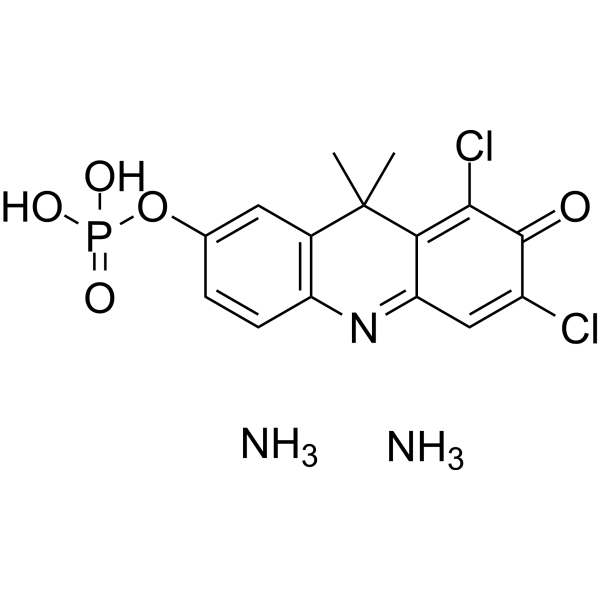
DDAO phosphate diTEA
DDAO phosphate diTEA is an amphoteric surfactant derived from DDAO (dimethyldodecylamine oxide). The head group of DDAO in DDAO phosphate diTEA exists in a non-ionic state at pH > 7 and in a cationic state at pH < 5 due to protonation of the oxygen atom. When combined with the anionic surfactant SDS, DDAO can incorporate into mixed micelles, reducing the net micellar charge and attenuating electrostatic repulsion between SDS head groups. DDAO can be used to formulate the ONOO⁻-targeting probe DDAO-PN, which generates significant near-infrared fluorescence at 657 nm.
For research use only. We do not sell to patients.
- Formula: C27H42Cl2N3O5P
- Molecular Weight:590.52
-
Storage:
Please store the product under the recommended conditions in the Certificate of Analysis.

To place orders, for customer services and technical support, please contact: MedChemExpress USA
Tel: 609-228-6898 E-mail: [email protected] [email protected]


-
 Biological Activity
-
Chemical Information
- Purity & Documentation
-
 Help & FAQs




Biological Activity
Description
In Vitro
The design principle of DDAO-PN involves protecting the phenolic hydroxyl group of the DDAO fluorophore with a benzyl group linked to a phenylboronic acid pinacol ester; this suppresses the intramolecular charge transfer (ICT) effect and keeps the near-infrared fluorescence in an "off" state. Upon oxidative cleavage of the boronate ester group by ONOO− to form a phenol, a self-elimination reaction occurs, releasing the free DDAO fluorophore and restoring the ICT effect, thereby resulting in a significant enhancement of near-infrared fluorescence at 657 nm (up to 84-fold). Consequently, free DDAO is one of the products of the reaction between DDAO-PN and ONOO−, which serves as the molecular basis for the fluorescence "turn-on" response of the probe[2].
(I) Experiments with the DDAO-PN near-infrared fluorescent probe[2]
1. Probe synthesis:
DDAO (120 mg, 0.40 mmol), K2CO3 (124 mg, 0.90 mmol), and 4-(bromomethyl)phenylboronic acid pinacol ester (264 mg, 0.80 mmol) were dissolved in 8 mL of DMF and heated in an oil bath at 85°C for 5.0 h. The mixture was extracted with ethyl acetate (60 mL × 3), the organic phase was concentrated via rotary evaporation, and the product was purified by silica gel column chromatography (petroleum ether:ethyl acetate = 10:1, v/v) to yield DDAO-PN as a red solid (60 mg, 28.7% yield).
2. In vitro spectroscopic detection:
A 5.0 μM solution of DDAO-PN was prepared in PBS-CH3CN (pH 7.4, containing 30% CH3CN). ONOO− (0–35 μM) was added to the solution, and fluorescence was measured at λex = 600 nm and λem = 657 nm; the reaction reached equilibrium in less than 30 seconds. For selectivity experiments, 50 μM metal ions, 500 μM biothiols, 50 μM ROS/RNS, or 25 μM ONOO− were separately added to the system. pH sensitivity experiments were conducted in buffers ranging from pH 5.0 to 10.0. For DDAO stability experiments, 10 μM free DDAO was incubated with 0–200 μM ONOO− for 30 min prior to measurement.
3. Cell culture and imaging:
MCF-7 cells were loaded with 10 μM DDAO-PN for 30 min; after washing with PBS, they were incubated with 0.5 or 1.0 mM SIN-1 (an ONOO− donor) for 0.5 h. For the control group, 250 μM minocycline was added simultaneously. RAW 264.7 cells were stimulated with 1.0 μg/mL LPS and 60 ng/mL IFN-γ for 6 h, followed by stimulation with 20 nM PMA for 0.5 h, and then loaded with 10 μM DDAO-PN; 100 μM uric acid was added to the control group. Confocal microscopy imaging was performed with λex = 594 nm and λem = 630–740 nm.
4. Cytotoxicity (MTT assay):
MCF-7 cells were treated with 0–15 μM DDAO-PN for 24 h, and cell viability was assessed using the MTT assay.
5. In vivo imaging:
Female Kunming mice (4–5 weeks old, 20–22 g) were used; fur was removed one day prior to imaging.
5.1 Detection of exogenous ONOO−:
Intraperitoneal injection of 100 μL of 0.5 mM DDAO-PN and 100 μL of ONOO− at various concentrations (0/50/100 μM); imaging was performed 10 min later.
5.2 Hind-limb inflammation model:
Subcutaneous injection of 50 μL of LPS (0/1.0/2.0 mg/mL) into the hind limb; 8 h later, 50 μL of 0.5 mM DDAO-PN (30% DMSO, v/v) was injected subcutaneously at the same site.
Peritonitis model:
Intraperitoneal injection of 100 μL of LPS (0/1.0/2.0 mg/mL); 8 h later, 100 μL of 0.5 mM DDAO-PN was injected intraperitoneally. For the inhibition group, 100 μL of 0.5 mM uric acid was injected intraperitoneally 10 min prior to probe administration.
Images were acquired using an IVIS Spectrum in vivo imaging system under isoflurane anesthesia (λex = 605 nm, λem = 660 ± 10 nm).
In vivo safety: Intraperitoneal injection of 100 μL of DDAO-PN (0/1.0/2.0 mM); body weight was recorded for 15 consecutive days.
MedChemExpress (MCE) has not independently confirmed the accuracy of these methods. They are for reference only. .


Chemical Information
-
Molecular Weight 590.52
-
Formula C27H42Cl2N3O5P
-
SMILES
O=C1C(Cl)=CC2=NC3=C(C(C)(C)C2=C1Cl)C=C(OP(O)(O)=O)C=C3.CCN(CC)CC.CCN(CC)CC
-
Shipping
Room temperature in continental US; may vary elsewhere.
-
Storage
Please store the product under the recommended conditions in the Certificate of Analysis.


Purity & Documentation

Calculators
Concentration (start) × Volume (start) = Concentration (final) × Volume (final)


DDAO phosphate diTEA Related Classifications
HY-D1739 Related Classifications
 Powered by Bioz