57 Results for "

Fructus

" in MedChemExpress (MCE) Product Catalog:
Products (57)

57 Results for "Fructus" in MCE Product Catalog:

Cat. No.: HY-N20455
Synonyms: Forsythiae Fructus extract
Category:  

Extract

Target:  

Others

Forsythia suspensa extract (Forsythiae fructus extract) is an extract of Forsythia suspensa containing a variety of bioactive components.
loading...
    loading...
Cat. No.: HY-N20148
Synonyms: Cnidium monnieri extract
Category:  

Extract

Target:  

Others

Cnidii fructus extract (Cnidium monnieri extract) is an extract of Cnidium monnieri (L.) Cuss., which can be used in research on impotence and osteoporosis.
loading...
    loading...
Cat. No.: HY-N20541
Synonyms: Malva verticillata extract
Category:  

Extract

Target:  

Others

Malvae fructus extract (Malva verticillata extract) is an extract of mallow seeds (Hymenochloa verticillata) that can be used to study ischial and bladder stones.
loading...
    loading...
Cat. No.: HY-N20400
Synonyms: Fructus sophorae extract; Rexflavone
Category:  

Extract

Target:  

Others

Sophora japonica fruit extract (Fructus sophorae extract) is an extract of Sophora japonica fruits, rich in isoflavones and containing a variety of bioactive components.
loading...
    loading...
Cat. No.: HY-N20263
Synonyms: Fructus ammomi rotundus extract
Category:  

Extract

Target:  

Others

Amomum kravanh fruit extract (Fructus ammomi rotundus extract) is an extract of white cardamom (Amomum kravanh Pierre ex Gagnep) with antioxidant activity.
loading...
    loading...
Cat. No.: HY-N20102
Synonyms: Fructus bruceae extract; Java brucea fruit extract
Category:  

Extract

Target:  

Others

Brucea javanica extract (Fructus bruceae extract) is an extract of the fruit of Brucea javanica, which has anti-tumor effects.
loading...
    loading...
Cat. No.: HY-N20109
Synonyms: Fructus monordicae extract; Luo han guo extract; Monkfruit extract
Category:  

Extract

Target:  

Others

Momordica grosvenori extract (Fructus monordicae extract) is an extract of Siraitia grosvenorii, which can be used in diabetes research.
loading...
    loading...
Cat. No.: HY-N20344
Synonyms: Kochia scoparia fruit extract
Category:  

Extract

Target:  

Parasite

Kochiae fructus extract (Kochia scoparia fruit extract) is an extract of Kochia scoparia (L.) Schrad., containing a variety of bioactive components with anti-inflammatory, anti-diabetic, insecticidal, anti-allergic, antipruritic, and anti-rheumatoid arthritis activities.
loading...
    loading...
Cat. No.: HY-N16662
CAS No.: 103687-27-0
erythro-Anethole glycol (Compound 11) is an aromatic diol compound found in Foeniculi Fructus. erythro-Anethole glycol has potential antioxidant activity and can be used for the researches of inflammation, cardiovascular and neurological disease .
loading...
    loading...
Cat. No.: HY-N17590
CAS No.: 1376267-63-8
Dihydrogingerenone B (Compound 78) is a diarylheptanoid that can be found in the dried mature fruit of Alpinia oxyphylla fructus .
loading...
    loading...
Cat. No.: HY-N17982
CAS No.: 879627-80-2
Vanillic acid 4-O-β-D-glucopyranoside is a vanillic acid glycoside with moderate antioxidant activity. Vanillic acid 4-O-β-D-glucopyranoside scavenges DPPH free radicals and superoxide anion radicals, and inhibits AAPH-induced lipid peroxidation in the linoleic acid system. The IC50 value of Vanillic acid 4-O-β-D-glucopyranoside against HIV-1 integrase is >100 μg/mL, indicating that it is not an effective HIV-1 integrase inhibitor. Vanillic acid 4-O-β-D-glucopyranoside is isolable from the ethyl acetate extract of Gardeniae Fructus.
loading...
    loading...
Cat. No.: HY-N20006
Synonyms: Motherwort fruit extract; Fructus leonuri
Category:  

Extract

Target:  

Others

Flatstem milkvetch seed extract (Motherwort fruit extract) is an extract of the flatstem milkvetch fruit containing a variety of bioactive components.
loading...
    loading...
Cat. No.: HY-N20245
Synonyms: Bitter orange extract; Fructus aurantii extract
Category:  

Extract

Target:  

Others

Hovenia dulcis extract (Bitter orange extract) is an extract of Hovenia dulcis that can be used in research on hypertriglyceridemia.
loading...
    loading...
Cat. No.: HY-N1636
CAS No.: 68353-24-2
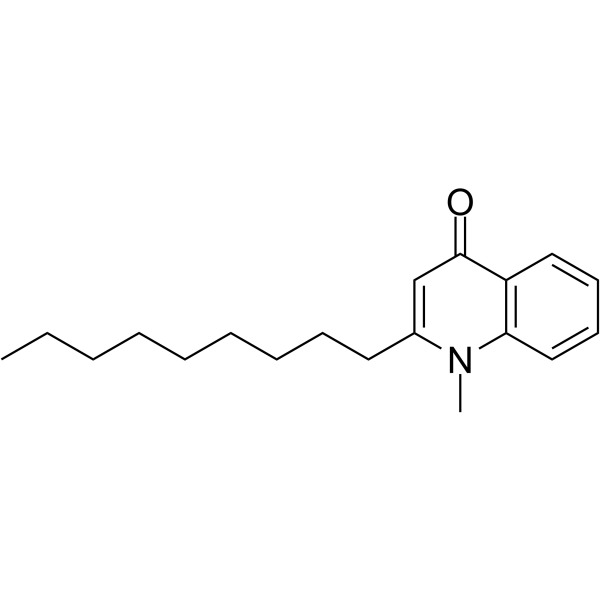
1-Methyl-2-nonyl-4(1H)-quinolone, a quinolone alkaloid, is a potent and selective MAO-B (monoamine oxidase) inhibitor. 1-Methyl-2-nonyl-4(1H)-quinolone exhibites inhibitory activity on leukotriene biosynthesis, with an IC50 of 12.1 μM .
loading...
    loading...
Cat. No.: HY-N15354
CAS No.: 146445-93-4
Jujubasaponin IV is a triterpenoid saponin compound found in Zizyphi Fructus. Animal studies have shown that Jujubasaponin IV possesses certain anti-ulcer activity, possibly through mechanisms such as enhancing the gastric mucosal barrier or inhibiting gastric acid secretion. Jujubasaponin IV can be used in research on digestive system diseases, particularly in the study of gastric ulcer mechanisms .
loading...
    loading...
Cat. No.: HY-L223
861 compounds

Antitussive and antiasthmatic method is a type of treatment strategy in traditional Chinese medicine, mainly used to alleviate symptoms such as coughing and asthma. These symptoms may be caused by various factors, such as: Bronchial asthma, chronic obstructive pulmonary disease, asthmatic bronchitis, cough-induced asthma, and others. Based on existing research in traditional Chinese medicine, many types of Chinese medicinal herbs showed antitussive and antiasthmatic effects. For example: Ardisiae Japonicae Herba, Ginkgo Semen, Amygdalus Communis Vas, Farfarae Flos, Viticis Cannabifoliae Fructus, Eriobotryae Folium etc. Therefore, the active ingredients derived from these traditional Chinese medicine have high medicinal value and have the potential to be developed into drugs for related diseases.

MCE can provide 861 active ingredients that can be obtained from traditional Chinese medicine with antitussive and antiasthmatic functions, which can be applied to drug development and research on disease mechanisms.

Cat. No.: HY-L224
2,478 compounds

Diarrhea is a disease symptom, and the pathophysiologic basis of diarrhea is a disturbance in intestinal water and electrolyte balance, which may be due to increased secretion of osmotically active electrolytes (secretory diarrhea) or increased intake of osmotically active substances (osmotic diarrhea). Food poisoning, pathogenic bacterial infections, and intestinal-related diseases can all contribute to the development of diarrhea. Traditional Chinese Medicine (TCM) considers diarrhea to be a symptom of an imbalance in the body's systems, particularly related to the functions of the spleen and stomach. Spleen qi deficiency, dampness-heat, liver and spleen disharmony are closely related to diarrhea. Many types of Chinese herbs regulate the function of diarrhea, such as: Dysosmae Verspiellis Rhixoma Et Radix, Ginkgo Semen, Forsythiae Fructus, and Campsis Flos.

MCE can provide 2,478 active monomers that can be obtained from TCM herbs with diarrhea-regulating functions, which can be applied to drug development and disease mechanism research.

