71 Results for "

VCAM-1

" in MedChemExpress (MCE) Product Catalog:
Products (71)

71 Results for "VCAM-1" in MCE Product Catalog:

Cat. No.: HY-183448
CAS No.: 117666-86-1
ETMTC is an orally active anti-inflammatory and antioxidant agent. ETMTC inhibits IKK-mediated phosphorylation and degradation of IkBα, blocks nuclear translocation and activation of NF-κB, and reduces the expression of ICAM-1, VCAM-1, E-selectin, Th2 cytokines and eosinophil chemokines. ETMTC abrogates neutrophil adhesion to endothelial monolayers and inhibits TNF-α-induced ROS production. ETMTC activates Nrf2, and enhances the activities of mitochondrial complex I and IV. ETMTC reduces lipid peroxidation levels, oxidative DNA damage, cytochrome c and caspase 9 activity, and decreases goblet cell metaplasia and subepithelial fibrosis. ETMTC can be used for the research of inflammatory diseases and asthma [1] .
loading...
    loading...
Cat. No.: HY-P11887
CAS No.: 1174559-81-9
VHPKQHR is a peptide-based delivery enhancer that binds to VCAM-1. VHPKQHR enables intracellular internalization of relevant nanomaterials and facilitates the targeted delivery of miRNA inhibitors to inflamed endothelial cells and endothelial cells activated by disturbed flow. When conjugated with magnetic mesoporous silica nanoparticles, VHPKQHR achieves targeted accumulation at atherosclerotic plaque sites. When displayed on the surface of polyelectrolyte complex micelles, VHPKQHR enhances the relevant effects of anti-miR-92a in Apoe -/- mice. When conjugated with ultrasmall superparamagnetic iron oxide nanoparticles, VHPKQHR forms a contrast agent for T1-weighted magnetic resonance imaging. VHPKQHR can be used in research related to atherosclerosis, stenosis and rheumatoid arthritis [1] .
loading...
    loading...
Cat. No.: HY-112868A
CAS No.: 222638-65-5
ABH is an orally active arginase inhibitor (Ki = 8.5 nM). ABH promotes NO production and reduces the expression of inflammatory response-related molecules (ICAM-1, VCAM-1, MCP-1). ABH improves erectile function, reduces lung damage, promotes wound healing, reduces arterial blood pressure, and improves vascular fibrosis [1] .
loading...
    loading...
Cat. No.: HY-183516
CAS No.: 19220-35-0
Synonyms: OPG
Osteoprotegerin (OPG) belongs to the tumor necrosis factor receptor (TNFR) superfamily . Osteoprotegerin blocks the RANKL-RANK interaction as well as the binding of TRAIL to its receptor. Osteoprotegerin activates NF-κB to induce the expression of ICAM-1, VCAM-1 and E-selectin, and activates the phosphorylation of ERK1/2. Osteoprotegerin regulates osteoclast activity, inhibits osteoclast maturation and formation, bone lysis and bone resorption, and increases bone mass. Osteoprotegerin regulates vascular endothelial cell function. Osteoprotegerin can be used in the research of cardio-cerebrovascular and bone-related diseases [1].
loading...
    loading...
Cat. No.: HY-171216
CAS No.: 278598-52-0
Target:  

Integrin

Research Areas:  

Neurological Disease

GW559090 is a selective, competitive, and high-affinity α4 integrin antagonist with a Kd of 0.19 nM for α4β1. GW559090 can effectively block the binding of α4β1 to vascular cell adhesion molecule 1 (VCAM-1) and fibronectin with IC50 values of 7.72 and 8.04 nM. GW559090 also inhibits the interaction between α4β7 and mucosal addressin cell adhesion molecule 1 (MAdCAM-1) (IC50 = 23 nM). GW559090 can inhibit inflammatory infiltration in the eyes, repair the corneal barrier and restore the function of goblet cells. GW559090 can be used for research of Sjögren's syndrome associated dry eye [1].
loading...
    loading...
Cat. No.: HY-136692
CAS No.: 479203-71-9
Target:  

Integrin

Research Areas:  

Inflammation/Immunology

HMR 1031 is a very late antigen-4 (VLA4, i.e., integrin α4β1) inhibitor, with IC50 values of 0.7 nM and 0.3 nM against VLA-4/VCAM-1 and VLA-4/fibronectin, respectively. HMR 1031 blocks allergen-induced airway responses and airway inflammation in mouse and sheep models. HMR 1031 can be used in asthma-related research [1].
loading...
    loading...
Cat. No.: HY-W013812S2
CAS No.: 1404475-07-5
Synonyms: Linoleic Acid ethyl ester-d2; Mandenol-d2
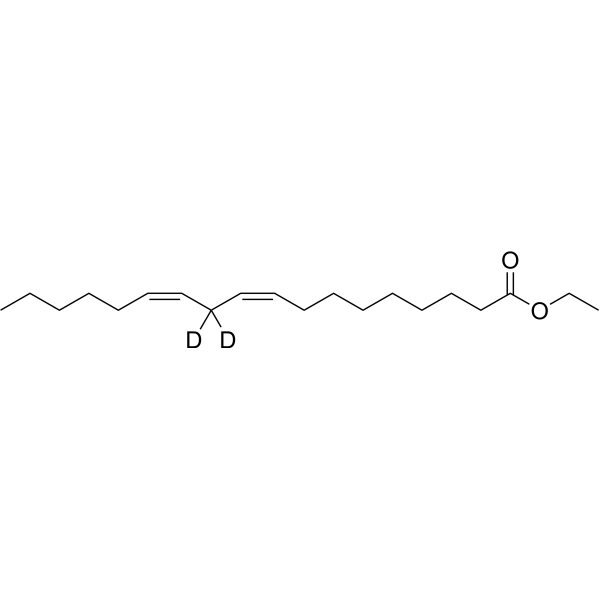
Ethyl linoleate-d2 (Linoleic Acid ethyl ester-d2; Mandenol-d2) is the deuterium labeled Ethyl linoleate (HY-W013812). Ethyl linoleate (Linoleic Acid ethyl ester) inhibit the development of atherosclerotic lesions and the expression of inflammatory mediators [1] .
loading...
    loading...
Cat. No.: HY-FLB2068
CAS No.: 8047-67-4
Synonyms: Iron saccharate solution
Research Areas:  

Metabolic Disease Cancer

Iron Sucrose solution is mainly composed of Iron sucrose (HY-B2068). Iron sucrose (Iron saccharate) is a intravenous iron preparation and a pro-oxidant agent. Iron sucrose has the potential for iron deficiency anemia treatment [1] .
loading...
    loading...
Cat. No.: HY-183353
Nrf2 activator-25 is a Nrf2 activator. Nrf2 activator-25 promotes the dissociation of Nrf2 from Keap1 (with a Kd of 21.3 μM for Keap1), drives Nrf2 nuclear translocation, and increases the production of downstream antioxidant enzymes. Nrf2 activator-25 inhibits apoptosis, ferroptosis and vascular fibrosis, and protects vascular endothelial cells from damage. Nrf2 activator-25 can be used in the research of diabetic vascular diseases [1].
loading...
    loading...
Cat. No.: HY-122023
CAS No.: 247044-77-5
Target:  

Integrin

Research Areas:  

Inflammation/Immunology Cancer

TBC3486 is a highly selective integrin α4β1 inhibitor. TBC3486 acts as a chemosensitizer to enhance the sensitivity of leukemia cells to chemotherapy. TBC3486 exhibits efficacy in preclinical models of integrin α4-dependent inflammatory and autoimmune diseases, including a mouse model of autoimmune encephalomyelitis. TBC3486 can be used for the research of precursor B-cell acute lymphoblastic leukemia [1].
loading...
    loading...
Cat. No.: HY-P991896
Synonyms: AT14-012
AT1412 is a CD9-binding antibody. AT1412 binds to the tetraspanin protein CD9 and modulates CD9 function by enhancing T cell adhesion to endothelial cells (HUVECs) and transendothelial migration. AT1412 binds to B-ALL cell lines but not to T-ALL. AT1412 induces antibody-dependent cellular cytotoxicity in B-ALL cell lines. AT1412 binds to melanoma cells, B-ALL, gastric cancer, colorectal cancer, and pancreatic cancer cells [1] .
loading...
    loading...

