90 Results for "

HBV replication

" in MedChemExpress (MCE) Product Catalog:
Products (90)

90 Results for "HBV replication" in MCE Product Catalog:

Cat. No.: HY-177667A
Target:  

HBV

Research Areas:  

Infection

Tomligisiran sodium is a siRNA in JNJ-3989 (JNJ-73763989). JNJ-3989 is comprised of 2 siRNAs (Daplusiran and Tomligisiran), that target hepatitis B virus (HBV) mRNAs for degradation, thereby inhibiting HBV replication.
loading...
    loading...
Cat. No.: HY-116607
CAS No.: 246872-58-2
Target:  

HBV

Research Areas:  

Infection

BAY38-7690 is a non-nucleoside inhibitor that inhibits HBV replication. BAY38-7690 inhibits viral DNA replication by preventing the formation of viral core particles (nucleocapsids). The IC50 value of BAY38-7690 against HBV in stably transfected HepG2.2.15 cells is 0.15 μM .
loading...
    loading...
Cat. No.: HY-117999
CAS No.: 247037-81-6
Target:  

HBV

Research Areas:  

Infection

BAY39-5493 is a non-nucleoside inhibitor that inhibits HBV replication. BAY39-5493 inhibits viral DNA replication by preventing the formation of viral core particles (nucleocapsids). The IC50 value of BAY39-5493 against HBV in stably transfected HepG2.2.15 cells is 0.03 μM .
loading...
    loading...
Cat. No.: HY-147255A
CAS No.: 2137847-77-7
Synonyms: (S)-ZM-H1505R
Target:  

HBV

Research Areas:  

Infection

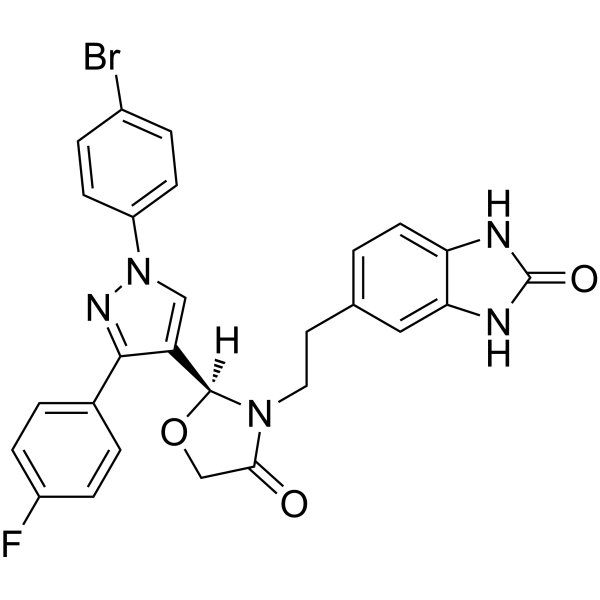
(S)-Canocapavir is the isomer of Canocapavir (HY-147255A). Canocapavir (ZM-H1505R) is an orally active HBV core protein-targeting antiviral agent. Canocapavir binds to the hydrophobic pocket at the dimer-dimer interface of HBV core protein (HBc), stimulating intracellular accumulation of nonfunctional HBV capsids, disrupting viral replication. Canocapavir interferes with the interaction between HBc and HBV large surface protein, resulting in diminished
production of empty virionsis. Canocapavir can be used for the research of hepatitis B virus (HBV) infection .
loading...
    loading...
Cat. No.: HY-170605
CAS No.: 1362113-74-3
Target:  

HBV

Research Areas:  

Infection

BA-AZT1 is the inhibitor for HBV polymerase and sodium taurocholate cotransporting polypeptide (NTCP). BA-AZT1 inhibits the secretion of viral capsid protein HBsAg and HBeAg with IC50 of 0.65 µM and 13.42 µM, inhibits the HBV DNA replication with an IC50 of 0.70 µM .
loading...
    loading...
Cat. No.: HY-B0017S
CAS No.: 1134182-00-5
Synonyms: Epavudine-d4; L-Thymidine-d4; NV 02B-d4
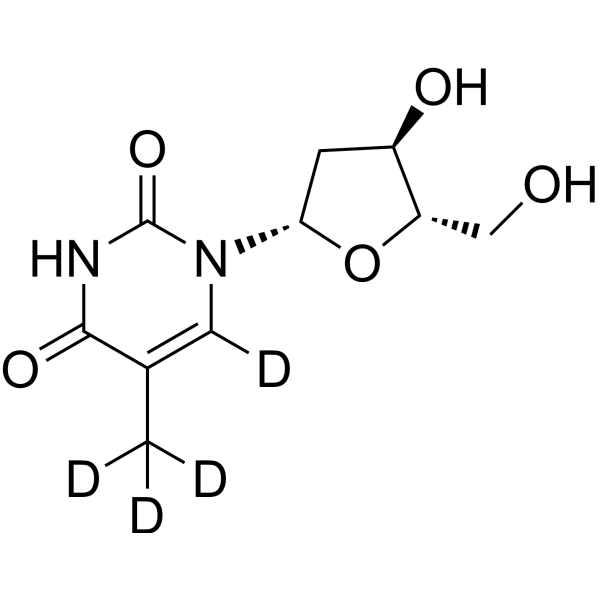
Telbivudine-d4 is deuterium labeled Telbivudine. Telbivudine (Epavudine), an orally active thymidine nucleoside analog, is a potent antiviral inhibitor of hepatitis B virus (HBV) replication .
loading...
    loading...
Cat. No.: HY-162579
CAS No.: 3036114-68-5
Research Areas:  

Inflammation/Immunology

TLR7 agonist 22 (Compound 11a) emerges as a selective TLR7 agonist with an IC50 value of 25.86 μM. TLR7 agonist 22 inhibits the cellular HBsAg secretion and effectively activates TLR7, thereby inducing the secretion of TLR7-regulated cytokines IL-12, TNF-αand IFN-αin human PBMC cells. TLR7 agonist 22 is a promising for research in the field of developing novel immunomodulatory anti-HBV agents .
loading...
    loading...
Cat. No.: HY-B0017R
CAS No.: 3424-98-4
Synonyms: Epavudine (Standard); L-Thymidine (Standard); NV 02B (Standard)
Target:  

Reference Standards HBV

Research Areas:  

Infection

Telbivudine (Standard) is the analytical standard of Telbivudine. This product is intended for research and analytical applications. Telbivudine (Epavudine), an orally active thymidine nucleoside analog, is a potent antiviral inhibitor of hepatitis B virus (HBV) replication .
loading...
    loading...
Cat. No.: HY-169125
CAS No.: 380458-45-7
Target:  

HBV

Research Areas:  

Infection

HBV-IN-49 is an anti-hepatitis B virus (HBV) agent that inhibits HBV replication. HBV-IN-49 can be utilized in infection research .
loading...
    loading...
Cat. No.: HY-173278
Target:  

HBV Potassium Channel

Research Areas:  

Infection

AIC263282 is a potent Hepatitis B Virus (HBV) capsid assembly modulator with an EC50 of 3.8 nM. AIC263282 shows an IC50 of 61 nM for hERG. AIC263282 exhibits activity against viral replication and hepatitis B surface antigen (HBsAG) on primary human hepatocytes .
loading...
    loading...
Cat. No.: HY-114956
CAS No.: 300669-68-5
Target:  

HBV

Research Areas:  

Infection

AT-61 is a non nucleoside HBV replication inhibitor. AT-61 prevents the capsid formation of pre genomic RNA, resulting in the production of empty capsids. AT-61 has the activity of drug-resistant mutant strains. AT-61 can be used for research on hepatitis B virus infection .
loading...
    loading...
Cat. No.: HY-119702
CAS No.: 1835652-66-8
Target:  

HBV

Research Areas:  

Infection

YZ51 is a derivative of Osalmid (HY-B2116) with stronger ribonucleotide reductase (RR) inhibitory activity and HBV replication inhibition ability than Osalmid. The IC50 of YZ51 against recombinant RR activity is 0.6 μM, and the IC50 against HepG2.2.15 cell RR activity is 23.7 μM .
loading...
    loading...
Cat. No.: HY-W105601
CAS No.: 161599-46-8
Synonyms: 2',3'-Di-O-acetyl-5'-deoxy-5-fluorocytidine
Target:  

Endogenous Metabolite

Research Areas:  

Infection

5'-Deoxy-2',3'-di-O-acetyl-5-fluorocytidine (2',3'-Di-O-acetyl-5'-deoxy-5-fluorocytidine) is an antiviral compound that inhibits HBV reverse transcriptase activity. 5'-Deoxy-2',3'-di-O-acetyl-5-fluorocytidine shows potential to control HBV replication in vitro. 5'-Deoxy-2',3'-di-O-acetyl-5-fluorocytidine, as a nucleoside analog, may provide a new option for the suppression of chronic hepatitis B .
loading...
    loading...
Cat. No.: HY-113308AS2
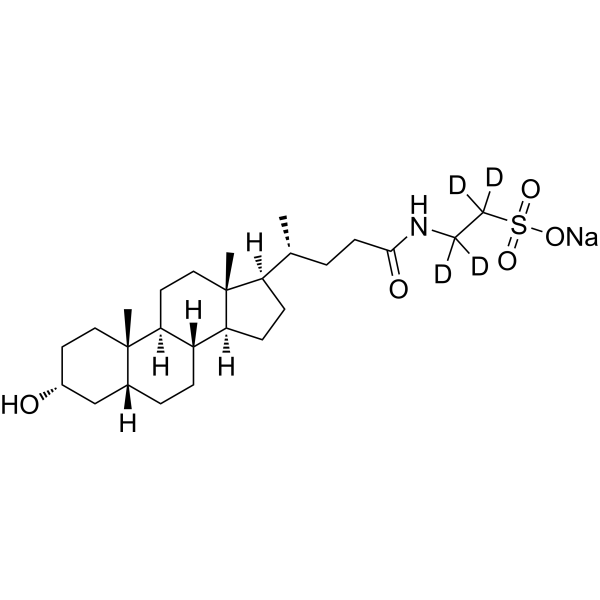
Taurolithocholic acid-d4-1 (sodium) is the deuterium labeled Taurolithocholic acid. Taurolithocholic acid sodium is an orally active bile acid and antiviral agent. Taurolithocholic acid sodium upregulates FADS2 by activating the TGR5-PI3K/AKT-SREBP2 signaling axis, inhibits SFTSV-induced ferroptosis, viral replication and viral entry of HBV/HDV, while reducing the release of IL-1β, lipid ROS and LDH. While exerting antiviral protective effects, Taurolithocholic acid sodium also stimulates the recycling of hepatocellular membrane transporters, impairs canalicular bile acid secretion function, and induces hepatocyte cholestasis, apoptosis and acute hepatocellular injury. Taurolithocholic acid sodium serves as an experimental model compound for hepatocellular cholestasis. At concentrations ≤200 μM, Taurolithocholic acid sodium shows no cytotoxicity and does not activate the interferon pathway. Taurolithocholic acid sodium not only protects mice from lethal SFTSV infection but also is suitable for studies related to severe fever with thrombocytopenia syndrome and cholestasis .
loading...
    loading...
Cat. No.: HY-113308S
CAS No.: 1265681-64-8
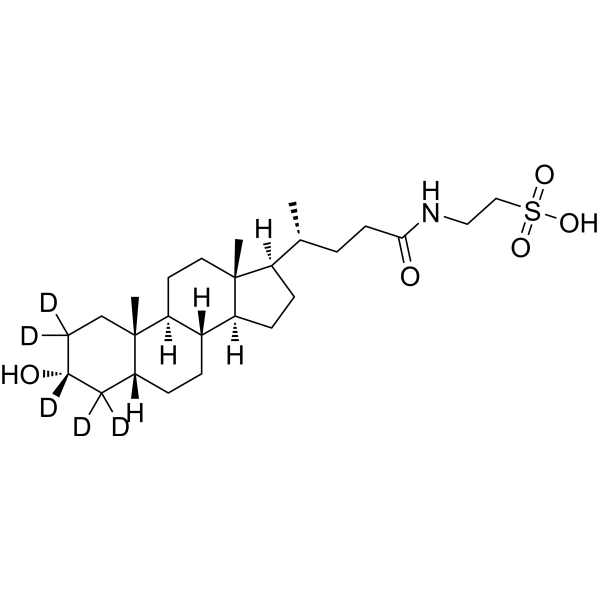
Taurolithocholic acid-d5 is deuterium labeled Taurolithocholic acid. Taurolithocholic acid is an orally active bile acid and antiviral agent. Taurolithocholic acid upregulates FADS2 by activating the TGR5-PI3K/AKT-SREBP2 signaling axis, inhibits SFTSV-induced ferroptosis, viral replication and viral entry of HBV/HDV, while reducing the release of IL-1β, lipid ROS and LDH. While exerting antiviral protective effects, Taurolithocholic acid also stimulates the recycling of hepatocellular membrane transporters, impairs canalicular bile acid secretion function, and induces hepatocyte cholestasis, apoptosis and acute hepatocellular injury. Taurolithocholic acid serves as an experimental model compound for hepatocellular cholestasis. At concentrations ≤200 μM, Taurolithocholic acid shows no cytotoxicity and does not activate the interferon pathway. Taurolithocholic acid not only protects mice from lethal SFTSV infection but also is suitable for studies related to severe fever with thrombocytopenia syndrome and cholestasis .
loading...
    loading...
Cat. No.: HY-183260
CAS No.: 3049354-73-3
Target:  

HBV Cytochrome P450

Research Areas:  

Infection

HBV-IN-57 is an orally active HBV inhibitor with pan-genotypic efficacy against HBV genotypes B/C. HBV-IN-57 inhibits HBV DNA replication and HBV capsid assembly. HBV-IN-57 can be used for the research of chronic hepatitis B .
loading...
    loading...
Cat. No.: HY-180524
CAS No.: 3014372-17-6
Target:  

HBV

Research Areas:  

Infection

CAB7-3 is an orally active HBV capsid assembly modulator (CAM). CAB7-3 exhibits an exceptional antiviral efficacy reducing HBV DNA with an EC50 = 70 nM, CC50 = 32.3 μM in HepDES19 cells. CAB7-3 exhibits significant anti-HBV activity in HBV-integrated HepDES19 (EC50 = 70 nM), HepAD38 (EC50 = 1 nM) and HBV-infected HLCZ01 cells (EC50 = 2 nM), respectively. CAB7-3 effectively reduces Hepatic HBV core protein levels and suppresses viral replication in vivo. CAB7-3 demonstrates a favorable drug-like and safety profile. CAB7-3 can be used for Hepatitis B Virus (HBV) research .
loading...
    loading...
Cat. No.: HY-184358
CAS No.: 321941-76-8
Target:  

HBV IFNAR

Research Areas:  

Infection

CLEC5A-IN-1 is an inhibitor that binds to CLEC5A, with a Kd value of 277 nM. CLEC5A-IN-1 inhibits HBV replication. CLEC5A-IN-1 induces the production of IFNα and IFNβ. CLEC5A-IN-1 reduces serum HBsAg and HBV DNA levels, as well as hepatic HBcAg levels, in HBV-infected animals. CLEC5A-IN-1 increases the positive rate and levels of serum HBsAb in HBV-infected animals. CLEC5A-IN-1 can be used for the research of hepatitis B .
loading...
    loading...
Cat. No.: HY-173121
Target:  

HBV

Research Areas:  

Infection

KR019 is a potent HBV capsid assembly modulator, exhibits potent antiviral activity in HBV-replicating cells. KR019 binds to the hydrophobic pocket at the core protein dimer-dimer interface, misdirecting capsid assembly into genome-free capsids and thereby inhibiting viral replication .
loading...
    loading...
Cat. No.: HY-179393
Target:  

HBV

Research Areas:  

Cancer

HBV-IN-54 is a selective and orally active HBV inhibitor. HBV-IN-54 exhibits anti-HBV activity in both HepAD38 cells (EC50 = 0.020 μM, CC50 > 100 μM) and HLCZ01 cells (EC50 = 0.024 μM, CC50 > 100 μM). HBV-IN-54 inhibits viral replication in vivo. HBV-IN-54 displays favorable physicochemical properties and high plasma stability. HBV-IN-54 can be used for research on Hepatitis B (HBV) .
loading...
    loading...

