






![(1R,5S)-Thalidomide-3,8-diazabicyclo[3.2.1]octane-(1R,4r)-cyclohexane-NH-Boc](https://file.medchemexpress.com/product_pic/hy-163226.gif "Click to View (1R,5S)-Thalidomide-3,8-diazabicyclo[3.2.1]octane-(1R,4r)-cyclohexane-NH-Boc Product Detail")
![(1R,4R)-Thalidomide-2,5-diazabicyclo[2.2.1]heptane-(1R,4r)-cyclohexane-NH-Boc](https://file.medchemexpress.com/product_pic/hy-163227.gif "Click to View (1R,4R)-Thalidomide-2,5-diazabicyclo[2.2.1]heptane-(1R,4r)-cyclohexane-NH-Boc Product Detail")

Scientific Reviews
Product Guides
Blogs
Topics
Targeted therapy! The Capetin Prize winning "Click Chemistry" can be used like this!Targeted therapy! The Nobel Prize winning "Click Chemistry" can be used like this!2025-02-06



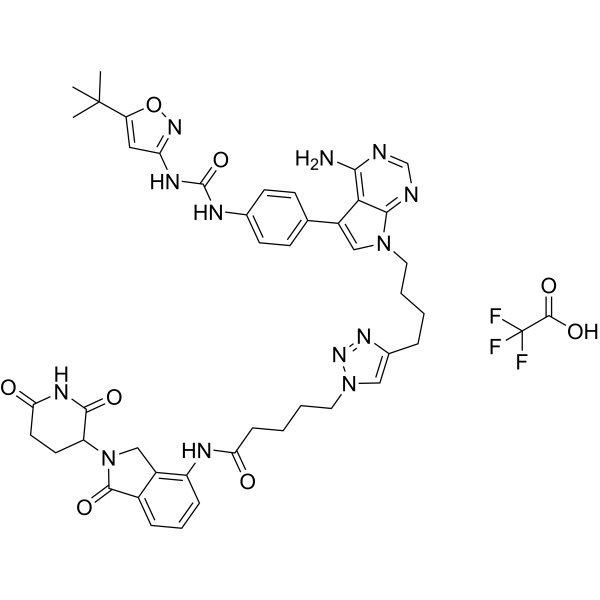
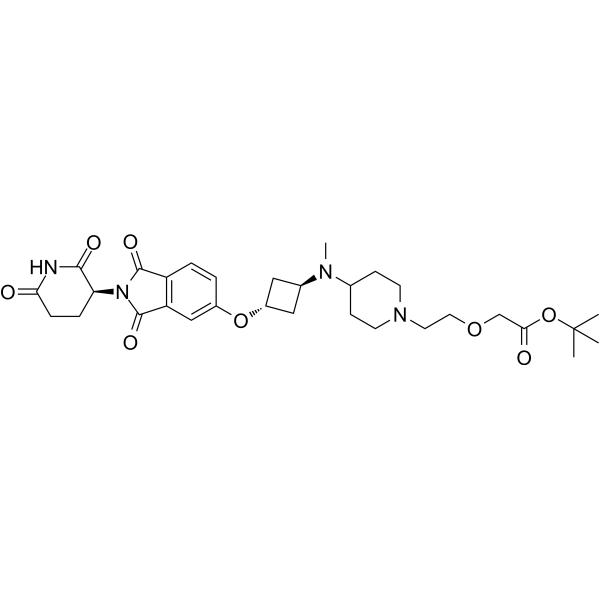
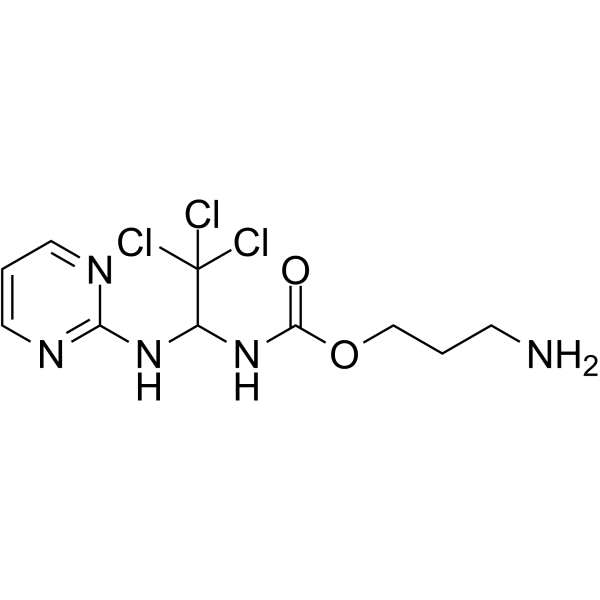
1100 Results for "PROTAC molecules" in MCE Product Catalog:
Targeted Protein Degradation (TPD) is a novel and promising approach to drug development. It shows great potential for targeting proteins traditionally considered "undruggable" due to the lack of enzymatic function and absence of binding sites by tagging them for degradation or recruiting natural degradation mechanisms.
Molecular glues are a type of small-molecule degraders that primarily induce novel interactions between E3 ubiquitin ligases and target proteins, forming ternary complexes that lead to protein ubiquitination and subsequent proteasomal degradation. Compared with PROTACs, molecular glues generally have lower molecular weights, higher cell permeability, and better drug-like properties. Additionally, the design of molecular glues is relatively simple, without the requirements for complex linkers and ligand optimization. As a result, molecular glues have gradually emerged as a promising therapeutic approach for various diseases.
Multiple types of molecular glues have been reported previously. Analysis of co-crystal complex structures reveals that CRBN-related molecular glues are more versatile. Therefore, MCE researchers select active molecules related to these targets as probes for artificial intelligence (AI) screening.Subsequently, molecular docking technology was used to verify whether the screened molecules retained the key pharmacophore features. Ultimately, we obtained 317 molecular glue analogs, and these compounds serve as powerful tools for the research of molecular glues.
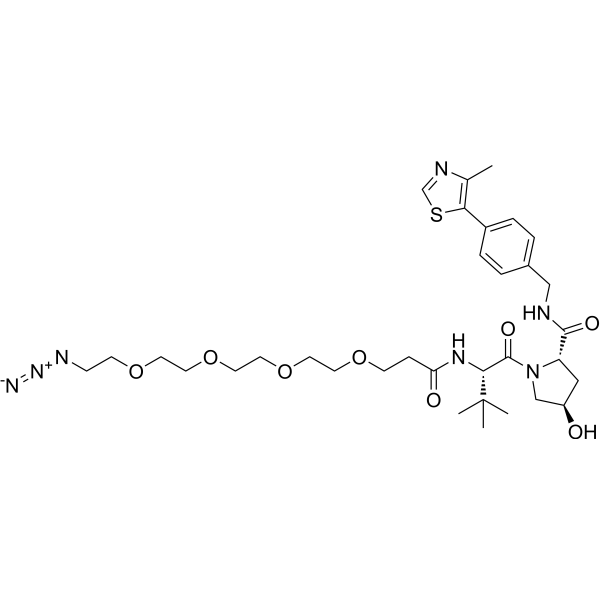
In modern drug discovery and chemical biology research, the azide group (-N3) is an important functional moiety that is widely used in click chemistry, biomolecular labeling, drug delivery systems, and prodrug design due to its unique reactivity and bioorthogonality.
The MCE Azide Structural Compound Library contains 100 compounds featuring -N3 functional groups. It is designed for the construction of click chemistry reaction systems and the subsequent development of functional molecules. This library enables the rapid assembly of targeting ligands, linkers, and functional molecular modules, thereby accelerating PROTAC assembly, optimization of antibody-drug conjugate (ADC) linkers, and the development of biological labeling probes. In addition, the high reaction selectivity and excellent biocompatibility of the azide group allow it to maintain stable reactivity even in complex biological environments, improving controllability and efficiency in drug design. It serves as an indispensable molecular tool in modern medicinal chemistry and chemical biology research.
Macrocyclic scaffolds are increasingly valued in modern drug discovery for their exceptional activity against undruggable targets (proteases, kinases, PPIs). 2026 marks a key commercial breakthrough for oral macrocyclic peptides: enlicitide, the world’s first oral PCSK9 macrocyclic peptide, has received FDA approval. Macrocyclic candidates targeting KRAS and other classic undruggable targets have also entered clinical development, validating macrocyclization as an effective strategy to overcome druggability barriers.
Two core R&D directions lead current macrocyclic drug design: AI-driven de novo generation and structural optimization of small-molecule macrocycles, and macrocyclic peptides based on sequence design and conformational engineering. Macrocycle druggability hinges on embedded linkers, which determine cyclization efficiency, final conformation and drug-like properties. Bifunctional reaction orthogonality is the core linker selection criterion. Our linker library enables stepwise intramolecular cyclization with suppressed side reactions, accommodates varied ring sizes, and covers three key reaction systems: amide condensation, nucleophilic substitution and CuAAC click chemistry.
Built on classical macrocyclization systems, the library is processed through reaction classification, bifunctional orthogonality evaluation, novelty clustering and redundancy removal, with PROTAC long-chain and ADC cleavable linkers explicitly excluded. Featuring rigid, semi-rigid and flexible scaffolds, it is widely applicable to small-molecule macrocycle synthesis and linear peptide cyclization.
Sulfonyl fluoride (-SO₂F) overcomes the poor target selectivity of traditional covalent warheads that rely heavily on cysteine. With high stability and tunable electrophilicity under physiological conditions, it targets multiple nucleophilic residues including Lys, Tyr, Ser and His, offering expanded druggable space, lower off-target risks and prolonged efficacy. It is widely used in covalent inhibitors, molecular glues, PROTACs and chemical probes.
MCE has built a highly diverse sulfonyl fluoride fragment library with 1,162 structurally diverse, drug-like fragments. Designed for balanced reactivity, stability and compatibility, these molecules feature tunable electrophilicity, simple scaffolds and high derivatization potential. Combined with SuFEx click chemistry, the library enables efficient modular modification and rapid structure optimization.
Ideal for targeting non-cysteine residues, this library improves covalent screening and probe development efficiency, serving as a precise tool for early-stage covalent drug discovery and chemical biology research.

Scientific Reviews
Product Guides
Blogs
Topics
Targeted therapy! The Capetin Prize winning "Click Chemistry" can be used like this!Targeted therapy! The Nobel Prize winning "Click Chemistry" can be used like this!2025-02-06
Protocols
Targeted therapy! The Capetin Prize winning "Click Chemistry" can be used like this!Targeted therapy! The Nobel Prize winning "Click Chemistry" can be used like this!2025-02-06



