






Scientific Reviews
Product Guides
Blogs
Topics
Targeted therapy! The Capetin Prize winning "Click Chemistry" can be used like this!Targeted therapy! The Nobel Prize winning "Click Chemistry" can be used like this!2025-02-06



122 Results for "compatibility" in MCE Product Catalog:
Sulfonyl fluoride (-SO₂F) overcomes the poor target selectivity of traditional covalent warheads that rely heavily on cysteine. With high stability and tunable electrophilicity under physiological conditions, it targets multiple nucleophilic residues including Lys, Tyr, Ser and His, offering expanded druggable space, lower off-target risks and prolonged efficacy. It is widely used in covalent inhibitors, molecular glues, PROTACs and chemical probes.
MCE has built a highly diverse sulfonyl fluoride fragment library with 1,162 structurally diverse, drug-like fragments. Designed for balanced reactivity, stability and compatibility, these molecules feature tunable electrophilicity, simple scaffolds and high derivatization potential. Combined with SuFEx click chemistry, the library enables efficient modular modification and rapid structure optimization.
Ideal for targeting non-cysteine residues, this library improves covalent screening and probe development efficiency, serving as a precise tool for early-stage covalent drug discovery and chemical biology research.
MCE adhesive aluminium foil plate seals are of strong adhesive that can reduce chance of well-to-well contamination and sample evaporation when applied to microplates. This aluminium foil seal is suitable for long-term storage of samples at -80°C. The high integrity sealing materials give the best protection against evaporation and contamination. The aluminium foil seal features excellent chemical resistance to DMSO and DNase- & RNase- free. MCE adhesive foil seal is pierceable, peelable and easy-to-use.
Cosmetics are complex mixtures formulated through the rational blending and processing of various natural, synthetic, or extracted raw materials. The ingredients used in cosmetics are diverse in type and functionality. Based on their properties and applications, cosmetic ingredients can generally be classified into two main categories: base materials and auxiliary ingredients. The former constitutes the primary component of cosmetics, accounting for a significant proportion in formulations and serving as the key functional substances. Auxiliary ingredients, on the other hand, play roles in shaping the product, ensuring stability, or imparting color, fragrance, and other specific characteristics.Establishing a systematic ingredient database is of great significance for cosmetic research and development. By analyzing the physicochemical properties (such as oil-water partition coefficients and molecular weight distribution), biological activity mechanisms (such as antioxidant pathways and cellular signaling regulation), and compatibility of ingredients, the database can provide precise guidance for formulation design. This approach helps shorten the development cycle of cosmetic/skincare products and reduces trial-and-error costs.
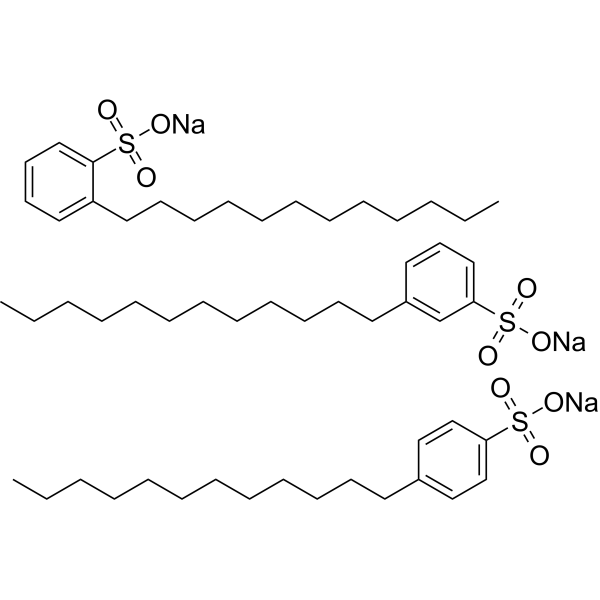
MCE offers 626 types of cosmetic ingredient compounds, including antioxidants, humectants, emulsifiers, film-forming agents, and more.
The Echo 384-well polypropylene microplate exhibits excellent resistance to DMSO, various buffers, and a wide range of organic solvents, making it suitable for compound and sample storage and ensuring precise and accurate liquid transfer when used with the Echo Liquid Handler.
Echo 384 LDV (Low Dead Volume) Microplate is specifically designed for Echo liquid handlers. Made from cyclic olefin copolymer (COC), it provides excellent acoustic transmission performance while being compatible with DMSO-based compound storage. Its unique well design effectively minimizes dead volume, maximizing the utilization of valuable samples.

Scientific Reviews
Product Guides
Blogs
Topics
Targeted therapy! The Capetin Prize winning "Click Chemistry" can be used like this!Targeted therapy! The Nobel Prize winning "Click Chemistry" can be used like this!2025-02-06
Protocols
Targeted therapy! The Capetin Prize winning "Click Chemistry" can be used like this!Targeted therapy! The Nobel Prize winning "Click Chemistry" can be used like this!2025-02-06



