146 Results for "

testosterone

" in MedChemExpress (MCE) Product Catalog:
Products (146)

146 Results for "testosterone" in MCE Product Catalog:

Cat. No.: HY-123037R
CAS No.: 43121-43-3
Triadimefon (Standard) is the analytical standard of Triadimefon (HY-123037). This product is intended for research and analytical applications. Triadimefon is an orally active fungicide. Triadimefon significantly reduces the phosphorylation of AKT1 and ERK1/2. Triadimefon significantly increases pAMPK levels, but does not affect total AMPK levels. Triadimefon inhibits the growth of Saccharomyces cerevisiae, disrupts hormone homeostasis (affecting the synthesis of testosterone, etc.), inhibits fetal adrenal development in rats, induces metabolic shifts in hepatocytes, and impairs spatial learning and memory .
loading...
    loading...
Cat. No.: HY-W414731
CAS No.: 16524-22-4
Synonyms: 3-MFA
Research Areas:  

Cancer

N-(3-Methylphenyl)anthranilic acid is an aldo-keto reductase 1C3 (AKR1C3)and AKR1C2 inhibitor with IC50 values of 0.24 μM and 0.38 μM, respectively. N-(3-Methylphenyl)anthranilic acid shows no inhibition of COX-1 or COX-2. N-(3-Methylphenyl)anthranilic acid can be used for the research of castration resistant prostate cancer .
loading...
    loading...
Cat. No.: HY-B1012
CAS No.: 152-43-2
Synonyms: W-3566
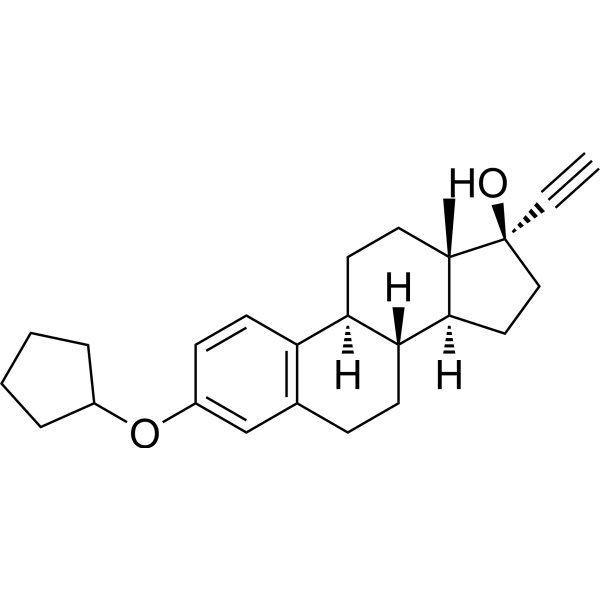
Quinestrol (W-3566) is an orally effective synthetic estrogen compound that acts on CYP3A4, CYP1A2, and GnRH. Quinestrol interferes with GnRH release and disrupts the hypothalamic-pituitary-ovarian axis. Quinestrol downregulates the gene expression of follicle-stimulating hormone β and luteinizing hormone β, induces oxidative stress, damages reproductive organs, reduces sperm density and motility, increases sperm malformation rate, and alters the levels of sex hormones such as testosterone, luteinizing hormone, estradiol, and progesterone. Quinestrol can be used in studies related to reproductive function regulation .
loading...
    loading...
Cat. No.: HY-157161
Target:  

11β-HSD

Research Areas:  

Cancer

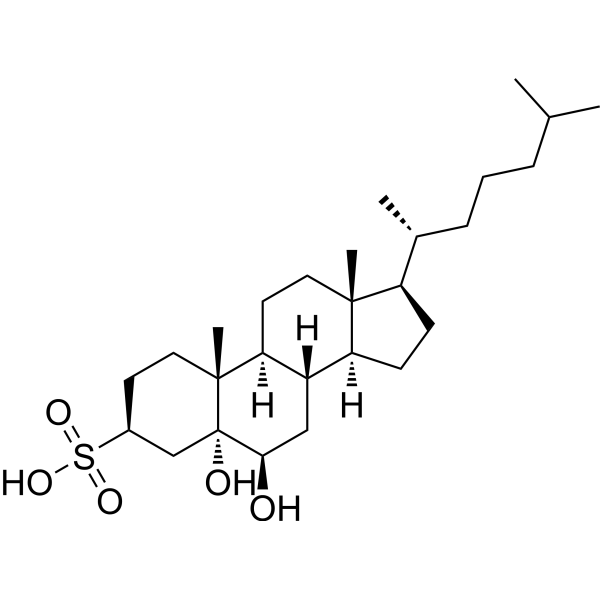
11β-HSD2-IN-1 (compound CDSN) is a potent inhibitor of 11β-HSD2, inhibiting the metabolism of Cholestane-3β,5α,6β-triol (CT) in cells by 11β-HSD2 into the tumor promoter, carcinosterone. 11β-HSD2-IN-1 inhibits testosterone biosynthesis, thereby inhibiting MCF-7 cell proliferation. 11β-HSD2-IN-1 has immune activity and antiviral infection effects .
loading...
    loading...
Cat. No.: HY-133676
CAS No.: 40321-98-0
Synonyms: MEOHP; 5-oxo-MEHP
Research Areas:  

Endocrinology

Mono (2-ethyl-5-oxohexyl) phthalate (MEOHP; 5-oxo-MEHP) is a secondary metabolite produced by cytochrome P450 enzyme-mediated oxidation of di(2-ethylhexyl) phthalate. Exposure levels of Mono (2-ethyl-5-oxohexyl) phthalate are associated with late-onset hypogonadism. Mono (2-ethyl-5-oxohexyl) phthalate can be used for research on mechanisms related to male reproductive endocrine disorders .
loading...
    loading...
Cat. No.: HY-133676S
CAS No.: 679789-44-7
Synonyms: MEOHP-d4; 5-oxo-MEHP-d4
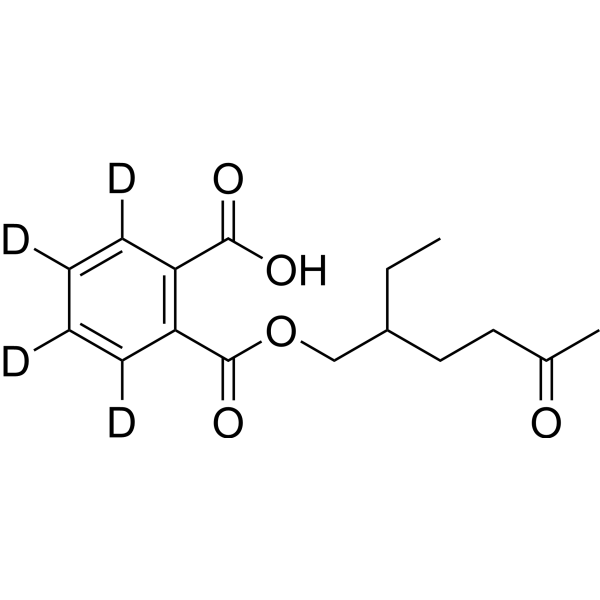
Mono(2-ethyl-5-oxohexyl) phthalate-d4 (MEOHP-d4; 5-oxo-MEHP-d4) is the deuterated-labeled Mono(2-ethyl-5-oxohexyl) phthalate (HY-133676). Mono (2-ethyl-5-oxohexyl) phthalate (MEOHP; 5-oxo-MEHP) is a secondary metabolite produced by cytochrome P450 enzyme-mediated oxidation of di(2-ethylhexyl) phthalate. Exposure levels of Mono (2-ethyl-5-oxohexyl) phthalate are associated with late-onset hypogonadism. Mono (2-ethyl-5-oxohexyl) phthalate can be used for research on mechanisms related to male reproductive endocrine disorders .
loading...
    loading...
Cat. No.: HY-P70058
Purity:  ≥ 95%, as determined by reducing SDS-PAGE.
Synonyms: CLU; Complement-Associated Protein SP-40,40; Prev. APOJ; Complement Lysis Inhibitor; Prev. CLI; Ku70-Binding Protein 1; Apolipoprotein J; NA1/NA2; TRPM-2; Clusterin (Complement Lysis Inhibitor, SP-40,40, Sulfated Glycoprotein 2, testosterone-Repressed Pro
Species:  
Mouse
Source:  
HEK293
loading...
    loading...
Cat. No.: HY-P85854
Synonyms: CLU; APOJ; CLI; KUB1; AAG4; Clusterin; Aging-associated gene 4 protein; Apolipoprotein J; Apo-J; Complement cytolysis inhibitor; CLI; Complement-associated protein SP-40; 40; Ku70-binding protein 1; NA1/NA2; testosterone-repressed prostate m

Host:  

Mouse

Application:  

WB, ICC/IF, ELISA

Reactivity:  

Human, Mouse, Rat

loading...
    loading...
Cat. No.: HY-P7895
Purity:  ≥ 90%, as determined by reducing SDS-PAGE.
Synonyms: CLU; Complement-Associated Protein SP-40,40; Prev. APOJ; Complement Lysis Inhibitor; Prev. CLI; Ku70-Binding Protein 1; Apolipoprotein J; NA1/NA2; TRPM-2; Clusterin (Complement Lysis Inhibitor, SP-40,40, Sulfated Glycoprotein 2, testosterone-Repressed Prostate Message 2, Apolipoprotein J); SGP-2; Epididymis Secretory Sperm Binding Protein; KUB1; Aging-Associated Gene 4 Protein; testosterone-Repressed Prostate Message 2; Aging-Associated Protein 4; Sulfated Glycoprotein 2; APO-J; SP-40; Apo-J; CLU2; SGP2; CLU1; AAG4; Clusterin; Complement Cytolysis Inhibitor
Species:  
Human
Source:  
HEK293
loading...
    loading...
Cat. No.: HY-165478
CAS No.: 155651-56-2
Target:  

5 alpha Reductase

Research Areas:  

Endocrinology

FCE 28260 is an orally active 4-azacyclic 5α-reductase (5αR) inhibitor. FCE 28260 exhibits IC₅₀ values for human 5αR type 1 and 5αR type 2 of 36 and 3.3 nM, respectively, and for human and rat prostates with IC₅₀ values of 16 and 15 nM, respectively. FCE 28260 simultaneously blocks the production of dihydrotestosterone (DHT) in the prostate and peripheral tissues. FCE 28260 can significantly inhibit the induction of prostatic and seminal vesicle hyperplasia by testosterone (T) in rat models, without inhibiting the growth of the prostate in DHT implantation models. FCE 28260 can be used for the studies DHT-dependent diseases such as benign prostatic hyperplasia (BPH) .
loading...
    loading...
Cat. No.: HY-16985R
CAS No.: 1297538-32-9
Synonyms: ODM-201 (Standard); BAY-1841788 (Standard)
Research Areas:  

Cancer

Darolutamide (Standard) is the analytical standard of Darolutamide (HY-16985). This product is intended for research and analytical applications. Darolutamide (ODM-201) is an orally active competitive androgen receptor (AR) antagonist, with a Ki of 11 nM for rat wild-type AR (wtAR) and an IC50 of 26 nM for human wild-type AR (hAR)-mediated transcriptional activation . Darolutamide inhibits testosterone-induced AR nuclear translocation and transcriptional activation . Darolutamide exerts selective effects on AR-positive cells by inhibiting AR-dependent signaling pathways, and its active metabolite retains full antagonistic activity against AR mutants . Darolutamide can be used for the research of prostate cancer, including androgen receptor-dependent prostate cancer .
loading...
    loading...
Cat. No.: HY-B1012R
CAS No.: 152-43-2
Synonyms: W-3566 (Standard)
Quinestrol (Standard) is the analytical standard of Quinestrol (HY-B1012). This product is intended for research and analytical applications. Quinestrol (W-3566) is an orally effective synthetic estrogen compound that acts on CYP3A4, CYP1A2, and GnRH. Quinestrol interferes with GnRH release and disrupts the hypothalamic-pituitary-ovarian axis. Quinestrol downregulates the gene expression of follicle-stimulating hormone β and luteinizing hormone β, induces oxidative stress, damages reproductive organs, reduces sperm density and motility, increases sperm malformation rate, and alters the levels of sex hormones such as testosterone, luteinizing hormone, estradiol, and progesterone. Quinestrol can be used in studies related to reproductive function regulation .
loading...
    loading...
Cat. No.: HY-16985S
CAS No.: 2484757-20-0
Synonyms: ODM-201-d4; BAY-1841788-d4
Darolutamide-d4 (ODM-201-d4) is deuterium labeled Darolutamide (HY-16985). Darolutamide (ODM-201) is an orally active competitive androgen receptor (AR) antagonist, with a Ki of 11 nM for rat wild-type AR (wtAR) and an IC50 of 26 nM for human wild-type AR (hAR)-mediated transcriptional activation . Darolutamide inhibits testosterone-induced AR nuclear translocation and transcriptional activation . Darolutamide exerts selective effects on AR-positive cells by inhibiting AR-dependent signaling pathways, and its active metabolite retains full antagonistic activity against AR mutants . Darolutamide can be used for the research of prostate cancer, including androgen receptor-dependent prostate cancer .
loading...
    loading...
Cat. No.: HY-184195
PROTAC AR Degrader-13 is a proteolysis-targeting chimera (PROTACs) that targets the androgen receptor (AR). PROTAC AR Degrader-13 has a DC50 of 0.90 nM in LNCaP cells and a DC50 of 0.23 nM in hDPC cells. PROTAC AR Degrader-13 induces AR degradation, downregulates TGF-β1 expression, upregulates β-catenin levels, and restores the Wnt/β-catenin pro-proliferation signaling in hair follicles. In a testosterone-induced androgenetic alopecia mouse model, PROTAC AR Degrader-13 accelerates hair regeneration rate, increases hair density and hair diameter. PROTAC AR Degrader-13 can be used for the research of androgenetic alopecia .
loading...
    loading...
Cat. No.: HY-19337S
CAS No.: 2484757-41-5
Synonyms: BAY 1896953-d3; ORM-15341-d3
Ketodarolutamide-d3 (BAY 1896953-d3) is the deuterium labeled Ketodarolutamide (HY-19337). Ketodarolutamide (ORM-15341) is a potent, high-affinity nonsteroidal competitive full antagonist of androgen receptor (AR). Ketodarolutamide displays a Ki value of 8 nM for rat wild-type AR and an IC50 value of 38 nM in AR-HEK293 cells . Ketodarolutamide inhibits testosterone-induced nuclear translocation of the AR and antagonizes both overexpressed and mutant ARs . Ketodarolutamide specifically suppresses the proliferation of AR-dependent prostate cancer cells and exhibits antitumor activity in models of castration-resistant prostate cancer (CRPC) . Ketodarolutamide is suitable for the mechanistic and therapeutic research of prostate cancer .
loading...
    loading...
Cat. No.: HY-19337S1
Synonyms: BAY 1896953-d6; ORM-15341-d6
Ketodarolutamide-d6 (BAY 1896953-d6) is the deuterium labeled Ketodarolutamide (HY-19337). Ketodarolutamide (ORM-15341) is a potent, high-affinity nonsteroidal competitive full antagonist of androgen receptor (AR). Ketodarolutamide displays a Ki value of 8 nM for rat wild-type AR and an IC50 value of 38 nM in AR-HEK293 cells . Ketodarolutamide inhibits testosterone-induced nuclear translocation of the AR and antagonizes both overexpressed and mutant ARs . Ketodarolutamide specifically suppresses the proliferation of AR-dependent prostate cancer cells and exhibits antitumor activity in models of castration-resistant prostate cancer (CRPC) . Ketodarolutamide is suitable for the mechanistic and therapeutic research of prostate cancer .
loading...
    loading...
Cat. No.: HY-N13195
CAS No.: 420781-85-7
(15α)-15,26-Dihydroxylanosta-7,9(11),24-trien-3-one shows a 5a-reductase inhibitory activity with an IC50 value of 41.9 μM. (15α)-15,26-Dihydroxylanosta-7,9(11),24-trien-3-one inhibits the growth of the ventral prostate induced by testosterone in rat. (15α)-15,26-Dihydroxylanosta-7,9(11),24-trien-3-one is promising for research of benign prostatic hyperplasia (BPH) as well as other 5α-dihydrotestosterone (DHT)-related disorders, such as acne and male pattern baldness .
loading...
    loading...
Cat. No.: HY-W018171R
CAS No.: 6515-38-4
Synonyms: TCPy (Standard)
Research Areas:  

Others

3,5,6-Trichloro-2-pyridinol (Standard) is the analytical standard of 3,5,6-Trichloro-2-pyridinol. This product is intended for research and analytical applications. 3,5,6-Trichloro-2-pyridinol (TCPy) is a chloride of 2-pyridone with oral activity. 3,5,6-Trichloro-2-pyridinol is the main degradation product of the herbicide Triclopyr and the insecticides Chlorpyrifos and chlorpyrifos-methyl. 3,5,6-Trichloro-2-pyridinol is associated with attention deficit hyperactivity disorder (ADHD) and decreased testosterone levels. 3,5,6-Trichloro-2-pyridinol causes hearing loss, hepatotoxicity and nephrotoxicity in mice.
loading...
    loading...
Cat. No.: HY-W490804
CAS No.: 2971-36-0
Research Areas:  

Metabolic Disease

HPTE is the active in vivo metabolite of Methoxychlor (HY-B1873), and acts as an inhibitor of 3β‑HSD and 17β‑HSD3. HPTE binds to the substrate-binding pocket of 3β‑HSD in a non-competitive manner, but competitively occupies the coenzyme NAD +-binding site, thereby inhibiting the conversion of pregnenolone to progesterone. HPTE binds to the androstenedione-binding pocket (the substrate pocket) of 17β‑HSD3 in a non-competitive manner, and competitively occupies the coenzyme NADPH-binding site, thus blocking the conversion of androstenedione to testosterone. HPTE interferes with androgen biosynthesis in Leydig cells by inhibiting the activities of these two key steroidogenic enzymes. HPTE can be used in studies related to androgen biosynthesis .
loading...
    loading...
Cat. No.: HY-W679754R
CAS No.: 72629-94-8
Synonyms: PFTrDA (Standard)
Pentacosafluorotridecanoic Acid (Standard) is the analytical standard of Pentacosafluorotridecanoic Acid (PFTrDA) (HY-W679754). This product is intended for research and analytical applications.Pentacosafluorotridecanoic Acid is a long-chain perfluoroalkyl carboxylic acid with strong endocrine-disrupting activity. Pentacosafluorotridecanoic Acid exhibits estrogenic effects and disrupts vtg1 transcription as well as sex hormone homeostasis in male Danio rerio. Pentacosafluorotridecanoic Acid disturbs steroidogenesis and HPG axis function in a sex-dependent pattern. Pentacosafluorotridecanoic Acid inhibits CYP17A and CYP11A1 to reduce testosterone and increase E2/T ratio in H295R cells. Pentacosafluorotridecanoic Acid triggers gender-specific immunomodulation after prenatal exposure. Pentacosafluorotridecanoic Acid correlates with lower eczema risk in female infants. Pentacosafluorotridecanoic Acid can be used for the research of endocrine disruption and eczema .
loading...
    loading...

