



Clusterin Antibody (YA5546)
(Synonyms: CLU; APOJ; CLI; KUB1; AAG4; Clusterin; Aging-associated gene 4 protein; Apolipoprotein J; Apo-J; Complement cytolysis inhibitor; CLI; Complement-associated protein SP-40; 40; Ku70-binding protein 1; NA1/NA2; Testosterone-repressed prostate m)
Based on 1 Customer Validation
Clusterin Antibody (YA5546) is a Mouse-derived and non-conjugated IgG1 monoclonal antibody, targeting to Clusterin.
-
Host:
Mouse
-
Isotype:
IgG1
-
Application:
WB, ICC/IF, ELISA
-
Reactivity :
Human, Mouse, Rat
-
Formulation:
Supplied in PBS, 50% glycerol, 0.05% Proclin 300, 0.05%BSA
-
Conjugation:
Non-conjugated


To place orders, for customer services and technical support, please contact: MedChemExpress USA
Tel: 609-228-6898 E-mail: [email protected] [email protected]





Applications
| Application |
WB

WB: Western Blot
|
ICC/IF
ICC/IF: Immunocytochemistry/
Immunofluorescence |
ELISA
ELISA: Enzyme Linked Immunosorbent Assay
|
|---|---|---|---|
| Dilution Ratio | 1:500-2000 | 1:100-500 | 1:1000-5000 |


Product Details
Clusterin Antibody (YA5546) is a Mouse-derived and non-conjugated IgG1 monoclonal antibody, targeting to Clusterin.
-
Host Mouse

-
Clonality Monoclonal

-
Species ReactivityHuman, Mouse, Rat
-
Observed Molecular WeightObserved band size: 68 kDa
Note: Due to possible protein modifications or aggregation, the molecular weight should be confirmed by actual measurement, and the predicted value is for reference only.

-
Calculated Molecular Weight Predicted band size: 68 kDa

Synthesized peptide derived from human protein.AA range:350-449
Protein G
Non-conjugated
Unmodified
IgG1


Product Properties
-
Appearance
Liquid
-
Formulation
Supplied in PBS, 50% glycerol, 0.05% Proclin 300, 0.05%BSA
-
Concentration
Batch-dependent, Please check the COA for the concentration of each lot. Check Lot Concentration
-
Storage & Stability
Stored at -20°C for 1 year. Avoid repeated freeze / thaw cycles.
-
Shipping
Shipping with blue ice.


Verification Images
-
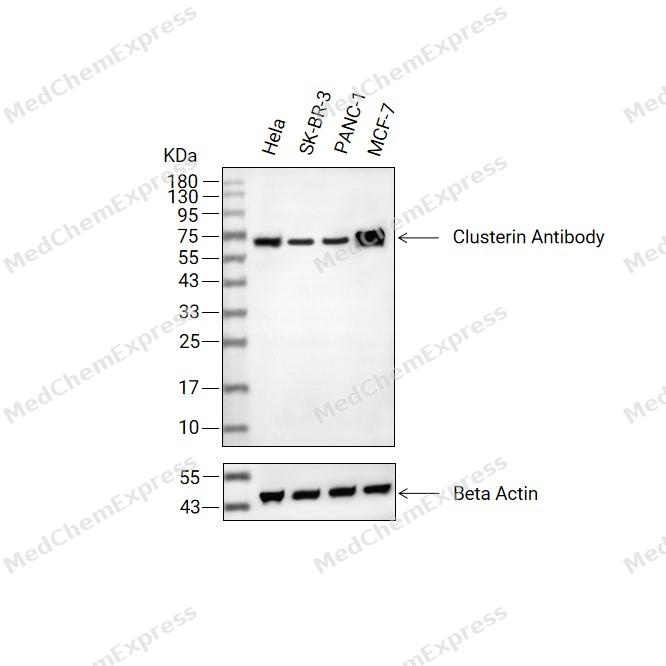 Western blot analysis of extracts from Hela (lane 2(20μg), SK-BR-3 (lane 3(20μg), PANC-1 (lane 4(20μg), MCF-7 (lane 5(20μg) using Clusterin Antibody. Proteins were transferred to a PVDF membrane and blocked with 5% BSA in TBST for 2 hour at room temperature. The primary antibody (1/1000) and Loading control antibody (Beta Actin, HY-P80438, 1/3000) was used in 5% BSA in TBST at 4°C overnight. Goat Anti-Mouse/Rabbit IgG-HRP Secondary Antibody (HY-P8004/HY-P8001, 1/10,000) was used for 1 hour at room temperature.
 -
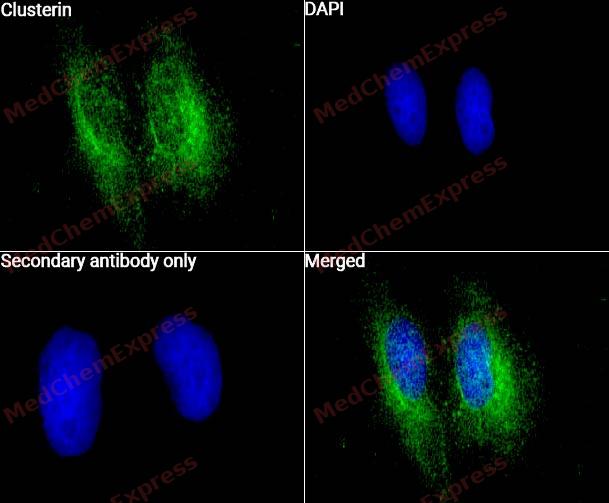 Immunocytochemistry analysis of Hela cells labeling Clusterin with Clusterin Antibody (HY-P85854) at 1/50 dilution. Cells were fixed in 4% paraformaldehyde for 15 minutes at room temperature, permeabilized with 0.1% Triton X-100 for 10 minutes at room temperature, then blocked with QuickBlock™ Blocking Buffer for Immunol Staining for 10 min at room temperature. Cells were then incubated with Clusterin Antibody (HY-P85854) at 1/50 dilution in QuickBlock™ Blocking Buffer for Immunol Staining at 4 ℃. Alexa Fluor® 488-conjugated AffiniPure Goat Anti-Mouse IgG H&L(HY-P8005, Green) was used as the secondary antibody at 1/1,000 dilution. PBS instead of the primary antibody was used as the secondary antibody only control. The Nuclear counterstain was DAPI (Blue).
 -
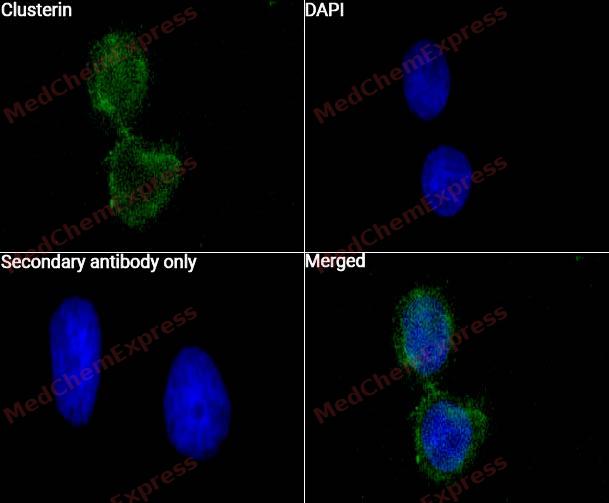 Immunocytochemistry analysis of Hela cells labeling Clusterin with Clusterin Antibody (HY-P85854) at 1/100 dilution. Cells were fixed in 4% paraformaldehyde for 15 minutes at room temperature, permeabilized with 0.1% Triton X-100 for 10 minutes at room temperature, then blocked with QuickBlock™ Blocking Buffer for Immunol Staining for 10 min at room temperature. Cells were then incubated with Clusterin Antibody (HY-P85854) at 1/100 dilution in QuickBlock™ Blocking Buffer for Immunol Staining at 4 ℃. Alexa Fluor® 488-conjugated AffiniPure Goat Anti-Mouse IgG H&L(HY-P8005, Green) was used as the secondary antibody at 1/1,000 dilution. PBS instead of the primary antibody was used as the secondary antibody only control. The Nuclear counterstain was DAPI (Blue).


Background
-
Function
Clusterin functions as extracellular chaperone that prevents aggregation of non native proteins. Prevents stress-induced aggregation of blood plasma proteins. Inhibits formation of amyloid fibrils by APP, APOC2, B2M, CALCA, CSN3, SNCA and aggregation-prone LYZ variants (in vitro). Does not require ATP. Maintains partially unfolded proteins in a state appropriate for subsequent refolding by other chaperones, such as HSPA8/HSC70. Does not refold proteins by itself. Binding to cell surface receptors triggers internalization of the chaperone-client complex and subsequent lysosomal or proteasomal degradation. Protects cells against apoptosis and against cytolysis by complement: inhibits assembly of the complement membrane attack complex (MAC) by preventing polymerization of C9 pore component of the MAC complex. Intracellular forms interact with ubiquitin and SCF (SKP1-CUL1-F-box protein) E3 ubiquitin-protein ligase complexes and promote the ubiquitination and subsequent proteasomal degradation of target proteins. Promotes proteasomal degradation of COMMD1 and IKBKB. Modulates NF-kappa-B transcriptional activity. A mitochondrial form suppresses BAX-dependent release of cytochrome c into the cytoplasm and inhibit apoptosis. Plays a role in the regulation of cell proliferation. An intracellular form suppresses stress-induced apoptosis by stabilizing mitochondrial membrane integrity through interaction with HSPA5. Secreted form does not affect caspase or BAX-mediated intrinsic apoptosis and TNF-induced NF-kappa-B-activity. Secreted form act as an important modulator during neuronal differentiation through interaction with STMN3. Plays a role in the clearance of immune complexes that arise during cell injury; Does not affect caspase or BAX-mediated intrinsic apoptosis and TNF-induced NF-kappa-B-activity; Does not affect caspase or BAX-mediated intrinsic apoptosis and TNF-induced NF-kappa-B-activity. Promotes cell death through interaction with BCL2L1 that releases and activates BAX[1][2][3][4][5][6][7][8][9][10][11][12][13][14][15][16][17][18][19][20][21][22][23][24].
-
Subcellular Localization
Secreted; Cytoplasm; Cytoplasm; Nucleus; Cytoplasm; Mitochondrion membrane; Peripheral membrane protein; Cytoplasmic side; Cytoplasm, cytosol; Microsome; Endoplasmic reticulum; Mitochondrion; Mitochondrion membrane; Cytoplasm, perinuclear region; Cytoplasmic vesicle, secretory vesicle, chromaffin granule
-
Expression
Tissue_specificity:Detected in blood plasma, cerebrospinal fluid, milk, seminal plasma and colon mucosa. Detected in the germinal center of colon lymphoid nodules and in colon parasympathetic ganglia of the Auerbach plexus (at protein level) . Ubiquitous. Detected in brain, testis, ovary, liver and pancreas, and at lower levels in kidney, heart, spleen and lung
Induction:Up-regulated in response to enterovirus 71 (EV71) infection (at protein level) (PubMed:16548883) . Up-regulated by agents that induce apoptosis, both at mRNA and protein level (PubMed:17689225) . Isoform 1 is up-regulated by androgen (PubMed:17148459) . Isoform 2 is down-regulated by androgen (PubMed:17148459) -
Isoforms & Post-Translational Modification
P10909 has 6 isomers: P10909-1: 52495 Da (predicted); P10909-2: 57833 Da (predicted); P10909-3: 32364 Da (predicted); P10909-4: 48803 Da (predicted); P10909-5: 53643 Da (predicted); P10909-6: 50251 Da (predicted).
Proteolytically cleaved on its way through the secretory system, probably within the Golgi lumen (PubMed:2387851). Proteolytic cleavage is not necessary for its chaperone activity (PubMed:25402950). All non-secreted forms are not proteolytically cleaved (PubMed:24073260). Chaperone activity of uncleaved forms is dependent on a non-reducing environment (PubMed:25402950);Polyubiquitinated, leading to proteasomal degradation (PubMed:17451556, PubMed:19137541). Under cellular stress, the intracellular level of cleaved form is reduced due to proteasomal degradation (PubMed:17451556);Extensively glycosylated with sulfated N-linked carbohydrates (PubMed:17260971, PubMed:2387851). About 30% of the protein mass is comprised of complex N-linked carbohydrate (PubMed:2387851). Endoplasmic reticulum (ER) stress induces changes in glycosylation status and increases level of hypoglycosylated forms (PubMed:22689054). Core carbohydrates are essential for chaperone activity (PubMed:25402950). Non-secreted forms are hypoglycosylated or unglycosylated (PubMed:24073260) -
Subunit
Antiparallel disulfide-linked heterodimer of an alpha chain and a beta chain. Self-associates and forms higher oligomers (PubMed:1903064).
-
SwissProt ID
-
Synonyms
CLU; APOJ; CLI; KUB1; AAG4; Clusterin; Aging-associated gene 4 protein; Apolipoprotein J; Apo-J; Complement cytolysis inhibitor; CLI; Complement-associated protein SP-40; 40; Ku70-binding protein 1; NA1/NA2; Testosterone-repressed prostate m


Documentation
-
Data Sheet (235 KB)
-
SDS (252 KB)
- English - EN (252 KB)
- Français - FR (252 KB)
- Deutsch - DE (252 KB)
- Norwegian - NO (252 KB)
- Español - ES (252 KB)
- Swedish - SV (252 KB)
- Italian - IT (252 KB)
- Korean - KR (252 KB)
- Portuguese - PT (252 KB)
-
User Guide for Antibodies (1077 KB)

 Powered by Bioz
