1674 Results for "

Mutant

" in MedChemExpress (MCE) Product Catalog:
Products (1674)

1674 Results for "Mutant" in MCE Product Catalog:

Cat. No.: HY-178061
CAS No.: 2598870-24-5
Target:  

ERK RET

Research Areas:  

Cancer

APS03118 is an orally active, potent and selective rearranged during transfection (RET) inhibitor. APS03118 broadly inhibits RET fusions and mutations (including G810, V804, L730, and Y806 variants), with IC50 values predominantly below 1 nM (0.095 nM for WT; ranging from 0.00438 to 5.72 nM for mutants), and demonstrates marked superiority against RET G810 mutations. APS03118 inhibits the entire RET signaling pathway (including RET, Shc, and ERK1/2), with >20-fold selectivity over most off-target kinases (except FLT3 and YES). APS03118 induces complete tumor regression in KIF5B-RET and CCDC6-RET V804 M patient derived xenografts (PDXs) and significantly prolongs survival in an intracranial CCDC6-RET metastasis mice model. APS03118 can be used for selective RET inhibitor (SRI)-resistant, RET-driven cancer research .
loading...
    loading...
Cat. No.: HY-180966
CAS No.: 3057939-66-6
Target:  

PROTACs EGFR

Research Areas:  

Cancer

Gly-PEG3-BA is an EML4-ALK PROTAC degrader. Gly-PEG3-BA effectively reduces EML4-ALK with a DC50 value of 0.50 μM in H3122 (EML4-ALK) cells. Gly-PEG3-BA effectively reduces EGFR mutant (L858R/T790M) levels with a DC50 of 20.15 μM in H1975 (EGER-L858R/T790M) cells. Gly-PEG3-BA exerts potent antiproliferation activity in H3122 (EML4-ALK) and H1975 (EGER-L858R/T790M) cells with IC50s value of 0.84 and 20.74 μM. Gly-PEG3-BA can be used for non-small lung cancer research .
loading...
    loading...
Cat. No.: HY-188044
Target:  

mAChR

Research Areas:  

Neurological Disease

DC-98-LC74 is a selective modulator of adult skeletal muscle-type nicotinic acetylcholine receptor (α1β1δε), with an EC50 value of 6.5 µM for the human receptor and an IC50 of 13.45 µM for the human α3β4 nicotinic acetylcholine receptor. DC-98-LC74 increases the ligand-free opening probability of the receptor via the ε subunit M2-M3 loop, and prolongs the burst duration and opening probability of wild-type and fast-channel mutant AChR. DC-98-LC74 exerts weak effects on neuronal AChR subtypes and has no agonist activity. DC-98-LC74 prolongs the mouse diaphragm endplate current and improves muscle contractility in isolated neuromuscular preparations from sarcopenic mice. DC-98-LC74 can be used for studies on neuromuscular junction function and myasthenia-related diseases .
loading...
    loading...
Cat. No.: HY-P706050
Purity:  ≥ 85%, as determined by reducing SDS-PAGE.
Synonyms: FGFR3; Mutant Fibroblast Growth Factor Receptor 3; Prev. ACH; Fibroblast Growth Factor Receptor 3-S; JTK4; Fibroblast Growth Factor Receptor; CD333; Receptor Protein-Tyrosine Kinase; CEK2; Hydroxyaryl-Protein Kinase; FGFR-3; Tyrosine Kinase JTK4; Fibroblast Growth Factor Receptor 3 Isoform C; CD333 Antigen; Fibroblast Growth Factor Receptor 3 Isoform B; HSFGFR3EX; Fibroblast Growth Factor Receptor 3; Achondroplasia, Thanatophoric Dwarfism
Species:  
Human
Source:  
Sf9 insect cells
loading...
    loading...
Cat. No.: HY-P706051
Purity:  ≥ 85%, as determined by reducing SDS-PAGE.
Synonyms: FGFR3; Mutant Fibroblast Growth Factor Receptor 3; Prev. ACH; Fibroblast Growth Factor Receptor 3-S; JTK4; Fibroblast Growth Factor Receptor; CD333; Receptor Protein-Tyrosine Kinase; CEK2; Hydroxyaryl-Protein Kinase; FGFR-3; Tyrosine Kinase JTK4; Fibroblast Growth Factor Receptor 3 Isoform C; CD333 Antigen; Fibroblast Growth Factor Receptor 3 Isoform B; HSFGFR3EX; Fibroblast Growth Factor Receptor 3; Achondroplasia, Thanatophoric Dwarfism
Species:  
Human
Source:  
Sf9 insect cells
loading...
    loading...
Cat. No.: HY-P706052
Purity:  ≥ 85%, as determined by reducing SDS-PAGE.
Synonyms: FGFR3; Mutant Fibroblast Growth Factor Receptor 3; Prev. ACH; Fibroblast Growth Factor Receptor 3-S; JTK4; Fibroblast Growth Factor Receptor; CD333; Receptor Protein-Tyrosine Kinase; CEK2; Hydroxyaryl-Protein Kinase; FGFR-3; Tyrosine Kinase JTK4; Fibroblast Growth Factor Receptor 3 Isoform C; CD333 Antigen; Fibroblast Growth Factor Receptor 3 Isoform B; HSFGFR3EX; Fibroblast Growth Factor Receptor 3; Achondroplasia, Thanatophoric Dwarfism
Species:  
Human
Source:  
Sf9 insect cells
loading...
    loading...
Cat. No.: HY-P706053
Purity:  ≥ 85%, as determined by reducing SDS-PAGE.
Synonyms: FGFR3; Mutant Fibroblast Growth Factor Receptor 3; Prev. ACH; Fibroblast Growth Factor Receptor 3-S; JTK4; Fibroblast Growth Factor Receptor; CD333; Receptor Protein-Tyrosine Kinase; CEK2; Hydroxyaryl-Protein Kinase; FGFR-3; Tyrosine Kinase JTK4; Fibroblast Growth Factor Receptor 3 Isoform C; CD333 Antigen; Fibroblast Growth Factor Receptor 3 Isoform B; HSFGFR3EX; Fibroblast Growth Factor Receptor 3; Achondroplasia, Thanatophoric Dwarfism
Species:  
Human
Source:  
Sf9 insect cells
loading...
    loading...
Cat. No.: HY-135498
CAS No.: 20008-20-2
Target:  

Bacterial

Research Areas:  

Infection

Ferrioxamine E is a siderophore and bacterial growth regulator. Ferrioxamine E can chelate ferric iron, and promote the growth, morphological differentiation and antibiotic synthesis of Streptomyces tanashiensis .
loading...
    loading...
Cat. No.: HY-181283
CAS No.: 2919699-59-3
Target:  

Bacterial

Research Areas:  

Infection

MSU-43557 is a Mycobacterium abscessus MmpL3 (MAB_4508) inhibitor and bactericidal agent. MSU-43557 inhibits MmpL3 function, disrupts trehalose monomycolate synthesis, and reduces biofilm-associated Mycobacterium abscessus viability. MSU-43557 exerts bactericidal activity against intracellular Mycobacterium abscessus. MSU-43557 shows low eukaryotic cytotoxicity and low Mycobacterium abscessus resistance frequency. MSU-43557 can be used for the research of mycobacterium abscessus infection .
loading...
    loading...
Cat. No.: HY-19616
CAS No.: 1604821-43-3
ML278 is a scavenger receptor-BI (SR-BI) inhibitor with an IC50 of 0.93 nM in mice. ML278 inhibits SR-BI-mediated lipid uptake, enhances the binding of high-density lipoprotein (HDL) to SR-BI, blocks the uptake of oleoylcholesteryl ester from HDL, and reversibly inhibits the efflux of free cholesterol to HDL particles. ML278 can be used in studies related to atherosclerotic coronary artery disease .
loading...
    loading...
Cat. No.: HY-E70239
CAS No.: 6712-02-3
Target:  

Endogenous Metabolite

Research Areas:  

Others

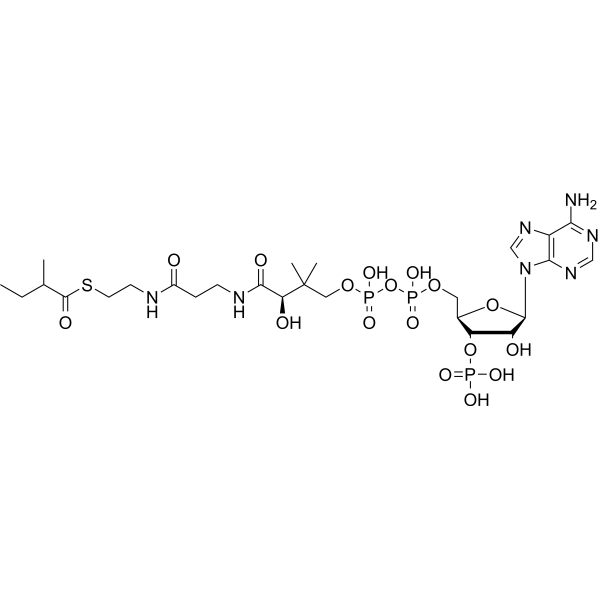
2-Methylbutyryl-CoA is a branched-chain acyl-CoA substrate. It serves as the preferred substrate for potato 2-methylbutyryl-CoA dehydrogenase (2MBCD), which catalyzes its α,β-dehydrogenation .
loading...
    loading...
Cat. No.: HY-P992396

Target:  

c-Met/HGFR

Research Areas:  

Cancer

KTN0073 is a high-affinity MET receptor tyrosine kinase inhibitor. KTN0073 can be used in studies related to non-small cell lung cancer and human cancers driven by HGF, MET amplification, or exon 14 mutation. KTN0073 binds to the Sema/PSI domain to block the HGF-MET interaction, and induces ubiquitination and degradation of oncogenic MET receptors via an HGF-independent pathway, thereby inhibiting MET-dependent signal transduction. KTN0073 exhibits significant antitumor activity in vivo, and its tumor suppressive activity is superior to that of the IgG1 subtype when grafted to the IgG2 constant region .
loading...
    loading...
Cat. No.: HY-12017C
CAS No.: 1159490-83-1
PF-04217903 phosphate is an orally active, highly selective ATP-competitive c-Met kinase inhibitor with a Ki value of 4.8 nM and a Kd value of 4.5 nM. PF-04217903 phosphate blocks c-Met and HGF signaling pathways, inhibits MET phosphorylation, and blocks downstream MAPK, PI3K/AKT and PLCγ1 pathways. PF-04217903 phosphate suppresses tumor proliferation, survival, migration, invasion, angiogenesis and metastasis, induces apoptosis, and enhances efferocytosis, Annexin A1 expression and resolution of inflammation. PF-04217903 phosphate retains activity against several c-Met mutants (M1131T, V1220I, H1094R). PF-04217903 phosphate increases the incidence of subarachnoid hemorrhage and reduces survival rate without altering aneurysm formation, and also prevents lymph node metastasis induced by VEGF inhibition. PF-04217903 phosphate is applicable to research related to tumors (pancreas, stomach, lung, brain, colon, breast, kidney, melanoma, etc.), intracranial aneurysms and inflammatory diseases (gouty arthritis, neutrophilic pleuritis) .
loading...
    loading...
Cat. No.: HY-13443S
Synonyms: Exenatide (Leu-13C6,15N) TFA
Exendin-4 (Leu- 13C6, 15N) TFA (Exenatide (Leu- 13C6, 15N) TFA) is the 13C, 15N-labeled Exendin-4 (HY-13443). Exendin‑4 (Exenatide) is an orally active, blood-brain barrier-permeable glucagon-like peptide-1 receptor (GLP‑1 receptor) agonist that resists degradation mediated by dipeptidyl peptidase IV. Exendin‑4 mediates multiple glucose-regulating effects, including stimulation of glucose-dependent insulin secretion, inhibition of glucagon production, increase in β-cell mass, delay of gastric emptying, reduction of food intake, improvement of peripheral insulin sensitivity, and restoration of normal islet structure. Exendin‑4 inhibits oxidative stress, alleviates inflammatory responses, and reduces neuronal apoptosis. Exendin‑4 reduces the aggregation level of mutant huntingtin, improves motor function, prolongs survival time, and regulates the expression levels of leptin and ghrelin. Exendin‑4 can be used in research related to type 2 diabetes, acute ischemic stroke, and Huntington's disease .
loading...
    loading...
Cat. No.: HY-141878A
CAS No.: 2767983-77-5
Research Areas:  

Neurological Disease

di-Ellipticine-RIBOTAC TFA is a RNase recruiting chimera (RIBOTAC) degrader, capable of specifically binding and degrading expanded G4C2 RNA repeat (r(G4C2) exp). di-Ellipticine-RIBOTAC TFA selectively binds the three-dimensional (3D) structure formed by r(G4C2) exp and that recruits an endogenous ribonuclease (RNase) to cleave r(G4C2) exp. di-Ellipticine-RIBOTAC TFA selectively degrades the mutant chromosome 9 open reading frame 72 (C9orf72) allele and reduces quantities of toxic dipeptide repeat proteins (DPRs) translated from r(G4C2) exp. di-Ellipticine-RIBOTAC TFA significantly improves the pathological phenotype of amyotrophic lateral sclerosis/ frontotemporal dementia (c9ALS/FTD) in cells and mouse models. di-Ellipticine-RIBOTAC TFA can be used for the study of amyotrophic lateral sclerosis (ALS) and frontotemporal dementia (FTD) .
loading...
    loading...
Cat. No.: HY-164392
CAS No.: 1451370-01-6
Target:  

EGFR Apoptosis

Research Areas:  

Cancer

TAS-121 is an orally active, selective, covalent, third-generation mutant EGFR-tyrosine kinase inhibitor (EGFR-TKI). TAS-121 inhibits the L858R mutation (IC50=1.7 nM), Ex19del mutation (IC50=2.7 nM), L858R/T790M mutation (IC50=0.56 nM) and Ex19del/T790M mutation (IC50=1.1 nM) and wild-type EGFR (IC50=8.2 nM). TAS-121 inhibits HER2 and HER4 with IC50s of 110 and 2.6 nM, respectively. TAS-121 inhibits phosphorylation of EGFR and its downstream signaling targets to block cell proliferation. TAS-121 induces apoptosis and displays antitumor activity in SW48 (EGFR G719S) and NCI-H1975 (EGFR L858R/T790M) xenograft models .
loading...
    loading...
Cat. No.: HY-P72450
Purity:  ≥ 95%, as determined by reducing SDS-PAGE.
Synonyms: TEK; Tyrosine-Protein Kinase Receptor TEK; Prev. VMCM; Endothelial Tyrosine Kinase; VMCM1; Venous Malformations, Multiple Cutaneous And Mucosal; TIE2; Mutant TEK Tyrosine Kinase; Angiopoietin-1 Receptor; Soluble TIE2 Variant 2; CD202b; Soluble TIE2 Variant 1; TIE-2; CD202b Antigen; Tyrosine Kinase With Ig And EGF Homology Domains-2; P140 TEK; Tunica Interna Endothelial Cell Kinase; GLC3E; Tyrosine-Protein Kinase Receptor TIE-2; HTIE2; TEK Receptor Tyrosine Kinase; TEK Tyrosine Kinase, Endothelial
Species:  
Human
Source:  
HEK293
loading...
    loading...
Cat. No.: HY-P72658A
Purity:  ≥ 95%, as determined by reducing SDS-PAGE.
Synonyms: FASLG; TNLG1A; Prev. APT1LG1; CD95L; Prev. TNFSF6; APTL; FasL; Tumor Necrosis Factor (Ligand) Superfamily, Member 6; Tumor Necrosis Factor Ligand Superfamily Member 6; Mutant Tumor Necrosis Factor Family Member 6; Fas Antigen Ligand; Apoptosis (APO-1) Antigen Ligand 1; CD95 Ligand; Tumor Necrosis Factor Ligand 1A; CD178; CD178 Antigen; Fas Ligand (TNF Superfamily, Member 6); ALPS1B; Apoptosis Antigen Ligand; FASL; Fas Ligand; CD95-L
Species:  
Human
Source:  
HEK293
loading...
    loading...
Cat. No.: HY-118144
CAS No.: 185039-91-2
Purity:  99.99%
Target:  

Src Bcr-Abl p38 MAPK

Research Areas:  

Cancer

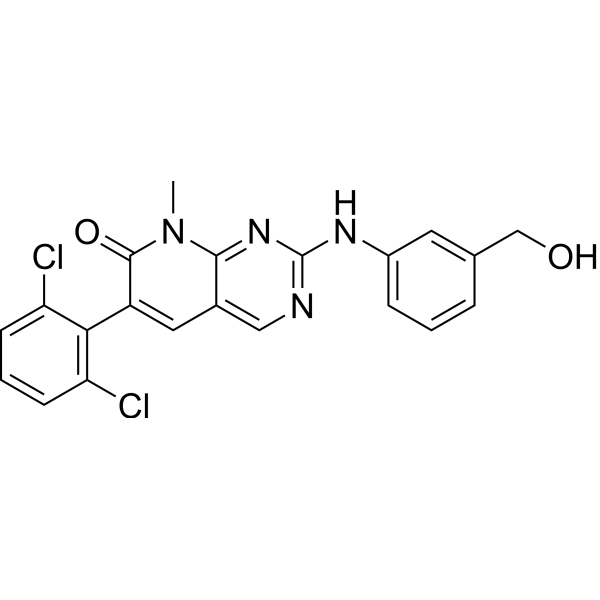
PD166326 is an orally active tyrosine kinase inhibitor with a IC50 of 8 nM against abl tyrosine kinase and a IC50 of 6 nM against src tyrosine kinase. PD166326 blocks Bcr/Abl kinase activity. PD166326 inhibits Bcr/Abl-dependent proliferation and cell cycle progression. PD166326 reduces peripheral blood granulocytosis, alleviates splenomegaly and prolongs survival in a mouse model of chronic myeloid leukemia. PD166326 can be used in research related to chronic myeloid leukemia .
loading...
    loading...
Cat. No.: HY-141551
CAS No.: 2369048-69-9
Purity:  98.00%
Target:  

Estrogen Receptor/ERR

Research Areas:  

Cancer

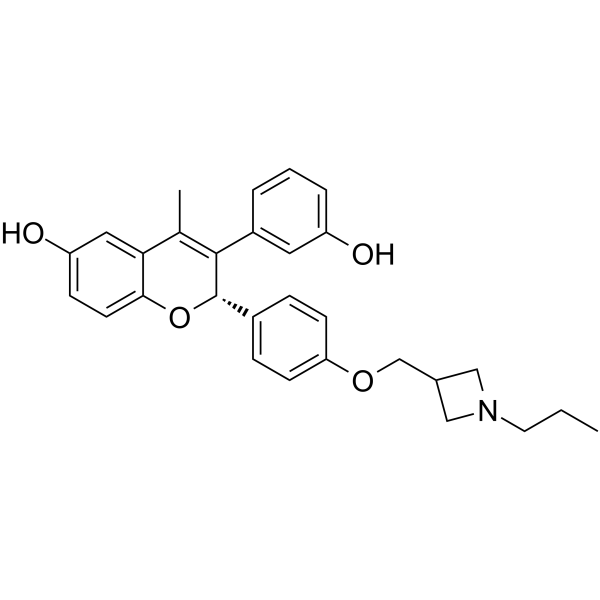
GNE-274 is a non-degrading estrogen receptor α (ERα/ESR1) modulator structurally similar to GDC-0927 (HY-111484). GNE-274 competes for binding to the ligand-binding domain of ERα and induces a coregulator-binding conformation similar to that of antagonists, yet retains partial agonistic transcriptional activity and does not promote ERα turnover. GNE-274 effectively inhibits E2-stimulated proliferation of ER-positive, HER2-negative breast cancer cells. GNE-274 promotes the recruitment of ERα to the nucleus and chromatin, increases chromatin accessibility, while largely maintaining the intranuclear mobility of ERα. GNE-274 can be used in research on ER-positive breast cancer and ERα transcriptional dynamics .
loading...
    loading...

