

1. Search Result
Search Result
Results for "

β-glucan

" in MedChemExpress (MCE) Product Catalog:

23

Inhibitors & Agonists

2

Biochemical Assay Reagents

1

Peptides

9

Natural
Products

4

Recombinant Proteins

Cat. No. Product Name Target Research Areas Chemical Structure
  • HY-W145521
    β-1,3-Glucan
    1 Publications Verification

    β glucan

    Biochemical Assay Reagents IKK NO Synthase Bacterial Infection Inflammation/Immunology Cancer
    β-1,3-Glucan (β Glucan) is an orally active polysaccharide composed of glucose polymers. β-1,3-Glucan increase the activity of IKKβ kinase, enhances the production of nitric oxide. β-1,3-Glucan improves resistance to Vibrio harveyi infection. β-1,3-Glucan enhances immune response, promotes blood pressure recovery, reduces lung, kidney and liver damage, inhibits the growth of syngeneic tumors .
    β-1,3-Glucan
  • HY-E70013

    endo-1,3:1,4-β-D-glucanase

    Endogenous Metabolite Metabolic Disease
    Lichenase, Microorganism (endo-1,3:1,4-β-D-Glucanase) is a specific, endo-(1-3),(1-4)-β-D-glucan 4-glucanohydrolase. Lichenase, Microorganism solubilizes β-glucans from cereal grains and gives gluco-oligosaccharides (GOS). Lichenase, Microorganism can be used in the degradation of polysaccharides in the cell walls .
    Lichenase, Microorganism
  • HY-P3004

    Lyticase

    Endogenous Metabolite Fungal Infection
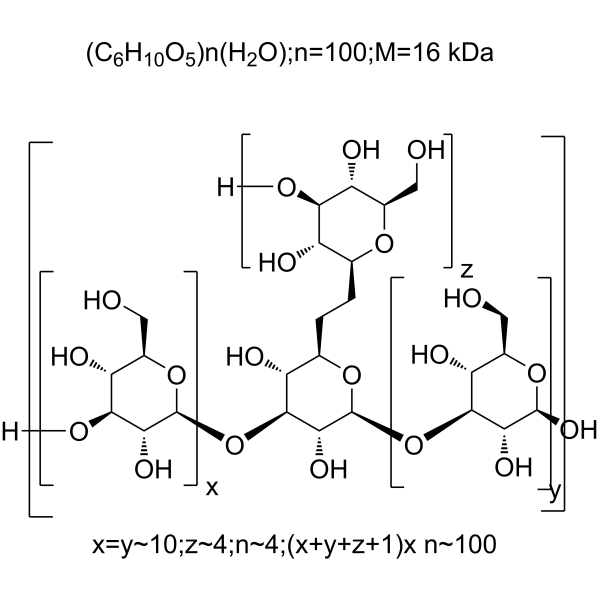
    Endo-1,3-β-glucanase (Lyticase) is an endoenzyme that can specifically cleave β-1,3-glycosidic bonds. Endo-1,3-β-glucanase recognizes and binds to β-1,3-glucan chains, catalyzing the cleavage of glycosidic bonds and hydrolyzing polysaccharides into oligosaccharides. Endo-1,3-β-glucanase eliminates vaginal Candida. Endo-1,3-β-glucanase can be used in the study of recurrent Candida vaginitis .
    Endo-1,3-β-glucanase
  • HY-147295

    BTH 1677; Imprime PGG

    Toll-like Receptor (TLR) Inflammation/Immunology Cancer
    Odetiglucan is a novel β-glucan that is a potent immunostimulant and a Dectin-1 (CLEC7A) agonist. Odetiglucan activates innate immune effector cells and triggers a coordinated anti-cancer immune response .
    Odetiglucan
  • HY-165126

    SPG

    Endogenous Metabolite Sirtuin JNK p38 MAPK PPAR AP-1 Infection Metabolic Disease Inflammation/Immunology Cancer
    Schizophyllan (SPG) is an orally active extracellular β-glucan produced by the fungus Schizophyllum commune. Schizophyllan improves mitochondrial function and protects against metabolic liver injury by activating the SIRT3 pathway. Schizophyllan inhibits osteoclastogenesis and promotes osteoblast differentiation by suppressing the phosphorylation of JNK/p38, as well as downregulating PGC1β/PPARγ, c-Fos and NFATc1. Recognized via Dectin-1, schizophyllan enables precise delivery of oligonucleotide drugs and antigens to antigen-presenting cells, thus holding great potential in the treatment of inflammatory diseases and vaccine development .
    Schizophyllan
  • HY-N15135

    Interleukin Related Toll-like Receptor (TLR) Fungal Metabolic Disease
    Arabinoxylan Medium viscosity is an orally active Dectin-1 splice variant modulator, glucose absorption inhibitor, and chyme viscosity enhancer. Arabinoxylan Medium viscosity inhibits particulate β-glucan-induced Dectin-1A activation and mildly suppresses Dectin-1B activation. In human dendritic cells stimulated with particulate β-glucan, Arabinoxylan Medium viscosity reduces the production of IL-10 and TNF-α, and increases the production of IL-4 and IL-23. Arabinoxylan Medium viscosity also supports antifungal immune responses without activating TLR2, TLR4 or TLR5, and does not induce cytokine production when used to stimulate human dendritic cells alone. Arabinoxylan Medium viscosity increases small intestinal chyme viscosity, gets degraded in the large intestine to produce short-chain fatty acids, reduces glucose absorption and insulin response, and improves glucose homeostasis. Arabinoxylan Medium viscosity supports microbial fermentation and the growth of beneficial microbiota in the gastrointestinal tract, prevents bile acid reabsorption, and delays starch digestion. Arabinoxylan Medium viscosity can be used in research related to type 2 diabetes, impaired glucose tolerance, and metabolic syndrome .
    Arabinoxylan (Medium viscosity)
  • HY-159114

    Biochemical Assay Reagents Inflammation/Immunology
    Whole Glucan Particles is a Dectin-1a agonist. Whole Glucan Particles activates the innate immune system to improve the function of macrophages, monocytes and other immune cells .
    Whole Glucan Particles
  • HY-E70013A

    EC 3.2.1.73

    Glycosidase Others
    Licheninase (EC 3.2.1.73) is a glycoside hydrolase is active on the β-glucan cell wall of cereals, fungi, and seaweed. Licheninase specifically hydrolyzes β(1→4) linkages in mixed linkage β(1→3)/β(1→4)-glucans. Licheninase improves cellulose degradation .
    Licheninase
  • HY-N8279

    Endo-β-1,3-1,4-glucanase

    Glycosidase Metabolic Disease
    β-1,3-1,4-glucanase (Endo-β-1,3-1,4-glucanase) is a glycoside hydrolase family 16 enzyme (some members belong to subfamily 25). β-1,3-1,4-glucanase shows high substrate specificity toward mixed‑linked β‑glucans and cleaves β‑1,4 glycosidic bonds adjacent to β‑1,3 linkages in an endo‑type pattern. β-1,3-1,4-glucanase can be used in industrial enzyme applications and monogastric animal feed supplementation .
    β-1,3-1,4-Glucanase
  • HY-P2763

    Glycosidase Fungal Infection Cardiovascular Disease
    beta-Glucanase belongs to glycosyl hydrolase family that hydrolyzes β-glucan polysaccharide, producing 3-O-cellotriosyl-d-glucose and 3-O-cellobiosyl-d-glucose. beta-Glucanase is capable of protecting plants against different fungal pathogens .
    beta-Glucanase
  • HY-P11003

    Toll-like Receptor (TLR) Inflammation/Immunology
    PTD-N5-1 (N5-1) is an IRF5 inhibitory peptide. PTD-N5-1 blocks β-glucan-induced IL-12 production in IFN-γ primed wild-type and Clec2d-difecient bone-marrow-derived dendritic cells (BMDCs). PTD-N5-1 regulates antifungal immunity through suppression of IRF5-mediated IL-12 production .
    PTD-N5-1
  • HY-N14472

    Fungal Infection
    Fusacandin B inhibits (1,3)-β-glucan synthetase and has antifungal properties .
    Fusacandin B
  • HY-E71154

    Glycosyltransferase Metabolic Disease
    1,3-β-Glucan synthase (EC 2.4.1.34) belongs to the family of glycosyltransferases, specifically the hexosyltransferases.
    1,3-β-Glucan synthase
  • HY-N5160

    Antibiotic Fungal Infection
    Arborcandin A is a 1,3-β-glucan synthase inhibitor that serves as an antifungal antibiotic. Arborcandin A exhibits IC50 values of 0.25 μg/mL and 0.05 μg/mL against Candida albicans and Aspergillus fumigatus, respectively. Additionally, Arborcandin A has an MIC of 4-8 μg/mL against the genus Candida .
    Arborcandin A
  • HY-N5165

    Antibiotic Fungal Infection
    Arborcandin F is a 1,3-β-glucan synthase inhibitor that serves as an antifungal antibiotic. Arborcandin F exhibits IC50 values of 0.012 μg/mL against both Candida albicans and Aspergillus fumigatus. Additionally, Arborcandin F has an MIC of 2-4 μg/mL against the genus Candida .
    Arborcandin F
  • HY-N5163

    Antibiotic Fungal Infection
    Arborcandin D is a 1,3-β-glucan synthase inhibitor that serves as an antifungal antibiotic. Arborcandin D exhibits IC50 values of 3 μg/mL and 0.35 μg/mL against Candida albicans and Aspergillus fumigatus, respectively. Additionally, Arborcandin D has an MIC of 4 μg/mL against the genus Candida .
    Arborcandin D
  • HY-N5162

    Antibiotic Fungal Infection
    Arborcandin C is a 1,3-β-glucan synthase inhibitor that serves as an antifungal antibiotic. Arborcandin C exhibits IC50 values of 0.15 μg/mL and 0.015 μg/mL against Candida albicans and Aspergillus fumigatus, respectively. Additionally, Arborcandin C has an MIC of 1-2 μg/mL against the genus Candida .
    Arborcandin C
  • HY-N5161

    Antibiotic Fungal Infection
    Arborcandin B is a 1,3-β-glucan synthase inhibitor that serves as an antifungal antibiotic. Arborcandin B exhibits IC50 values of 0.30 μg/mL and 0.025 μg/mL against Candida albicans and Aspergillus fumigatus, respectively. Additionally, Arborcandin B has an MIC of 2-4 μg/mL against the genus Candida .
    Arborcandin B
  • HY-N5164

    Antibiotic Fungal Infection
    Arborcandin E is a 1,3-β-glucan synthase inhibitor that serves as an antifungal antibiotic. Arborcandin E exhibits IC50 values of 0.1 μg/mL and 0.012 μg/mL against Candida albicans and Aspergillus fumigatus, respectively. Additionally, Arborcandin E has an MIC of 0.5-2 μg/mL against the genus Candida .
    Arborcandin E
  • HY-E71303

    Biochemical Assay Reagents Others
    β-Glucan-transporting ATPase (EC 7.5.2.3) can be used to investigate the application of β-glucan-transporting ATPase in carbohydrate transport research.
    β-Glucan-transporting ATPase
  • HY-180483

    Fungal Infection
    Antifungal agent 144 (Compound 3f) is a highly selective antifungal agent against Aspergillus niger, with an MIC of 7.5 μg/mL. Antifungal agent 144 simultaneously inhibits chitin deacetylase AngCDA and 1,3-β-glucan synthase. Antifungal agent 144 functions by disrupting the integrity of the fungal cell wall and does not bind to Ergosterol (HY-N0181). Antifungal agent 144 can be used for research on Aspergillus niger infections .
    Antifungal agent 144
  • HY-E70928

    Biochemical Assay Reagents Metabolic Disease
    Laminarinase,Trichoderma sp. (EC 3.2.1.6) degrades β-1,4-glucans of cellulose, xyloglucan and β-1,4-xylan. β-Glucanase represents a group of carbohydrate enzymes which break down glycosidic bonds within beta-glucan.
    Laminarinase,Trichoderma sp.
  • HY-149151

    Endogenous Metabolite PKC Glycosidase TNF Receptor Reactive Oxygen Species (ROS) Infection Inflammation/Immunology
    Variegatic acid is a secondary metabolite derived from basidiomycete fungi. Variegatic acid is a PKCβ1 inhibitor with an IC₅₀ of 36.2 μM. Variegatic acid inhibits antigen- or calcium ionophore-induced β-hexosaminidase release (IC₅₀ values of 10.4 μM and 22.2 μM, respectively) and TNF-α secretion (IC₅₀ values of 16.8 μM and 20.1 μM, respectively). Variegatic acid suppresses the enzymatic activity of calcium-activated PKCβ1 and reduces Fe(III) to Fe(II) in a pH-dependent manner, enabling the generation of hydroxyl radicals (·OH) through reaction with H₂O₂, which facilitates the degradation of lignocellulose. Variegatic acid is useful for studying biological degradation and allergic responses.
    Variegatic acid

Inquiry Online

Your information is safe with us. * Required Fields.

Salutation


Country or Region *

Applicant Name *


Organization Name *

Department *


Email Address *


Product Name *

Cat. No.


Requested quantity *

Phone Number *


Remarks

Inquiry Online

Inquiry Information

Product Name:
Cat. No.:
Quantity:
MCE Japan Authorized Agent:

